The 5000-Airport Reality and What the Safety Record Actually Tells Pilots
Flat incursion counts mask rising severity at uncontrolled airports.
The safety gap at U.S. public-use uncontrolled airports is the absence of an independent layer overseeing pilot self-separation. Flat nationwide runway-incursion totals do not establish safety at these fields, because they obscure rising severity and depend on reporting that is thinner without controllers. Pilots need to read the record through three separate questions about exposure, consequences, and what goes unobserved.
Why the aggregate incursion count is the wrong number to watch
The nationwide runway-incursion count for fiscal year 2024 was nearly the same as for fiscal year 2019. That looks like stability after the pandemic disruption. But a total treats every recorded incursion as one event, regardless of how close it came to a collision. A flat count can therefore coexist with a worsening distribution of consequences.
The FAA defines Category A as an incident in which a collision was narrowly avoided. Category B involves decreased separation and significant collision potential, which may require a time-critical corrective or evasive response. These are the encounters nearest to catastrophic outcomes. Their increase raises a different question from whether the overall count has changed, namely whether the defenses against the most dangerous events are weakening.
The DOT Inspector General’s March 2025 audit found that the FAA has no joined-up way to study runway-incursion data and find risks. That finding limits what the stable total can establish. The oversight body does not yet have a clear picture of what is driving the trend. For pilots, the distinction is between counting events and understanding the conditions that allow the most serious ones to develop.
How the FAA's severity taxonomy was built for a world where someone is watching
The FAA classifies runway incursions into three types, which are pilot deviation, vehicle or pedestrian deviation, and operational incident. These describe the event’s origin. An operational incident requires a controller to be present and involved, so that category cannot exist at a non-towered airport. The classification framework therefore operates differently across the two environments.
The DOT Inspector General identifies pilot deviations as close to two-thirds of all U.S. runway incursions. At uncontrolled fields, pilot and vehicle or pedestrian deviations can occur without an external authority present to catch, correct, or record them as they unfold. The missing controller changes more than the available response. It also removes a source of observation from the record on which later safety analysis depends.
The severity scale can still describe a recorded event accurately. Incident data from uncontrolled fields is structurally thinner, so fewer recorded events cannot by themselves establish that fewer hazardous encounters occurred. Nor does the disappearance of one incursion type mean that its absence provides a compensating safety benefit. A measurement gap is not a visible reduction in danger, but a limit on what the record can reveal.
What self-separation actually asks of a pilot at a non-towered airport
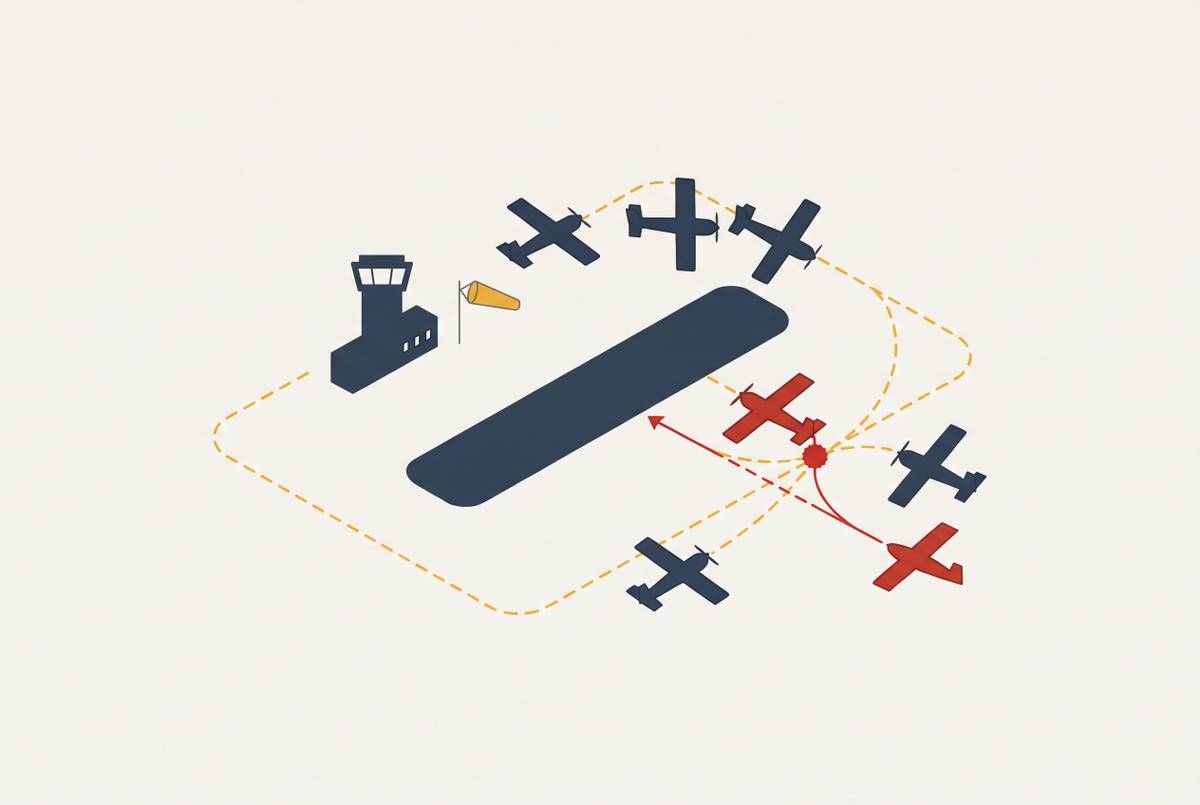
When two aircraft approach a runway at a non-towered airport, their pilots must work out how to stay apart through established procedures, radio communication, and visual scanning, without separation instructions from a controller. The common traffic advisory frequency, or CTAF, supports that coordination. It does not provide independent verification of the traffic picture. No controller is present to establish that every pilot has heard, understood, and acted on the information exchanged.
The FAA’s Advisory Circular AC 61-98E identifies failure to comply with ATC instructions, lack of airport familiarity, and nonconformance with standard operating procedures as runway-incursion causal factors. The first cannot occur where no ATC instructions are being issued. The other two remain, without a controller to compensate. Transient pilots who do not know the local patterns and terrain face those risks without independent oversight.
The reported proximity data illustrates the dependence on communication. Three-quarters of pilot-filed near-collision reports involve operations within ten nautical miles of a non-controlled aerodrome, and near-collisions occur twice as often when there was no prior radio warning of other traffic. Those findings do not make a radio call a guarantee of separation. The architecture assigns pilots coordination tasks that a towered airport supports with infrastructure and controller authority because no independent layer is available.
Why per-facility collision comparisons make non-towered airports look safer than they are
A decade of midair-collision data appears to offer a strong counterargument. Towered airports recorded approximately 41 times more midair collisions on a per-airport basis than non-towered airports. Read without its denominator, that comparison seems to favor uncontrolled fields. But it measures collisions per facility. Far more aircraft movements take place at each towered airport.
A lightly used field with one operation a day and no collision contributes one airport to the denominator. A towered field with hundreds of operations counts as one airport too. The comparison describes the distribution of recorded collisions among facilities without adjusting for their different levels of exposure.
Normalizing for operations is therefore necessary before drawing a conclusion about relative risk. The per-facility figure cannot prove that uncontrolled airports are safer, but setting it aside does not prove that they are more dangerous either. That distinction preserves the limits of the evidence. It also clears the way for a separate question about consequences, namely where fatal outcomes have occurred and which defenses were absent there. Exposure and severity both belong in the analysis, but neither can substitute for the other.
What the fatal-accident record at non-towered airports actually shows
The recent fatal runway-incursion accident record concentrates those outcomes at uncontrolled facilities with no tower. That is a different signal from the per-facility midair-collision comparison. It identifies where the most consequential runway-incursion failures occurred rather than treating all recorded collisions as equivalent. The concentration warrants attention even when the absolute number is small.
The collision at Marana Regional Airport in Arizona provides a concrete example of the uncontrolled-field environment. On February 19, 2025, a Lancair collided in midair with a Cessna 172 there. The FAA describes Marana Regional as an uncontrolled field. The event illustrates the stakes of aircraft proximity without tower oversight, although a midair collision and a runway incursion are distinct event descriptions and should not be silently combined into one statistic.
The Flight Safety Foundation 2025 Safety Report warns that high reliability cannot be assumed simply because it has been achieved in the past. It calls for recurring proximity events to be treated as actionable system risk. That principle is especially relevant where the record lacks an independent observer. Where fatal accidents cluster does not, on its own, show the per-operation risk or what caused every accident. It does identify a high-consequence concern in an environment without the oversight layer that can intercept deviations before collision. Low frequency is not sufficient reassurance when the outcome is fatal and a structural defense is absent.
What rising severity at the system level means for pilots operating specifically at uncontrolled fields
The 44-percent rise in Category A and B incursions is a system-level figure. The increase nonetheless signals worsening severity in the broader system in which these pilots operate. Together with the concentration of fatal runway incursions, it gives pilots at uncontrolled fields reason to check what defenses they have during their own operations even while the total remains stable.
The Foundation’s report describes a system operating near its limits in people, infrastructure, and procedures, with less margin for variability, disruption, and surprise. Non-towered fields begin without a controller overseeing local separation. Communication gaps and unfamiliarity are therefore not simply disruptions to an otherwise supervised process. They arise within a process that already depends on pilots assembling and maintaining the traffic picture themselves.
IATA’s 2025 Annual Safety Report adds another pressure on situational awareness. It found that reported GPS jamming events rose sharply and there were far more GPS spoofing incidents than in 2023. This shows external stress on navigation technology on which pilots may rely without establishing interference at any particular uncontrolled airport.
For the pilot, these findings converge at each approach, pattern entry, and runway crossing. The immediate task remains self-separation, but the broader safety record offers less reassurance about the margin for error. Along with following familiar procedures, pilots have to deal with uncertainty without independent oversight.
Why most small airports have no control tower, and what changes when oversight is present
Traditional manned towers cost an estimated $5–10 million to build and need staff that small airports cannot afford to keep. Most U.S. airports have no tower, so pilots there rely on self-separation. Addressing the absence of infrastructure that can support and independently oversee pilots’ coordination requires more than instructions telling them to exercise care.
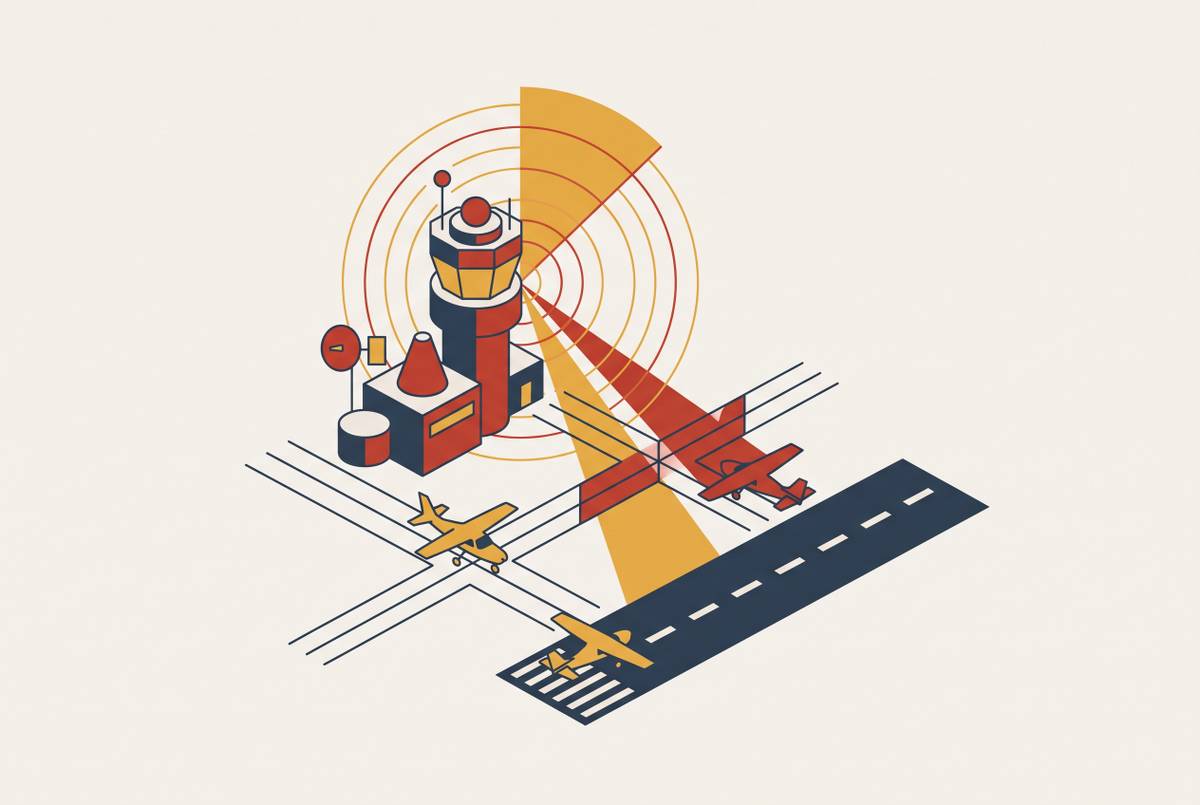
Digital tower technology changes how that oversight can be provided. Cameras, sensors, and panoramic displays replace the out-the-window view from a physical cab, giving a controller at a remote workstation a continuous 360-degree view of the airport and surrounding airspace. Typical sensor suites include high-definition cameras, infrared sensors for low-visibility operations, surface detection, and ADS-B receivers for airborne traffic. The cameras can show enough detail to read tail numbers and spot runway debris.
That capability is not itself evidence of nationwide implementation. The Digital Tower Technology Coalition, launched in 2026, includes U.S. airports, regional partners, air traffic controllers, OEMs, and federal partners. Its stated goal is to advocate for FAA implementation of the digital tower program across the National Airspace System. Advocacy for a program must remain distinct from deployment.
The structural fit is nonetheless clear. Remote oversight offers a way to address the missing control layer at airports that cannot justify a physical tower, rather than asking pilot behavior alone to compensate for its absence.
How pilots should read the safety record at their specific non-towered airports right now
For pilots applying these findings to a particular field, the first distinction is between a clean record and a complete record. An airport with few reported incidents may have had few incidents, or it may have few ways to record them. Category A and B trends provide relevant system context, but they should not be presented as a measured local increase where field-specific data does not exist.
The practical response begins with communication, the highest-leverage variable under a pilot’s control in this operating model. CTAF discipline on every approach, pattern entry, and runway crossing is a key way for pilots to coordinate with each other and goes beyond courtesy in following procedures. Communication still does not replace visual scanning or establish that every aircraft is represented in the exchange.
Airport familiarity is the next controllable factor. Pre-flight review of field-specific procedures, NOTAMs, and local traffic patterns addresses a known source of risk before the pilot enters an environment without controller support. That preparation supplies context within the existing self-separation model. It is particularly important for transient pilots whose unfamiliarity would otherwise add uncertainty to the shared traffic picture.
The policy implication follows from the same distinction. Better pilot preparation can strengthen today's operating model, while oversight infrastructure would change the model itself. Understanding what the record measures, what it misses, and where severe outcomes concentrate allows pilots to act more carefully now and participate as informed stakeholders in decisions about future coverage.