Blind Spots in FAA Safety Oversight at Non-Towered Airports
The FAA's safety tools ignore most U.S. airports.
Most U.S. airports have no control tower, and that fact alone reshapes how the entire system should be judged. The FAA's safety apparatus, built to watch towered fields, has almost nothing to say about the airports where most flying actually happens, and that silence is the subject of this piece.
Non-Towered Airports as the Dominant Condition of U.S. Aviation
Non-towered fields make up the overwhelming majority of airports in the National Airspace System. The absence of a controller is the default condition of American aviation infrastructure, not a gap in it.
At these airports, a pilot flying the pattern has no one confirming separation, catching a misread runway assignment, or ordering a go-around when two aircraft converge. Pilots announce their intentions over a Common Traffic Advisory Frequency, look out the window for other traffic, and judge spacing and sequencing on their own. There's no controller cross-checking that judgment. FAA Advisory Circular 90-66C, updated June 6, 2023, lays out how pilots should operate at these fields: recommended calls, pattern entry procedures, right-of-way conventions. But that guidance is procedural, and nothing enforces it in real time. Nobody is listening who can correct a pilot before a mistake becomes a conflict.
NASA's Aviation Safety Reporting System stated the stakes of that distinction in CALLBACK Issue 548, published September 2025: simple oversights or cutting corners in a non-towered environment may degrade flight safety more than the same infractions would under the watch of a tower controller. A mistake that a controller would catch and correct at a towered field plays out to its conclusion at a non-towered one, good or bad, because self-enforcement is the only enforcement available. That single fact, compliance resting entirely on the judgment of the pilots involved, is what the rest of the FAA's oversight architecture fails to account for.
The FAA's Safety Oversight Architecture and Towered Airports
The agency's core tools for finding risk and acting on it assume a tower is already watching. Strip that tower away, and most of those tools stop collecting anything.
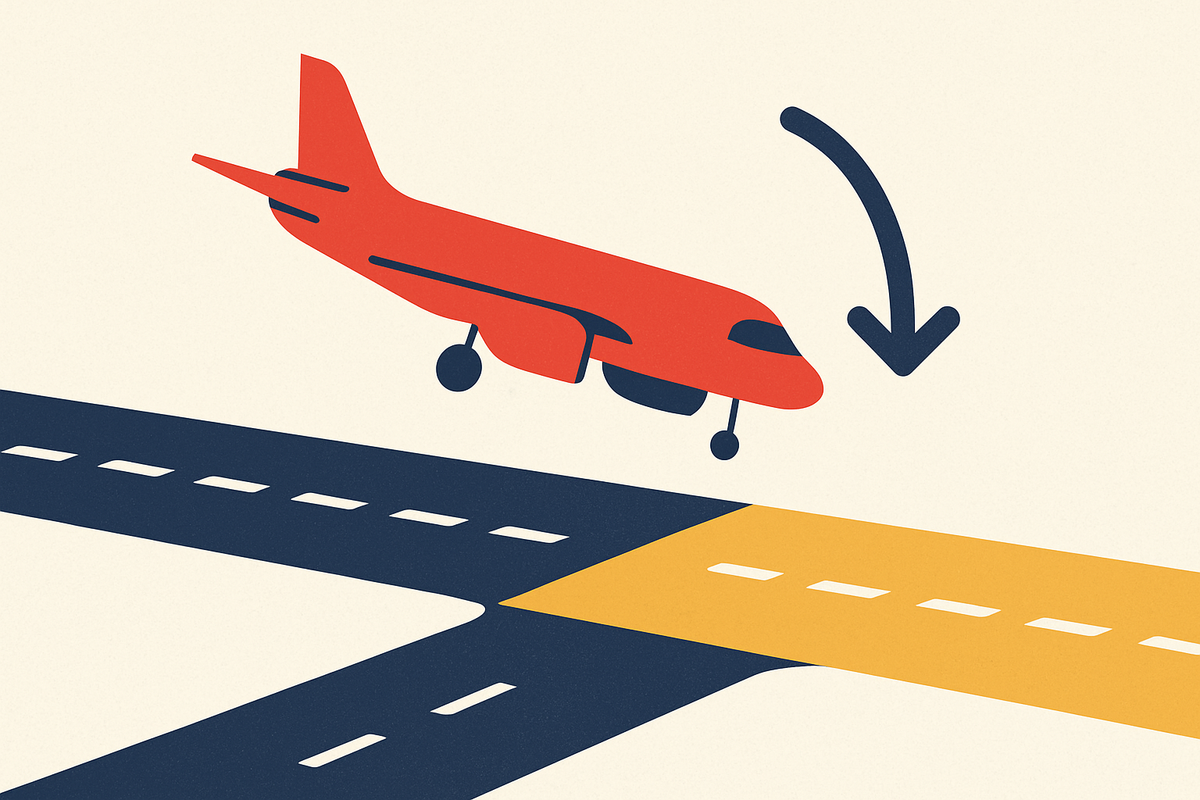
Runway incursion tracking shows this clearest. A federal audit came out in March 2025, and it found that of 383 primary commercial service airports, the FAA tracks runway incursions at only 294. The remaining 89 airports report nothing, because they have no operational FAA or federal contract tower to collect and relay the data. These fields serve scheduled passenger traffic, so they are not remote grass strips. If the data gap runs that wide even among commercial airports, the gap across the far larger population of fields with no commercial service at all is likely wider still, even though no audit has measured it directly.
The same DOT audit found that even where the FAA does collect incursion data, it has no integrated way to analyze it. Incursion data gets used mostly for one-off reviews at individual airports. The agency doesn't have all the causal data it needs, and what it does have doesn't always move freely between its own offices. Large and medium hub airports are getting surface surveillance and detection systems, which are meant to catch an incursion before it turns into a collision. The OIG report discusses that rollout only for primary commercial fields. There is no comparable deployment plan for non-towered airports, because the architecture was never built with them in mind.
The FAA's Aviation Safety Information Analysis and Sharing system, ASIAS, is supposed to be the agency's early-warning tool for spotting risk trends before they turn into accidents. But it runs on data feeds that non-towered airports simply can't supply. The DOT audit found that MITRE Corporation reviewed ASIAS data for the FAA, and it concluded that the review gave no added context for spotting emerging runway incursion trends. An independent Safety Review Team issued 24 recommendations in November 2023 touching process integrity, staffing, facilities, equipment, and technology. By October 2024, the FAA had acted on five of them, and every one addressed a towered airport context. The tool built to catch what the tower-based system misses has nothing to feed on where there's no tower to begin with.
The data void that makes the oversight gap self-concealing
Because there is no mandatory reporting requirement at non-towered airports, incidents there go uncounted and trends go undetected, and the resulting silence gets mistaken for safety.
The clearest statement of that limitation comes from the agency running the one voluntary channel that does exist. NASA's ASRS Database Report Set on non-tower airport incidents, updated December 12, 2025, contains just 50 records, and the report set itself states that the number of reports received on any given event type represents only the lower bound of how often that event actually occurs. NASA is explicit that ASRS reports are submitted voluntarily, filed independently, and not corroborated by NASA, the FAA, or the NTSB. So you can't use the reports to estimate how common a given problem actually is across the airspace system.
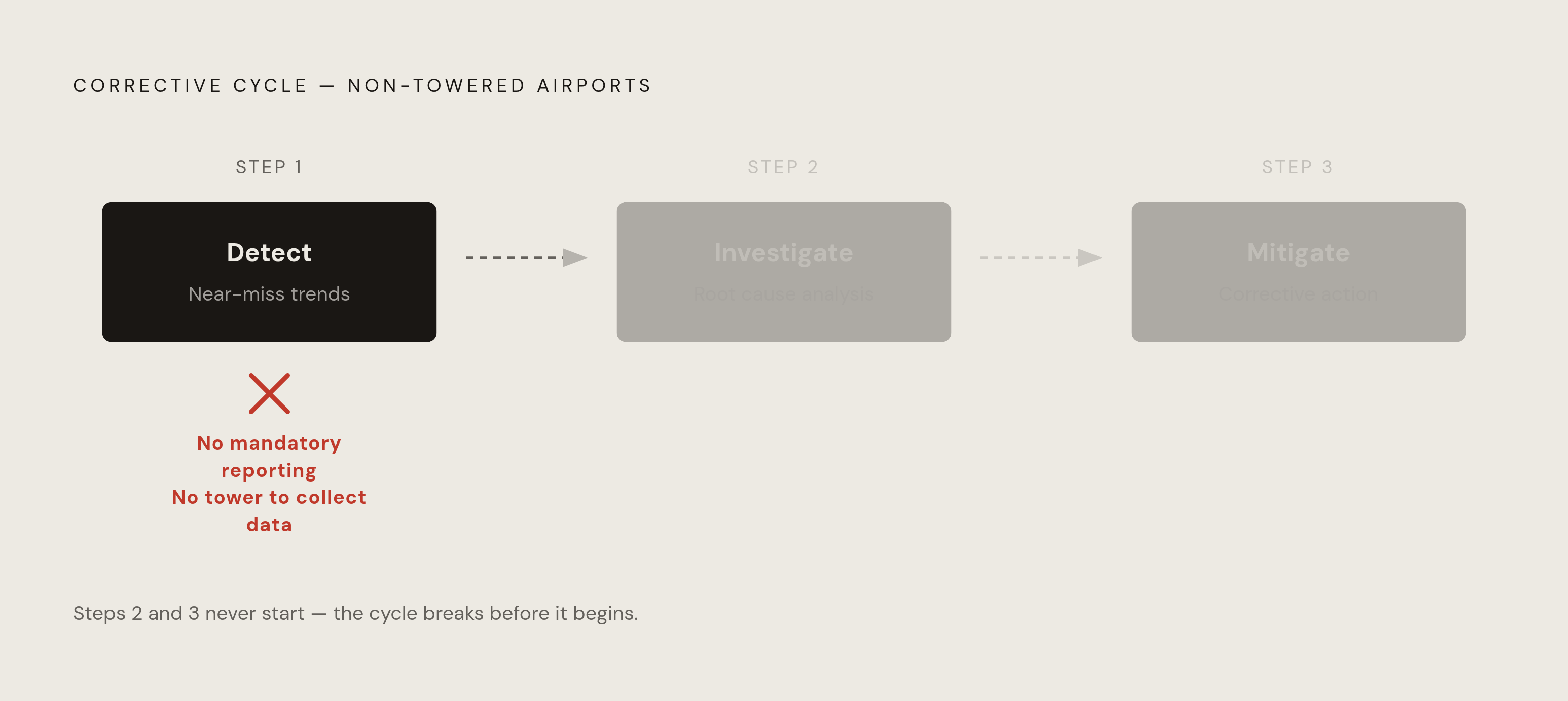
Reporting bias compounds the problem in ways nobody can currently measure. A hazard might look more concentrated at one airport purely because pilots who fly there know about ASRS and bother to file reports, while an identical hazard at a quieter field never gets written down by anyone. The FAA's standard corrective cycle runs on three steps: detect a trend, investigate it, mitigate it. At non-towered airports, the first step doesn't function, so the other two never start. The fields that get the least oversight infrastructure are the same fields least likely to produce the data that would justify building any.
Hazards of Operating Without an Intermediary
The reports that do surface describe a recurring category of danger: situations a tower controller would likely have caught, left instead to whoever happened to be flying that day to resolve.
ASRS CALLBACK Issue 548, from September 2025, recounts a DC-3 crew lined up for takeoff at a non-towered field when an aircraft on short final made no CTAF call. The DC-3 crew tried the radio three times, and UNICOM urged the inbound aircraft to go around. The inbound aircraft was a student pilot flying with an instructor, tuned to the wrong frequency, who never saw the DC-3 on the runway and continued the approach to landing. Nothing but radio persistence from the aircraft already on the ground kept that encounter from getting worse.
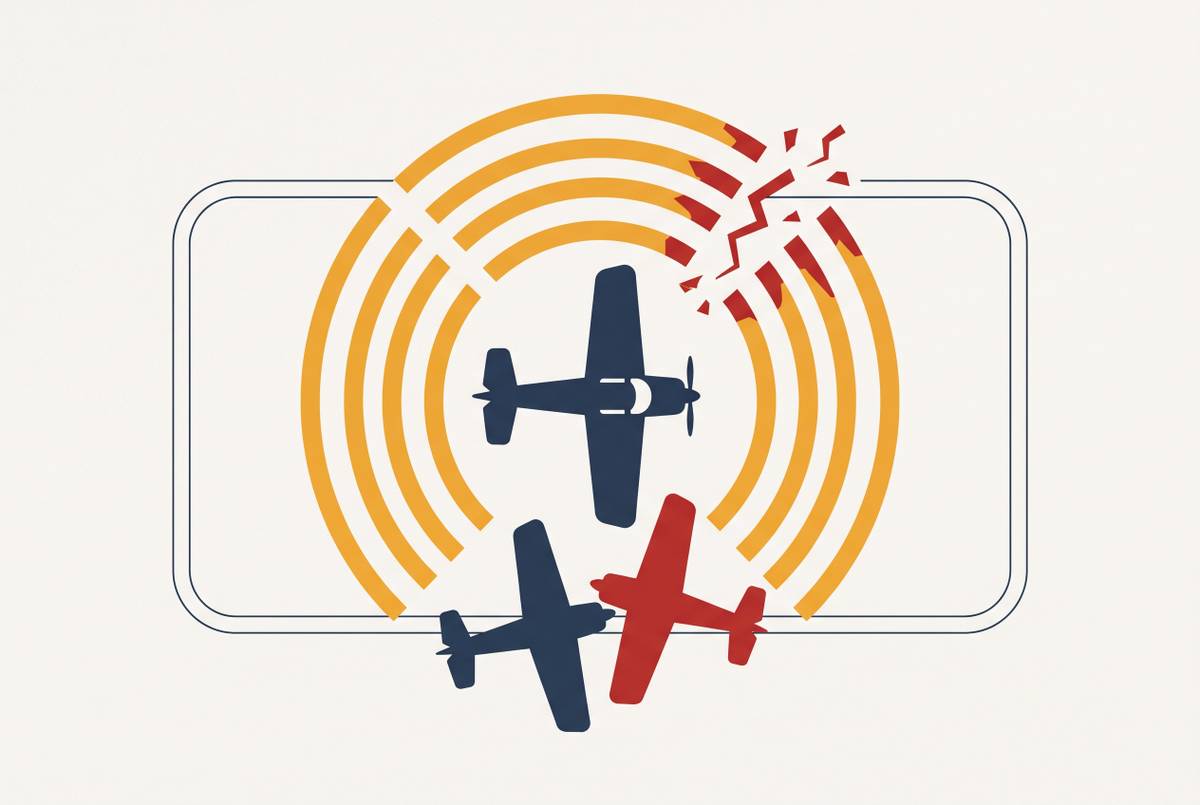
A joint federal aviation accident prevention bulletin issued in December 2024 describes a near-collision at Birchwood Airport (PABV) in Birchwood, Alaska. A pilot saw a visual ADS-B traffic alert and first took it for a ghost signal, a false return, until he realized it showed a second Cessna 100 feet directly above him, with no audible warning. A self-initiated, steep descending turn to base was what kept the two aircraft apart. The bulletin's detail about the pilot first dismissing the alert matters beyond the near-miss itself: at a non-towered field, a pilot has to both detect a threat and correctly interpret the instrument telling them about it, under time pressure, with nobody else to confirm the read.
Terrain poses its own version of the same problem. One ASRS CALLBACK report describes a Part 121 crew that deviated from an obstacle departure procedure at an uncontrolled airport, operating on the assumption that air traffic control would handle terrain separation. ATC later clarified that the responsibility was the crew's alone. No collision resulted, but the crew acknowledged afterward that they had departed from their own operations manual, based on a mistaken assumption about who was watching. A separate incident in the same ASRS set describes an Embraer crew arriving at a non-towered field, where gear warning sirens triggered because the descent rate came too close to terrain. A warning system caught what the absence of any ATC guidance did not.
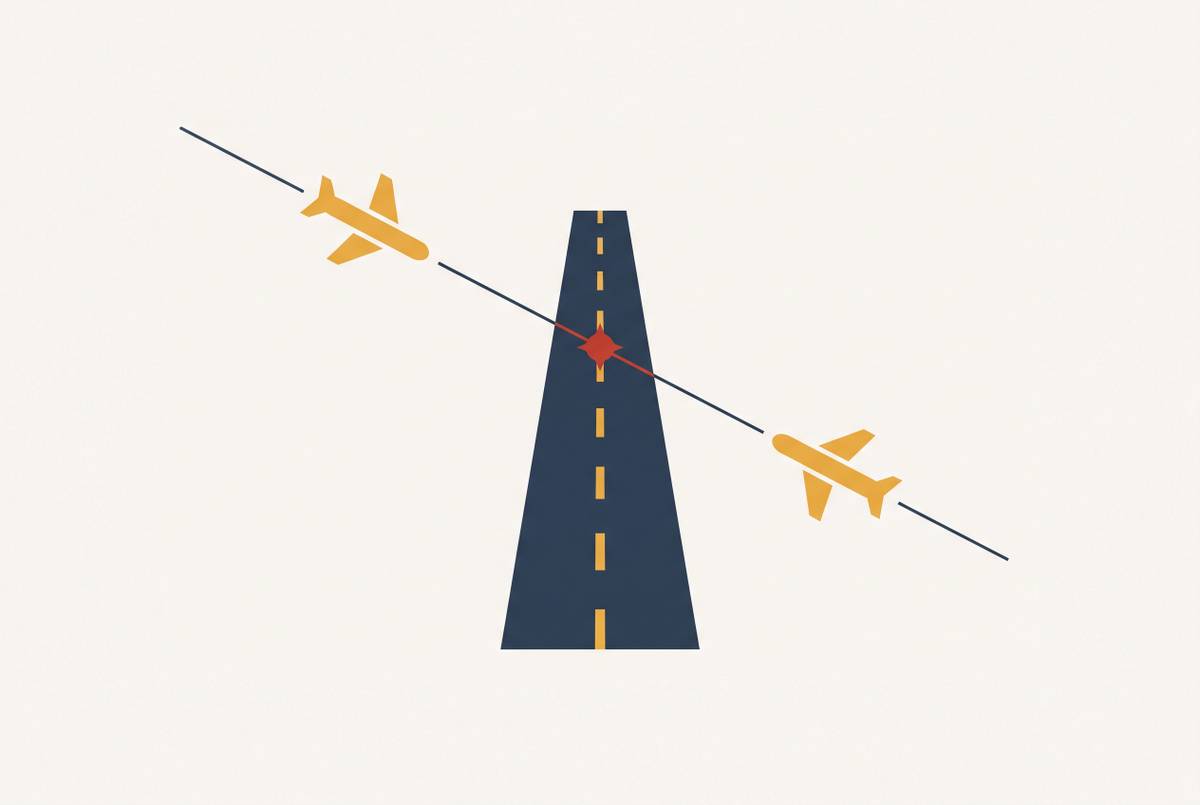
The ASRS non-tower airport incident report set, updated June 17, 2026, includes accounts of aircraft attempting to land from opposite directions on the same runway at the same time, near-midair collisions on short final, and an air carrier captain's report that one runway's approach end sits dangerously close to the active departure end of a runway at an adjacent airport, a structural hazard with no tower anywhere to manage sequencing between the two fields. The DOI bulletin closes with an instruction aimed squarely at pilots: stay alert, practice sound lookout doctrine. That is the FAA's answer to the whole category of hazard described above, better individual vigilance, not a structural fix.
How frequency congestion and pilot experience patterns concentrate risk at non-towered airports
Risk at non-towered airports is not spread evenly. Some fields carry conditions that would draw active attention at a towered airport, but get none at all under the current system.
Shared CTAF frequencies are one such condition. If several non-towered airports share one frequency, pilots approaching one field hear traffic calls meant for several others at once, so congestion at a high-volume field spills over onto every quieter field on that channel. Flight training adds a second layer of concentration. Airports where student pilots make up a large share of operations are, as the ASRS CALLBACK record shows, the places where frequency errors and procedural missteps happen most. No mechanism exists to flag these fields for closer monitoring or to intervene when the pattern repeats.
Takeoff and landing remain the highest-risk phases of any flight, and they are precisely the phases where non-towered operations carry the most exposure and where a controller's presence would add the most value. The oversight framework has no way of recognizing that a high-traffic, frequency-congested field or a training-heavy pattern needs more attention than a rural strip that sees a handful of operations a week. Every non-towered airport gets treated the same way under current policy: no active oversight, regardless of how much traffic or how much training activity runs through it.
Why the FAA's funding and modernization programs have not closed the gap
The FAA has put its safety and modernization money overwhelmingly into infrastructure that non-towered airports cannot use, and the slow pace of the digital tower debate has let that imbalance persist.
After the string of 2023 runway incursion incidents, the FAA awarded more than $200 million in runway incursion mitigation grants, and that money went to large commercial airports. The DOT Inspector General's audit scoped its entire review to primary commercial service fields, which underscores how little of the current investment cycle reaches non-towered facilities.
The FAA Contract Tower program does let airports sustain, build, repair, rehabilitate, modernize, replace, relocate, or construct a digital tower certified by the agency, funded at a substantial level over ten years through the Infrastructure Investment and Jobs Act. The program has become a point of real contention, and some aviation experts argue that rebuilding aging regional towers as conventional brick-and-mortar replacements wastes a chance to modernize instead. Internal FAA documents show that any vendor system that wants to operate in the National Airspace System must first get system design approval at the FAA's William J. Hughes Technical Center. Congress directed the FAA to expand that approval process to at least three airports outside the Technical Center, and the agency has not made progress on that expansion.
Layered on top of all this is the Brand New Air Traffic Control System, the FAA's plan to replace decades-old infrastructure with a fully digital system. FAA Administrator Bryan Bedford told Congress in September 2026 that Phase One will cost substantially more than what Congress appropriated, so a shortfall now threatens the whole modernization timeline. That funding gap, combined with a controller shortage concentrated at towered facilities, consumes the political attention available for air traffic control policy. The non-towered airport oversight gap gets crowded out of the conversation almost entirely, not through neglect of the problem so much as through the sheer size of the towered-airport problems competing for the same limited dollars.
What digital remote tower technology changes at non-towered airports
Digital remote tower technology offers a way to put an authoritative intermediary back into non-towered operations without the cost of constructing a physical tower, and it is currently the only approach built to scale to the size of the non-towered airport population.
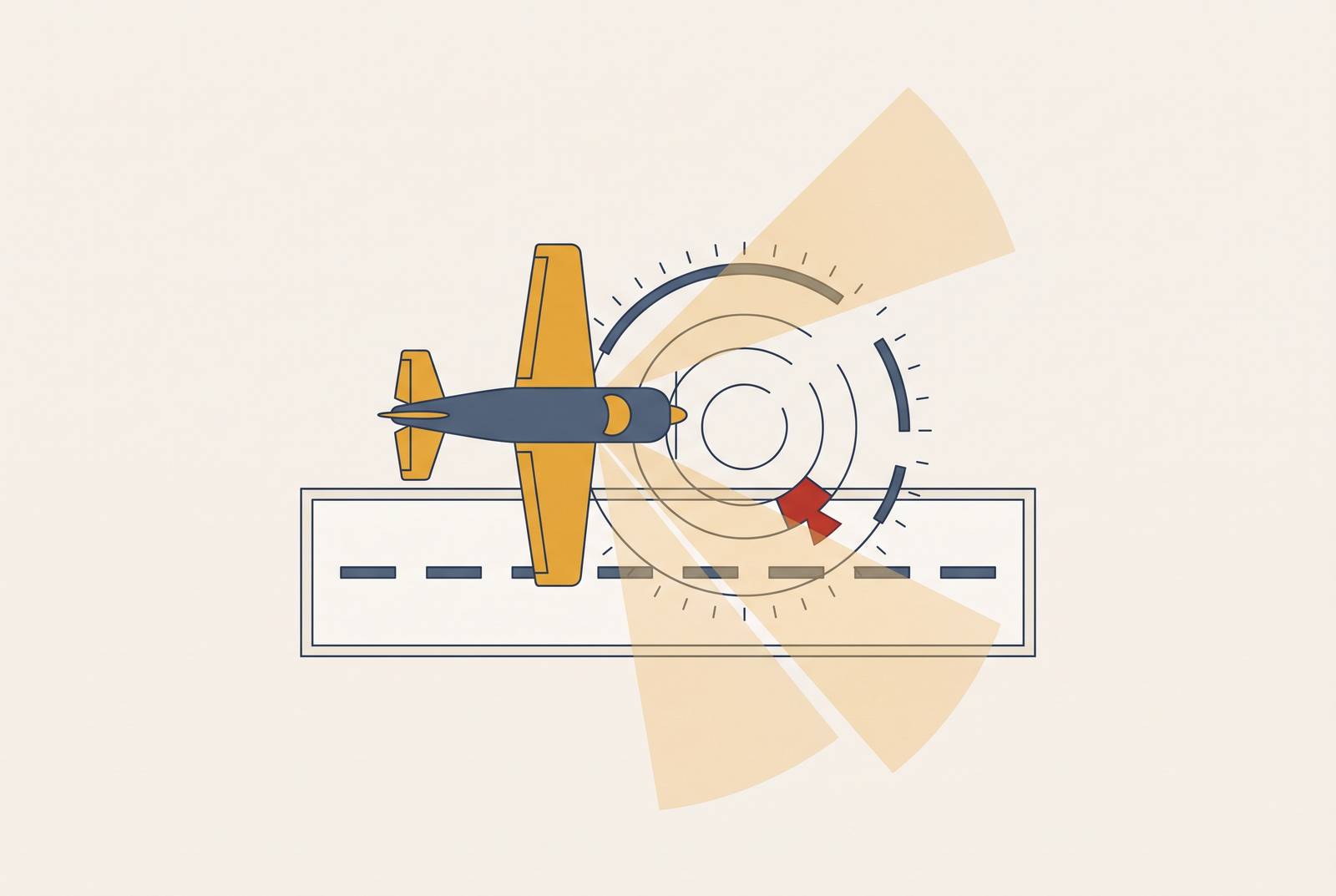
The technology swaps the traditional out-the-window view for a digital one, assembled from cameras, sensors, and panoramic displays. A controller sits at a remote workstation and watches a continuous, 360-degree feed of the airfield and the surrounding airspace, doing the same job a tower controller does, from a location that doesn't have to sit on the airport property. Cameras and sensors can eliminate the blind spots a physical tower cab has always had, and infrared imagery gives controllers a view in low-visibility conditions that an out-the-window view never could. In some respects, the digital version does the job better than the structure it replaces.
The remote workstation is what makes the economics work for a system this size. Because the controller isn't tied to a single physical location, one facility can watch over several airports at once, so it directly answers the frequency congestion and multi-airport sequencing problems that self-sequencing pilots cannot solve on their own, no matter how disciplined their radio calls are. For the thousands of airports the current oversight architecture was never built to see, that is the first tool on offer that was built with them in mind from the start.