The Economics and Politics That Keep Most U.S. Airports Uncontrolled
Funding rules and controller shortages make small airports structurally unable to afford towers.

Most small U.S. airports have no air traffic control tower because federal funding rules, the cost of building a conventional tower, and the need to staff it with controllers leave them with no workable way to get service. The safety gap at uncontrolled airports in the U.S. National Airspace System is therefore a structural policy outcome. Closing it requires an operating model that small airports can afford and the FAA can approve.
Why do most small airports in the U.S. have no air traffic control tower?
Most U.S. public-use airports have no on-site air traffic control. That condition reflects the system’s underlying allocation of resources. Airports with substantial commercial activity have stronger access to infrastructure funding, while smaller fields must justify major investments against much narrower revenue bases. The absence of a tower is therefore not evidence that an airport’s needs have gone unnoticed.
The distinction changes what would count as a solution. An oversight might be corrected by drawing attention to it. A structural problem persists even when airport operators, municipalities, and federal officials understand the need, because the available funding and operating arrangements still do not support coverage. In economic terms, the result is an equilibrium, with institutional incentives sustaining an outcome that individual airports have limited power to change.
How federal airport funding is structured to favor large commercial airports
The Airport Improvement Program, or AIP, distributes formula funding through criteria tied to enplanements and commercial activity. Airports with more passengers boarding flights get larger formula entitlements. GA airports instead receive Non-Primary Entitlement grants subject to an annual cap, with funds bankable for up to four years. A small airport’s predictable funding remains constrained before any tower proposal reaches the design stage.
Discretionary AIP grants offer another route, but they are limited and contested. Small airports without staff whose job is to write grant applications have a harder time competing for that money. Even when federal support covers most of an eligible project, the sponsoring municipality must provide the remaining share. That obligation can stop a project outright. Even a small local share of a large infrastructure project can cost more than a small town can afford.
The FAA’s airport infrastructure plan for 2025–2029 identifies tens of billions in eligible infrastructure needs across the system. Airports also have to pay their day-to-day operating expenses, usually from the money they earn from aeronautical activity. That leaves little room to build capital reserves.
What a conventional ATC tower actually costs, and why that number forecloses the conversation for most airports
Johnston Regional Airport and Raleigh Executive Jetport have FAA approval for conventional towers that are each expected to cost tens of millions of dollars. Much of that cost falls on taxpayers. These are useful comparisons because they concern the smaller-airport problem directly, rather than the infrastructure demands of a major commercial hub. Against projects of this size, four years of banked Non-Primary Entitlement funding provides only a fraction of the required capital.
The price reflects the demands of purpose-built, FAA-certified infrastructure. Structural engineering, equipment, real estate, and years of design and approval work all contribute to the cost. These requirements do not disappear at a smaller airport. A conventional tower still requires a physical facility that meets its operational and regulatory purpose, even where the airport’s traffic and revenue cannot support an investment of that scale.
Consequently, a tower is often not a deferred purchase. It is outside the airport’s practical funding options. Getting a tower depends heavily on winning discretionary support beyond routine grants, which gives airports with strong political or commercial backing an edge. The mechanism for selecting projects does not necessarily direct coverage toward the greatest unmet safety need.
How the controller shortage makes the staffing problem as binding as the construction cost
The FAA’s Federal Contract Tower program provides staffing for many smaller towered airports, but it was well short of its targeted headcount as of April 2025. Attrition and stagnant wages contributed to that shortfall. A small airport seeking tower service would therefore have to find controllers in a labor market that is already struggling to staff existing facilities. Funding a building would not secure its workforce. The airport would still need access to qualified controllers.
The FAA broke its annual controller hiring record in FY2026, yet the net gain in certified professional controllers over the prior year remained modest. Hiring and certification are different stages of the pipeline. Training takes years, while attrition continues to erode gains. That distinction is especially consequential for a proposed small-airport tower, which would compete for scarce staff against towered airports that are already understaffed.
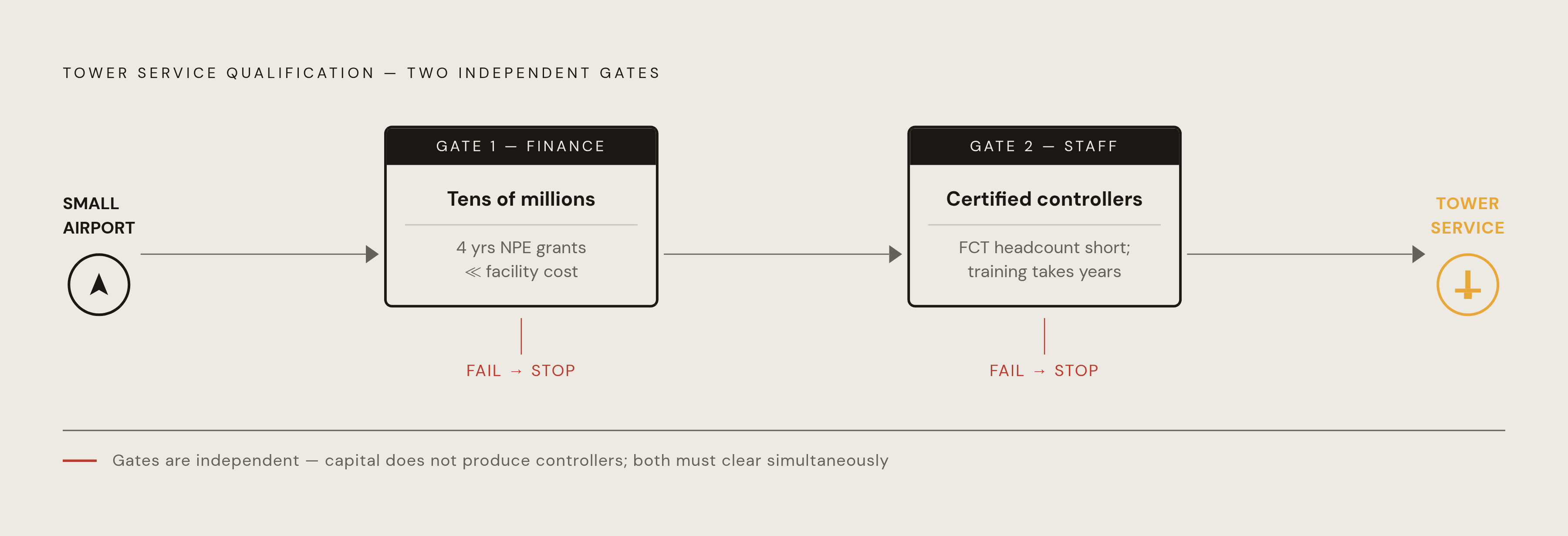
This constraint operates independently of the construction budget. More capital can be appropriated without producing a certified controller in the same period. A conventional tower proposal must therefore clear two separate tests, namely whether a facility can be financed and whether it can be staffed. For small airports, that makes it hard to expand the conventional model even when they can get funding beyond what is normally available.
The political economy that keeps these structural barriers in place
Federal airport funding policy is shaped by congressional appropriators and the FAA in a political environment where commercial traffic, employment, and visible economic activity command attention. Large commercial airports have a strong voice in that setting. Small GA airports serve flight schools, business aviation, air ambulance operators, and rural communities, but those constituencies are more diffuse. Their shared needs are harder to organize politically. That imbalance helps explain why funding priorities stay the same even when those involved act in good faith.
The FAA also faces different institutional demands when approving familiar infrastructure and a new operational model. Conventional towers go through a set approval process, though it can be slow. Digital remote towers require the agency to establish how a different model will be approved. Familiar projects therefore have an easier path through approval than other options that might better fit what small airports can afford. The difficulty is not simply choosing technology, but creating a regulatory process around it.
In 2023, the FAA selected a Manhattan architecture firm to design up to 31 conventional “sustainable” towers at smaller airports and set aside significant funding. Congress separately required a comprehensive remote tower plan by November 2024, but the FAA did not issue one by that deadline. Transportation Secretary Duffy’s broader ATC overhaul plan makes no mention of remote or digital towers. Together, these choices show a gap between interest in alternatives and institutional commitment to making them deployable.
What the safety record at uncontrolled airports reveals about the cost of the status quo
At an uncontrolled airport, pilots provide the local sequencing that a tower controller would otherwise supply. They announce intentions on the Common Traffic Advisory Frequency and maintain situational awareness through those communications and see-and-avoid practices. When two aircraft approach the runway at the same time, the pilots remain responsible for coordinating their sequence. That places substantial demands on shared awareness. The system can function under favorable conditions, but it has inherent limits at busy fields.
The FAA’s preliminary account of the February 2025 midair collision at Marana Regional Airport in Arizona described a Lancair and a Cessna 172, with two people aboard each aircraft. Marana was an uncontrolled field. The event establishes a concrete occurrence of the risk. Determining causation requires more than identifying the airport’s control status. The broader comparison between towered and non-towered safety is genuinely complex.
FAA investigators also found multiple hazardous near-collisions and a larger number of high-risk events in a year of parallel departure data at Centennial Airport. Centennial is a controlled, high-traffic field. Its record demonstrates why tower presence alone cannot establish the relative safety of towered and non-towered airports. Meanwhile, improvements in overall GA accident and fatality trends do not eliminate specific vulnerabilities at individual busy uncontrolled airports.
Business aviation operators, flight schools, and air medical operators use these fields often, while rural communities rely on them for emergency services and links to business. Airports with demanding traffic conditions need access to traffic sequencing when the conventional funding and staffing model gives them no way to get it soon.
Why digital remote towers represent a structurally different solution, not just a cheaper version of the same thing
Digital remote towers separate the control function from a physical tower at each airport. A remote installation can cost a fraction of conventional construction, while controllers work from a centralized facility. The economic distinction extends beyond cheaper construction. A remote tower center can manage multiple airports and allocate staffing more flexibly across demand.
This model changes how scarce certified controller resources can be deployed. Remote towers are in operation or advanced development across more than a dozen countries, including centers managing multiple airports, while the U.S. has none in operational service. Differences between the amount of traffic overseas and conditions in the U.S. still give reason for caution. The relevant proposition for U.S. testing is whether multi-airport staffing can support domestic operations.
Johnston Regional’s director has envisioned one digital remote tower managing traffic for both the Smithfield and Sanford airports. The proposal would share control service across airports, replacing the need to build and staff a separate tower at each one. U.S. testing is now underway. Operational approval, however, remains distinct from demonstrating the technology.
Digital towers also have uses beyond bringing service to uncontrolled airports. They can augment existing Class D towers, provide nighttime coverage when a manned tower would otherwise close, and serve as backup during outages. They can also support UAS integration into the National Airspace System, which current infrastructure at most airports is not equipped to accommodate. These uses broaden the model’s relevance. They do not remove the need to establish an approved basis for operations.
Where federal policy currently stands on digital towers, and what it would take to change the structural outcome
The 2025 “One Big Beautiful Bill,” signed on July 4, 2025, provided the first dedicated federal appropriation for advancing remote digital towers within the FAA’s broader National Airspace System overhaul. FAA Flight Plan 2026 sets a goal of deploying the technology at a first key site. The FAA also released an RFP in April 2026 for proposals to use part of the allocation. These are concrete steps toward domestic deployment. They provide funding and a procurement opportunity that interest alone could not supply.
Yet procurement is not permission to operate. The FAA has no established approval pathway for remote tower operations, so even a funded and tested system cannot move into operational airport service without regulatory approval. The agency has yet to decide how to define and approve the model itself. A demonstration can establish technical performance, but it cannot substitute for that decision. Funding addresses one constraint while leaving the regulatory constraint intact.
Airport operators seeking earlier coverage are therefore pressing for a defined certification process as well as financial support. Johnston Regional’s director has framed the airport as a potential “first in flight,” offering it as a test case for advancing the regulatory timeline. The effort also draws on U.S.-built digital ATC solutions made for small and uncontrolled airports at a price they can afford. The technology exists and is being refined. The next required step is an FAA approval pathway that allows airports to use it in operational service.