CTAF Radio Failure Risks in High-Traffic Pattern Work
A voluntary radio system built for sparse traffic collapses when patterns get crowded.
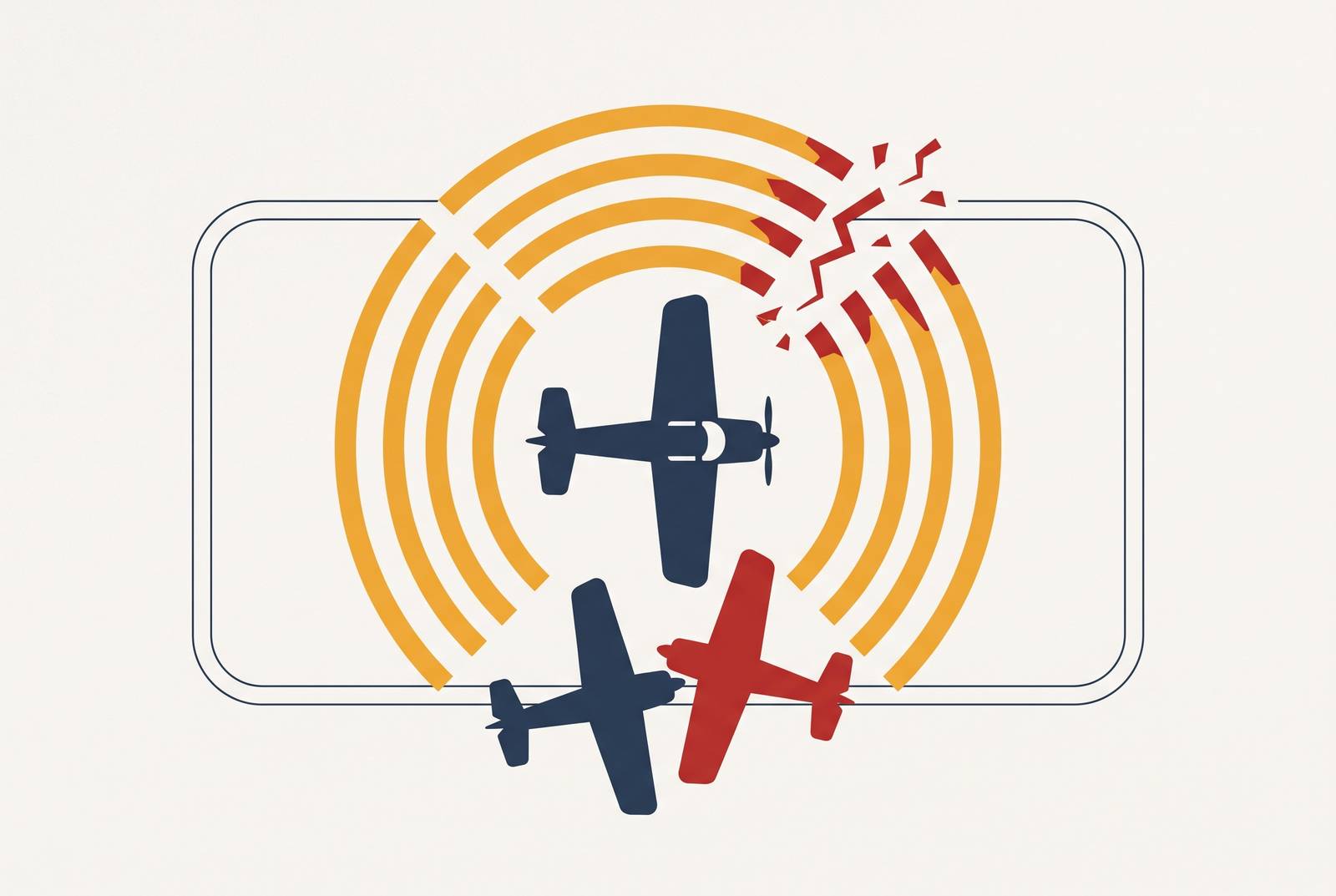
CTAF, the Common Traffic Advisory Frequency, breaks down in high-traffic pattern work because the system was never built to carry the load that busy pattern traffic places on it. This piece lays out why CTAF is structurally unsuited to dense multi-aircraft operations, how its failure modes compound into cascades, where those cascades have ended in documented incidents, and what kind of technology can close the gap that self-announce procedures cannot.
Why CTAF is structurally unfit for busy pattern environments
CTAF was built as an advisory tool for a world with a handful of aircraft in the pattern at a time. Its entire mechanism rests on voluntary self-announcement, with no controller, no clearances, and no requirement that anyone participate. The design assumes traffic density low enough that a pilot can hold the whole picture in their head from position reports alone. American Flyers' 2025 guide puts the legal reality in plain terms: communicating on CTAF is not required when flying to or from a non-towered airport, and many pilots who fly equipped aircraft simply do not use it. That single fact means the entire safety architecture rests on choices individual pilots make on their own, with no backstop if they choose wrong.
The frequency itself adds a second layer of fragility before anyone even keys a mic. Pilot Institute's CTAF explainer makes clear that CTAF is a designated function rather than one fixed number, so the actual frequency changes airport to airport. A pilot has to look it up before the flight, and if that step gets missed, the aircraft disappears from the shared picture without anyone else knowing it happened. The FAA's own guidance, spelled out in AIM Chapter 4 and Advisory Circular 90-66C, treats CTAF and see-and-avoid as a paired system. Both halves lean on human attention and judgment, and both degrade at the same time once a pattern gets crowded: more aircraft to track by eye, more calls competing for the same airtime, less margin for either to catch what the other misses. CTAF was never load-tested against that condition. It was built for the opposite one.
The four ways a radio "fails" before any hardware breaks
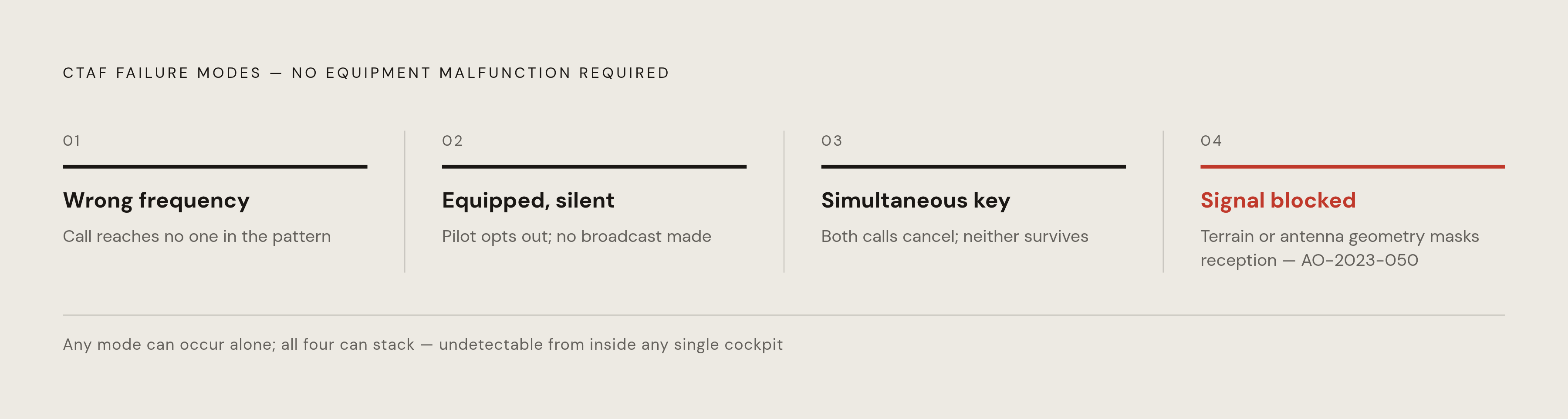
When people picture a "radio failure" in a traffic pattern, they often picture a box that stops working. Almost none of the documented cases work that way. CTAF breakdown is the simultaneous expression of several distinct vulnerabilities, any one of which can occur on its own or in combination with the others, and none of which requires a single broken part.
The first is wrong frequency. A pilot tuned to the wrong CTAF transmits into empty air and hears nothing from the actual traffic around the field, so they become functionally invisible to everyone else in the pattern. ASRS CALLBACK lists frequency selection error as one of several recurring failure modes at non-towered airports, alongside failure to monitor CTAF, aircraft that never communicate at all, and pilots who don't follow standard pattern procedure.
The second is equipped but silent: a pilot with a working radio who neither transmits nor listens. American Flyers calls this the system's major caveat, and it is the clearest expression of the voluntary-compliance hole at CTAF's center. The radio works. The pilot simply opts out.
The third is simultaneous transmission, sometimes called over-transmission. Two aircraft key the mic at the same moment, both messages get garbled or wiped out entirely, and neither pilot has any way of knowing the other one even spoke. Flight Safety Australia's review of ATSB investigations found this exact failure in multiple incidents, including AO-2024-009 and AO-2023-050.
The fourth is antenna and signal degradation, where terrain, aircraft geometry, or building shielding weakens a transmission even when the pilot sending it is on the correct frequency and doing everything right. The ATSB's investigation into the Mildura near-miss, AO-2023-050, found that the Dash 8 crew had been using Comm 2 for CTAF calls, and that radio's antenna was mounted on the underside of the aircraft, which may have kept the crew from hearing the Lancair's broadcasts.
None of these four modes rules out the others. In a pattern carrying several aircraft, two or three can be active at once, and the result is a set of gaps in the shared traffic picture that no single pilot inside any one cockpit has the means to detect or fix.
How busy traffic patterns multiply these failures into cascades
Traffic density doesn't just add more opportunities for one of these four failures to occur. It multiplies them against each other while shrinking the time and attention each pilot has left to compensate by scanning visually or sequencing mentally. A training circuit running touch-and-goes is the clearest example: several aircraft at different points in the pattern all need to announce around the same moments, which is exactly the condition that produces over-transmission, two calls stepping on each other and both getting lost.
E3 Aviation's guide identifies the most common pattern mistake as keying the mic before listening, an error that gets more likely, not less, as traffic builds and pilots feel pressure to get their call out before the window closes. Density pushes the error rate higher.
Silence compounds the problem rather than resolving it. As E3 Aviation points out, ultralights, gliders, and other aircraft not required to carry radios can sit in the pattern without ever making a call. A pilot who hears nothing and assumes the pattern is clear is acting on an absence of information. An ASRS CALLBACK Issue 256 report describes the window just before a tower opens for the day, functionally identical to an uncontrolled environment, where aircraft taxi and cross runways with no CTAF calls at all and corporate jets and turboprops land and depart in total silence. The reporter's own conclusion was direct: as traffic increases, an incident is building.
A second-order confusion sits on top of all this. Many CTAF frequencies are shared across multiple nearby airports, so a pilot at one field and a pilot at another may both be listening to the same channel, each assuming the traffic they hear belongs to their own pattern. Skipping the airport name on a call, which happens constantly, makes the two situations indistinguishable from inside the cockpit.
Putting the pieces together, a chain forms. If a plane is on the wrong frequency or stays silent, it is already invisible to everyone else. An over-transmission destroys the one call that might have closed that gap. Antenna shielding means even a clean, correctly transmitted call might never reach the aircraft that needed to hear it. What results is a pattern where each pilot is flying with a mental picture of traffic that is missing aircraft physically present in the same airspace. Each failure in the cascade removes one more chance to catch the others.
What incident reports show about where cascade failures terminate
The documented record shows this chain playing out the same way: a gap in communication lets a non-communicating aircraft slip into the pattern unnoticed, and see-and-avoid, already stretched thin by workload, fails to catch it in time.
One ASRS report describes a flight instructor flying with a student who rejected the takeoff roll after a non-communicating aircraft departed from the opposite runway, forcing the instructor to maneuver off to the side. The outcome was fine, but only because an experienced instructor happened to be at the controls and caught the conflict in time.
A second ASRS incident shows the same mechanism, but with a worse near-miss. A flight crew lined up on the runway after making their CTAF call, and the airport manager had to radio them that an aircraft was on final at 500 feet and hadn't made any calls. The student pilot and instructor on that final approach were on the wrong frequency the entire time and never detected a DC-3 lined up opposite them on the same runway.
In February 2025, a Lancair and a Cessna 172 collided in midair at Marana Regional Airport in Arizona, an uncontrolled field, with two people aboard each aircraft. The collision happened three weeks after the Potomac River crash had already put mid-air collision risk in front of the national public. The timing underscores a point this piece has been building toward: a disaster at a controlled field with radar and clearances drew the headlines, while a structurally similar risk sat quietly at uncontrolled fields across the country, waiting for the same gap to open again.
Australia's record shows the same pattern. The mid-air collision at Caboolture Airfield, AO-2023-036, between a Jabiru J430 and a Piper PA-25 Pawnee, killed both occupants of the Jabiru. The ATSB's investigation found the Jabiru likely could not transmit or receive radio calls at all, which meant its presence in the pattern was invisible to the Pawnee pilot by design, not by mistake.
The NASA ASRS Non-Tower Airport Incidents database holds 50 recent reports that sample operations at non-tower airports. The sheer number of pattern conflict reports inside that sample is a recurring outcome of a system working exactly as designed.
Why self-announce protocols cannot close the gap
The strongest case for CTAF is that it works fine if pilots just follow the procedure properly. That argument collapses once you account for what happens when some pilots in a shared pattern are silent, mistuned, or simply not required to carry a radio. A single pilot making every call exactly as trained has no way to restore a shared picture that other aircraft are actively leaving incomplete.
Flight Safety Australia states the limit directly: "Even with a correctly tuned radio and structured, concise CTAF calls, you can't assume other aircraft have heard you." CTAF offers no receipt, no confirmation that a transmission landed anywhere. American Flyers adds that asking "any traffic in the area, please advise" does not count as self-announcing under the standard. Pilots who rely on that phrase believe they've completed the required call when they haven't said anything at all about their own position or intentions.
Some aircraft are legally allowed to skip CTAF. Certain ultralights, gliders, and experimental aircraft are not required to carry radios, and they can occupy the pattern without ever appearing in a single CTAF exchange no matter how carefully every other pilot in the air performs. See-and-avoid is the only thing left standing between that aircraft and everyone else, and it runs entirely on human attention and line-of-sight, both of which get worse as traffic and workload increase.
From inside a cockpit doing everything right, another aircraft that's silent by choice looks the same as one that's simply on the wrong frequency. Both produce the exact same experience: nothing heard, no way to know why.
The usual counterargument, that better training and more discipline would fix this, doesn't survive contact with a real training environment. A pattern full of student aircraft running simultaneous circuits guarantees a mix of skill levels, attention spans, and communication habits sharing the same airspace at the same time. System-level safety in that environment is set by the weakest pilot in the pattern, not the average one. That's the condition CTAF was never built to absorb.
The surveillance gap that leaves even some towered small airports blind
No independent way exists to see traffic that doesn't depend on a pilot choosing to report it, and that gap extends well past uncontrolled fields.
Of the 265 contract ATC towers operating nationwide, 91 have no radar or surface surveillance equipment. Controllers at those towers sequence traffic with binoculars, radio calls, and pilot position reports, the same raw inputs a CTAF pilot relies on, just routed through a controller instead of handled aircraft to aircraft. The structural weakness doesn't disappear once a tower gets built. It moves into the tower cab.
Lawmakers have started treating this as a recognized gap rather than a theoretical one. A bipartisan Senate bill introduced in February 2026, the Air Traffic Situational Awareness Enhancement Act, would equip more than 90 of these radar-less towers with Airborne Position Reference Tools, or APRTs, which use ADS-B data to give controllers a visual picture of aircraft position they currently don't have. The technology behind the bill isn't speculative. uAvionix received FAA approval in 2025 for FlightLine, described as the first FAA-approved APRT system, built as a cloud-based platform running on ADS-B data.
ADS-B narrows the gap but doesn't close it. Aircraft without ADS-B equipment stay invisible to any tool built around that data, and as ADS-B becomes the standard surveillance layer in both towers and cockpits, the aircraft that lack it get harder to see in an airspace that is otherwise increasingly well-instrumented. The common thread running through controlled and uncontrolled fields alike is the same: the traffic picture depends on pilots choosing to report themselves, and nothing independent exists to catch the ones who don't. Any real fix has to address that root condition.
What digital and remote tower technology offers beyond CTAF
Digital and remote tower systems attack the actual dependency that makes CTAF cascades possible in the first place: they give a controller, or an automated system, direct visual and sensor-based awareness of every aircraft in the airspace, whether or not any pilot ever transmits a word.
A Remote Tower Service setup replaces the physical tower cab with a remote facility, where controllers watch the airfield through high-definition cameras, infrared sensors, and AI-assisted object detection. That means the controller sees the aircraft that structurally cannot transmit, the pilot who had a working radio and chose not to use it, and the student who is tuned to the wrong frequency without knowing it, all at once, all independent of what any of them say or don't say over the air. The AI detection layer in these systems is built to flag runway incursions and wildlife hazards directly, and the infrared sensors extend usable visibility into low-light and low-visibility conditions where both pilot scanning and controller eyesight would otherwise lose effectiveness.
This isn't an unproven idea. Örnsköldsvik Airport in Sweden became the first airport in the world to be managed remotely in 2015. Avinor's Remote Tower Centre in Norway now runs multiple airports out of a single facility. London City Airport became the world's first major international airport fully controlled by a remote digital tower in 2021. Each case shows the same underlying shift: traffic awareness moving from something pilots have to construct themselves, call by call, to something a sensor network maintains independent of any single person's behavior.
For the large number of U.S. airports that have no tower at all, this kind of technology offers the first realistic route to independent surveillance, because it was built from the start to be deployable and affordable without the construction costs and full-time staffing that have kept towers out of reach for most small fields. CTAF will keep functioning as a communication layer. What it has never had, and what cascading failures keep exposing, is a way to see the traffic that doesn't bother to speak up.