Near-Miss Reporting Gaps at Non-Towered Airports
One Nebraska airport's flight data revealed 40 near-misses that never reached any safety database.
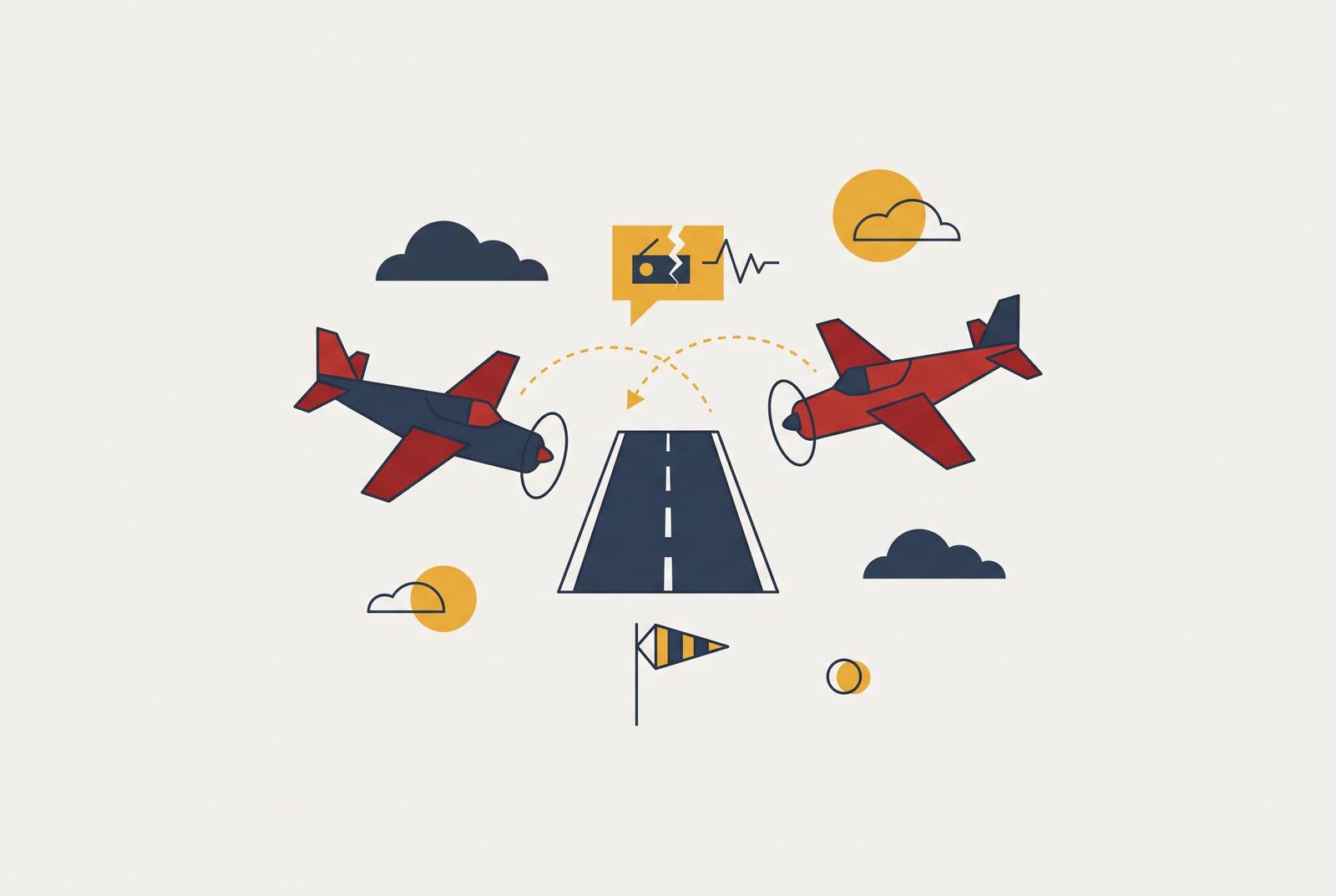
Near-miss data at non-towered airports does not just arrive thin or late. It fails to arrive at all, because the system built to capture it depends on a witness who, at most non-towered airports, was never hired. That witness is the control tower, and its absence is the starting point for understanding why safety data at these fields is structurally broken.
A towered airport has a trained, independent observer watching every movement on the field and in the surrounding pattern. That controller can flag a separation violation, start an investigation, or log a report whether or not either pilot involved ever says a word about it afterward. The event gets captured because someone whose job is to watch was watching. If that controller is removed, the event's survival in any safety database depends entirely on whether one of the pilots involved decides, after the fact, to write it up.
At the vast majority of U.S. airports, that is exactly the arrangement in place. No tower, no independent observer, no mechanism that forces an incident into the record. If neither pilot involved in a close call files a voluntary report, the encounter disappears completely, not just from public view but from the FAA's, the NTSB's, and every researcher's dataset. The primary channel built to catch these events, the Aviation Safety Reporting System, run through NASA and open to pilots, controllers, dispatchers, cabin crew, and maintenance technicians, states in its own documentation that its reports are voluntary, uncorroborated by NASA, the FAA, or the NTSB, and shaped by reporting biases nobody can fully measure.
That last point deserves attention on its own. A cluster of ASRS reports from one location does not necessarily mean that location is more dangerous than another with fewer reports. It may just mean the pilots flying there know the system exists and use it. The resulting map tells you about reporting culture, not about where risk actually concentrates. Mistaking one for the other means resources, attention, and regulatory focus can be aimed at the wrong airports, while the quiet ones, the ones with low ASRS volume and no tower, stay invisible by default.
Objective flight-track data versus voluntary reports
The gap between what happens in the air and what official reporting captures is measurable directly, because aircraft now broadcast their own positions continuously through ADS-B, independent of anything a pilot chooses to write down afterward.
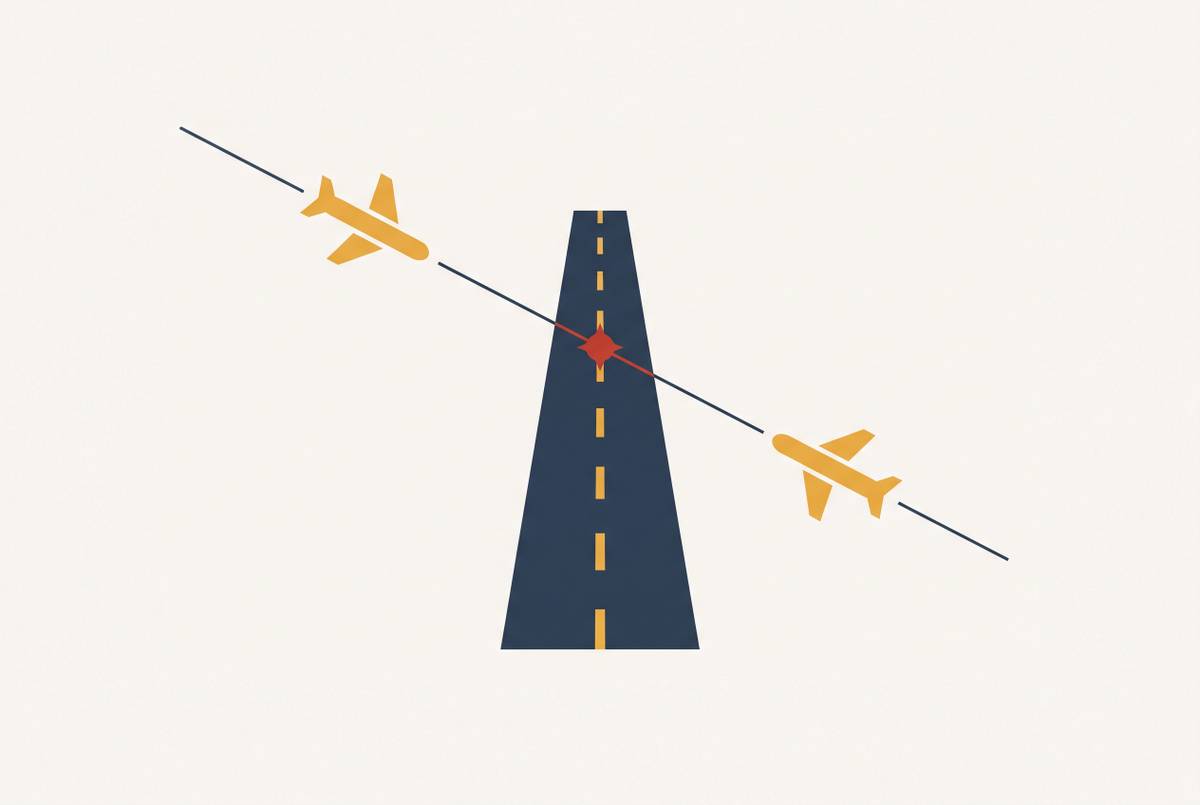
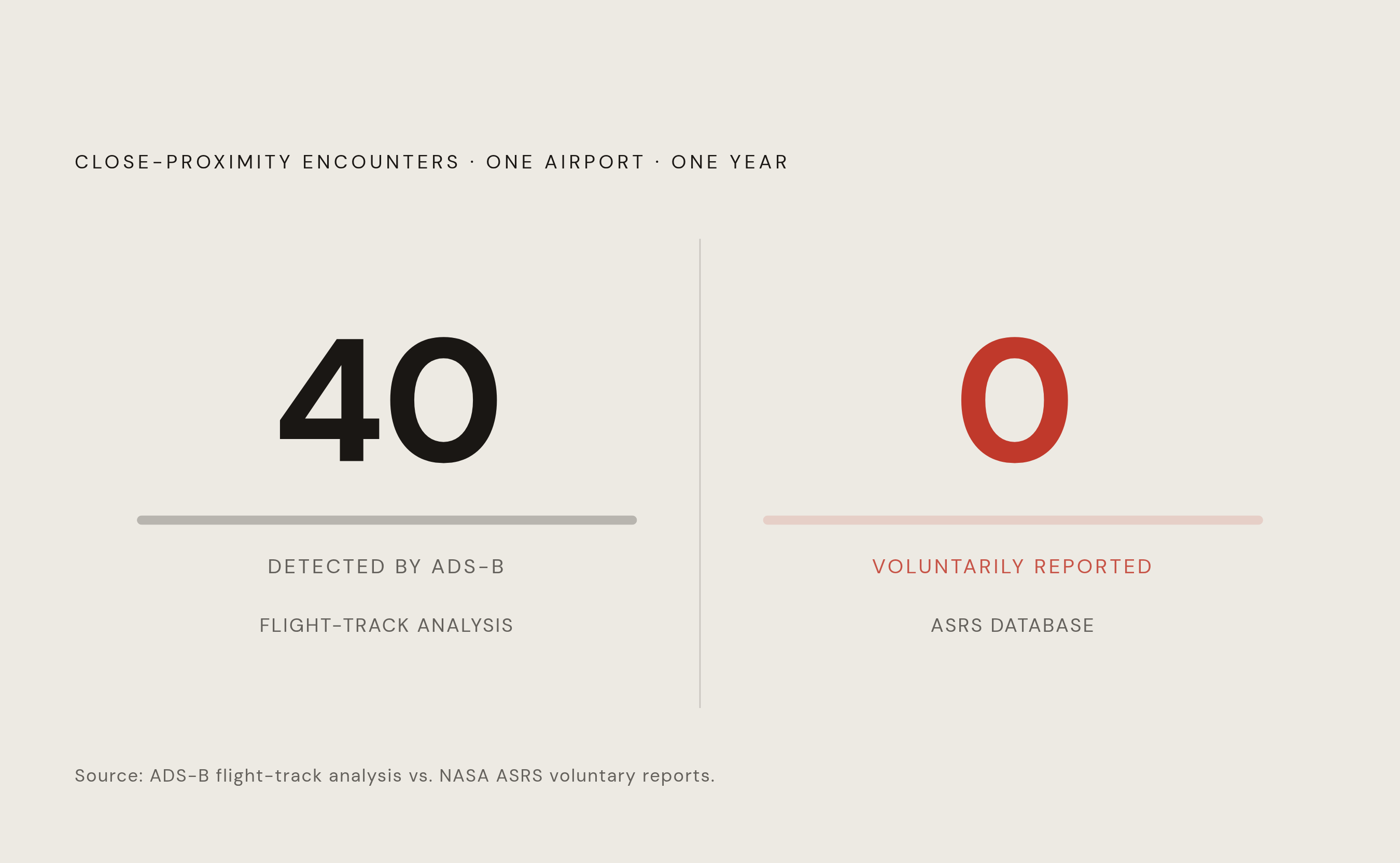
A 2026 AIAA study from Embry-Riddle Aeronautical University took a year of ADS-B flight data from a single non-towered airport in Nebraska and checked it against the ASRS database. The flight-track analysis identified 40 recurring close-proximity encounters, concentrated in the approach and departure phases where aircraft converge on the same runway environment with no independent set of eyes watching the convergence. None of those 40 events appeared anywhere in ASRS.
That number matters because of what it rules out. This was not a case of a few pilots failing to notice a close call or forgetting to file afterward. The same aircraft generating zero voluntary reports were generating dozens of objectively documented proximity events in the trajectory data, making the absence total. Whatever gap exists between what pilots experience and what they report, this study found a gap of a different order: between what happened and what anyone, anywhere, wrote down.
The same analysis, led by researchers at the University of Nebraska with Embry-Riddle as a collaborating institution, found systematic altitude inconsistencies and duplicated radar identity at the airport, signs of equipment calibration problems and surveillance data integrity issues that produced the near-miss numbers. This deepens the safety concern: not only were close encounters going unreported, but the underlying data streams used to detect them were carrying their own errors.
One airport in Nebraska does not prove that every non-towered field in the country hides 40 unreported encounters a year. The study was not built to generalize in that way, and treating a single-site finding as a national average would overreach. What it proves instead is a mechanism: that near-miss events can be frequent, recurring, and entirely absent from every safety database simultaneously. Once that mechanism is demonstrated in one place, with real flight-track data, the burden shifts to anyone who wants to assume it isn't happening elsewhere.
How wide the known near-miss picture is
Scaling the question up from one airport to the whole country, the picture does not improve. It confirms the same gap at a larger size.
A September 2026 data analysis worked from non-mandatory reports filed by flight crews and found roughly half a dozen near collisions at U.S. airports every month. The analysis itself flagged that figure as likely an undercount, a rare instance of a voluntary reporting system acknowledging its own blind spot in print. Of the incidents the dataset did record, the locations of nearly 50 were never disclosed. The reporting system is already known to miss events, but a large share of what it does catch carries no geographic information at all, so researchers and safety authorities cannot even sort those events by airport type or control status to look for patterns.
The cost of that opacity is not abstract. In February 2025, two small planes collided at Marana Regional Airport, an uncontrolled field northwest of Tucson, killing two people. Authorities released limited details after the crash, and that limited disclosure is consistent with how non-towered incidents get handled generally: thin on information even when the outcome is a fatality rather than a close call that both pilots walked away from. A fatal collision at an uncontrolled field that draws a sparse public record says something about how little visibility exists for the much larger number of near-misses at the same kinds of airports that never make the news.
The population affected by this gap is not a narrow slice of recreational flying. Non-towered airports serve student pilots and flight instructors building hours in the traffic pattern, corporate jet operators, air ambulance crews flying time-critical missions, and aerial firefighting aircraft that operate in and out of fields near wildfire zones. Each of those operations carries consequences well beyond the individual pilots in the cockpit, and each currently flies into and out of airspace where the only safety record is whatever someone chooses, voluntarily, to write down afterward.
Why the safety system cannot correct what it cannot see: the NTSB recommendation backlog
An invisible near-miss does more than vanish from a database. It also keeps the entire correction cycle from starting, because the NTSB's recommendations are built from the incidents it reviews, and at non-towered airports there is often nothing substantial to review.
The NTSB can investigate crashes and incidents and issue recommendations off the back of them, but it has no power to make anyone adopt those recommendations. That authority belongs to the FAA, to Congress, and to other bodies that move on timelines set by budget cycles and political priorities, not by the urgency of the safety case in front of them. Even when the NTSB does see something, in other words, acting on what it sees is a separate and slower process.
The USAir Flight 427 crash in 1994 killed all 132 people aboard and produced a string of NTSB recommendations in its wake. Safety mandates stemming from that crash took over 30 years to reach full implementation, an illustration of how long the gap can stretch between a recommendation being issued and a corrective action being completed, even in a case with full public attention, 132 deaths, and a clear investigative record behind it.
Now consider what happens when there is no crash to investigate in the first place, only a string of unreported near-misses at a non-towered field. No investigation opens. No recommendation gets written. The 30-year lag that followed Flight 427 at least started counting from the moment of the crash. At a non-towered airport where the near-miss never enters any database, the clock never starts at all, and a system that moves slowly even when it is paying attention has no way of paying attention to begin with.
Voluntary reporting's limits as a safety tool at small airports
Most small airports do not operate without a tower because anyone decided towers were unnecessary for safety. They operate without one because the funding structure available to them has never made an independent, staffed tower affordable.
The math behind that is concrete. To cover even a modest infrastructure project and match the FAA's typical share of the cost, an airport has to bank multiple years of capped entitlement grants before it can move forward. Larger projects require a sponsor match running into the millions, money that has to come from the surrounding municipality, and most small-airport sponsors simply don't have that kind of capacity sitting in a budget.
Johnston Regional Airport and Raleigh Executive Jetport in North Carolina show what that math looks like in practice. Both have FAA approval to build a traditional air traffic control tower, at an estimated cost running from $10 million to $20 million, largely funded by taxpayers. Airport Director David Harris has pointed out that a digital remote tower would run roughly half that price. Both airports are now stuck between two unresolved paths: a digital system not yet fully approved at the federal level, and a traditional tower whose cost remains out of reach even with approval already in hand.
That bind explains why voluntary reporting has remained the only safety observation tool at most of these airports. It was never chosen for being adequate. It became the default because nothing else was affordable, and its adequacy went untested against objective data until the Embry-Riddle study put flight-track evidence next to the ASRS record and showed just how much the voluntary system misses.
What digital tower technology observes
The core failure at a non-towered airport is the absence of an observer, so the fix has to be something that observes continuously, independent of whether any pilot ever decides to report anything. That is what digital tower technology does.
A digital tower gives air traffic control specialists the visual and sensor information they need to provide tower services from a location away from the airfield itself, built from camera systems and sensor arrays that can give controllers situational awareness matching, and in some configurations exceeding, what they'd have from a conventional tower cab. The difference that matters most here is what the system leaves behind afterward. A voluntary ASRS report exists only if a pilot chooses to write one. A digital tower's surveillance record exists as a matter of normal operation: close-proximity encounters, altitude deviations, and traffic conflicts get captured in the system log whether or not any pilot involved is even aware a close call occurred.
The FAA is currently testing digital tower systems at a site in Atlantic City, New Jersey. Separately, the Atrak MAESTRO Digital Remote Tower platform went through more than 18 months of testing at Václav Havel Airport Prague before its public unveiling in May 2026, which shows that a validation path for this kind of system already exists even while U.S. federal approval for vendors is still working its way through the process.
One objection comes up naturally: a digital tower still needs a trained, certified controller, so doesn't it run into the same staffing shortage that makes traditional towers unworkable at small airports? The staffing model answers that concern directly. A controller working from a remote tower center can be certified to handle multiple airports, monitoring one at a time and transferring control to a colleague as traffic demands shift. So a limited national pool of certified controllers can cover far more airports than the one-controller-per-tower model that traditional staffing requires.
The controller shortage, new federal funding, and the case for digital towers
Two developments from 2025 and 2026 have moved digital towers from a long-range idea into something closer to an immediate requirement. The first is the controller shortage itself. The alternative to installing a digital observer at a non-towered airport is not a traditional human controller, because the staffing to put one in every small tower cab across the country does not exist and is not coming. The real alternative is leaving the airport exactly as invisible as it is now.
The remote tower center staffing model, where one certified controller can handle traffic at multiple airports and hand off control as needed, turns the controller shortage into a direct argument for this technology. A shortage that would cripple any plan to staff individual towers at thousands of small airports is far less limiting when one controller's certification can stretch across several fields at once.
The second development is federal funding. The July 2025 legislation known as the "One Big Beautiful Bill" set aside dedicated funding to advance digital remote towers as part of the FAA's Brand New Air Traffic Control System initiative. That funding changes the shape of the policy conversation to how quickly that money can move systems into the airports that need them most, and which airports get prioritized first.
Closing the observer gap: effects on safety data and decision-making
Putting an independent observer back at non-towered airports would not simply add one more safety feature to the list. It would change the quality of the underlying data that the FAA, the NTSB, airport operators, pilots, and policymakers all depend on when they make decisions.
Once a digital tower is in place, close-proximity encounters get recorded as part of normal system operation, independent of pilot discretion. That record gives the NTSB something concrete to analyze, gives the FAA a real foundation for rulemaking, and reveals patterns in the data that the ASRS system currently misses or obscures. It also shortens the distance between an incident occurring and a recommendation following from it, cutting into a lag that has historically stretched across years and, in cases like Flight 427, decades.
Airport operators at Johnston Regional and Raleigh Executive Jetport are making real infrastructure decisions right now: build a traditional tower at a cost of tens of millions of dollars, or wait for federal approval of a digital system at roughly half that price. They're making that choice without reliable near-miss data, because the same non-towered status that drives the decision is what makes collecting that data impossible.
The Embry-Riddle ADS-B study shows that the data these operators need already exists. Aircraft transponders are broadcasting it continuously. What's missing is a system watching that data in real time, with the standing and authority to act on what it shows.
A national airspace system cannot be called modern or safe while most of its airports run with no independent safety observation, no real-time conflict detection, and no way to capture the near-misses that come before fatal accidents. Digital tower technology is the only path available right now that is both affordable and scalable enough to close that gap.