When the Pattern Gets Crowded and Nobody Is in Charge
Self-separation breaks down when radio calls overlap and arriving aircraft stay off the radar.
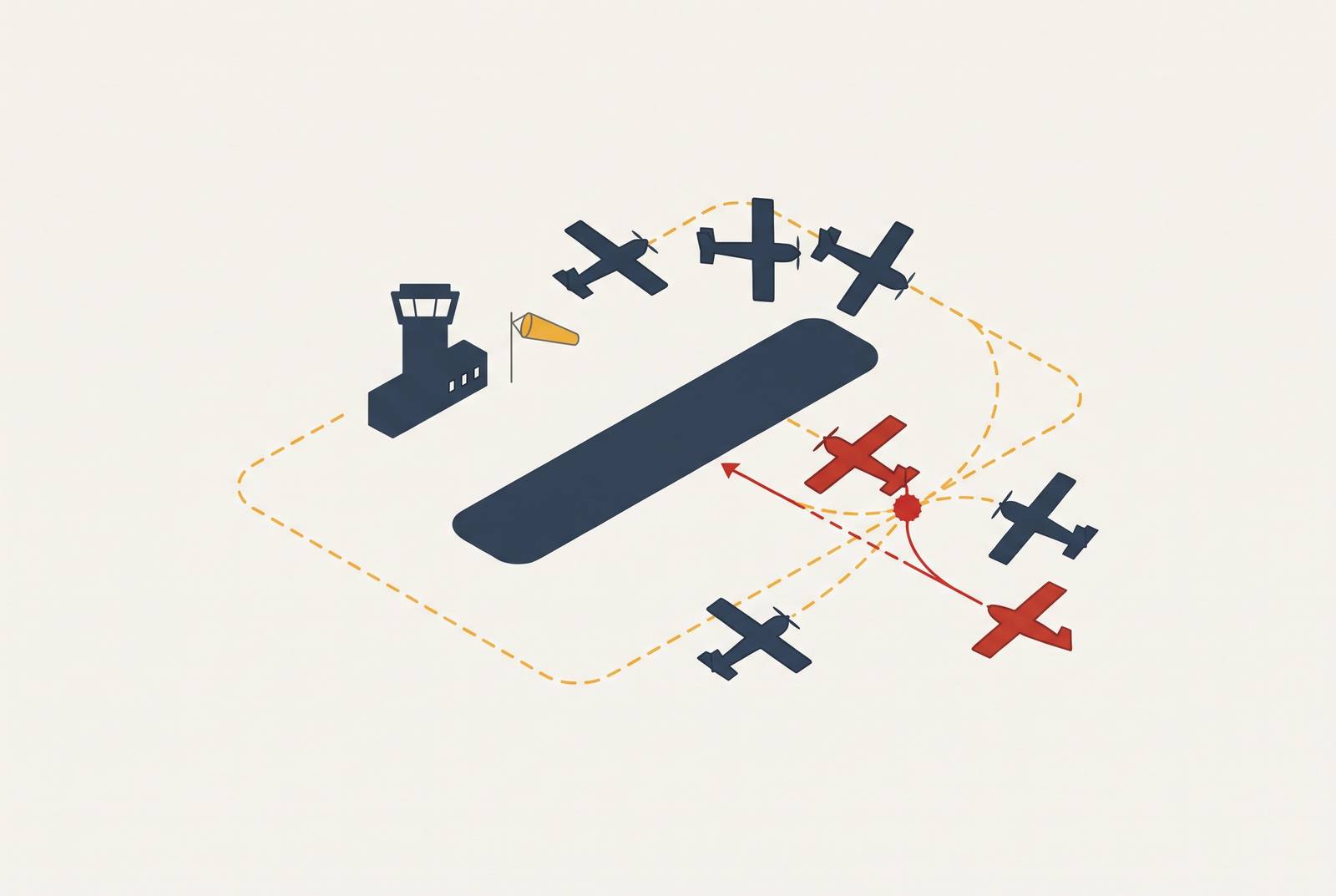
More than 4,600 U.S. public-use airports have no control tower, so pilots must coordinate traffic themselves. That model becomes structurally vulnerable when crowded patterns overwhelm shared radio calls and mutual awareness. Digital towers offer a way to close this safety gap in the National Airspace System, but deployment requires risk-based priorities, credible lifetime costs, and an operating model small airports can afford.
How non-towered airport traffic is supposed to work
The Common Traffic Advisory Frequency, or CTAF, is the channel pilots share to coordinate at a non-towered airport. Pilots announce their positions and intentions, listen for other aircraft, and use those calls to build a mental picture of nearby traffic. Each participant contributes to the picture and interprets it. No controller sequences arrivals, separates aircraft, or verifies that everyone understands the situation in the same way.
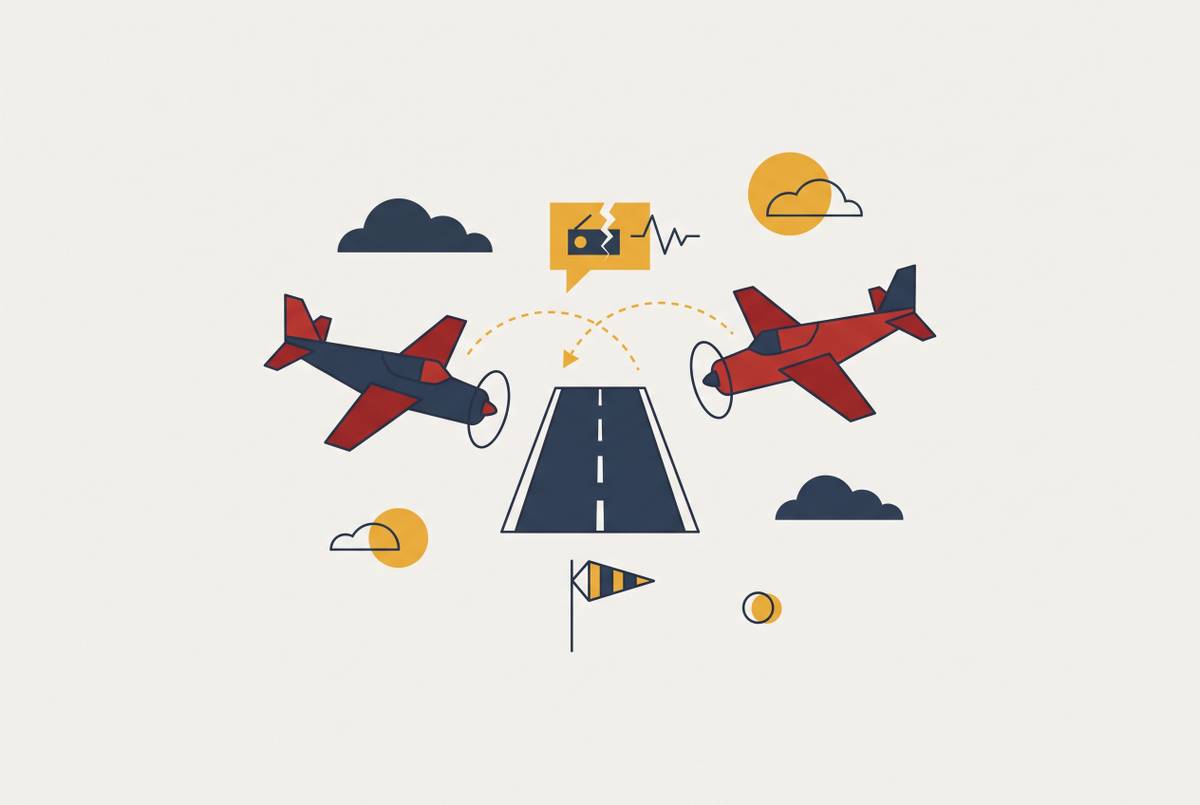
When two aircraft approach the runway at the same time, coordination remains with their pilots. Position reports and stated intentions tell each pilot where the other aircraft is likely to go. The operating model assumes that both are listening, communicating, and following shared procedures. It also assumes mutual awareness of other traffic. Under low-traffic conditions, this allows pilots to coordinate without the airport having a staffed control tower, using a common frequency and a common understanding of the pattern.
Where the system's design assumptions break down under pressure
Radio participation is not guaranteed by the operating model. Communicating on CTAF is not legally required at non-towered airports, even for aircraft equipped with radios. Some aircraft have no radios, while some equipped pilots do not monitor the frequency. Silence therefore leaves each listening pilot with a picture that may omit traffic.
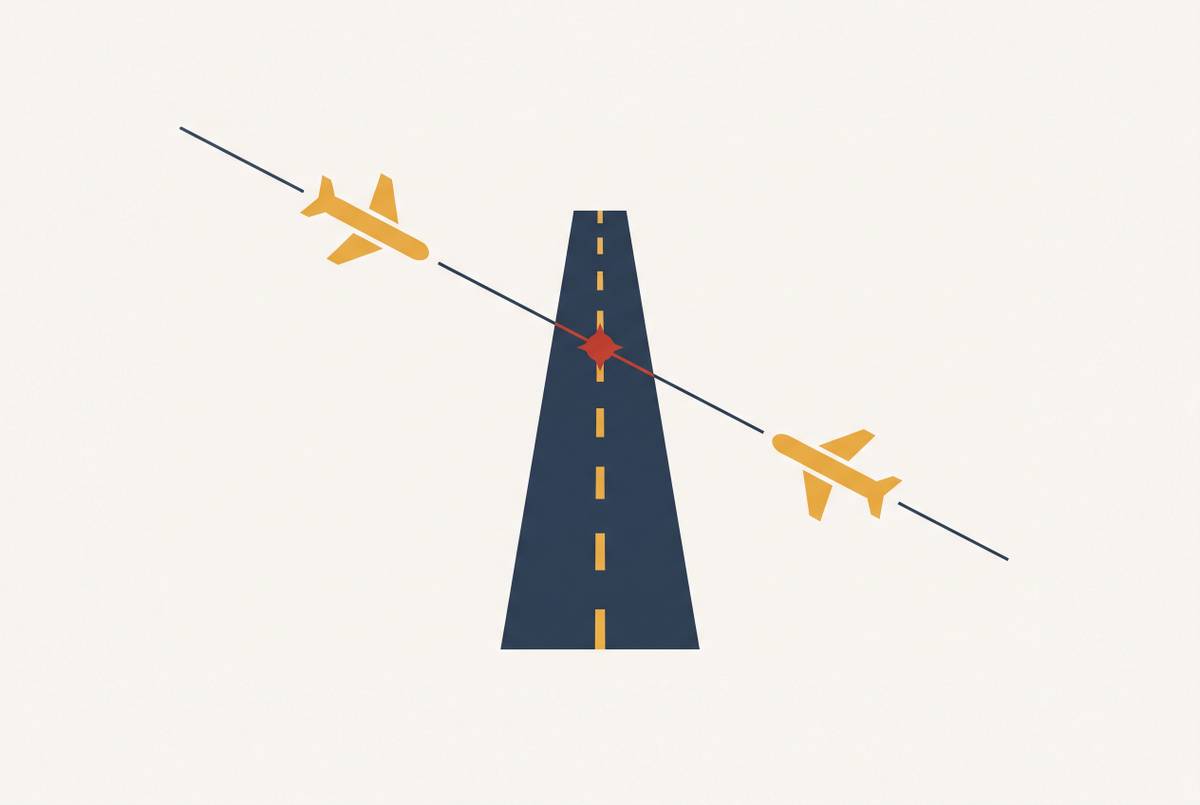
GPS-enabled straight-in approaches introduce a different gap in that picture. A pilot navigating direct to final from miles away can descend through pattern altitude without entering the standard circuit. Other pilots may consequently lack a position report that places the arriving aircraft in the sequence they are using. The aircraft is outside their expected traffic picture.
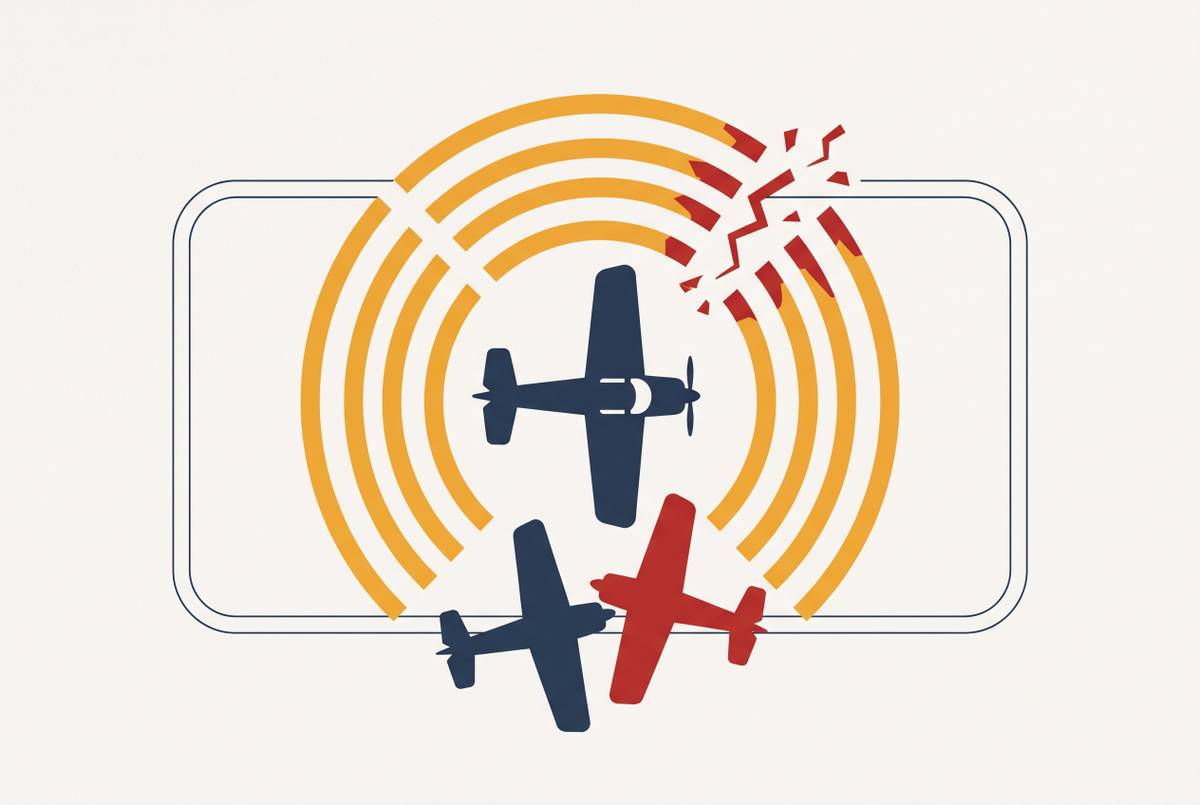
As traffic increases, the shared channel itself becomes congested. Simultaneous position calls can overlap, obscuring transmissions and leaving pilots with different accounts of the same traffic situation. Non-towered airports also draw a disproportionate share of transient pilots unfamiliar with local pattern geometry and terrain, without a controller to compensate for that unfamiliarity. These weaknesses make one another worse as traffic grows. Self-separation depends on complete participation and shared awareness precisely when both become harder to sustain.
What the incursion and near-miss data shows about where the risk concentrates
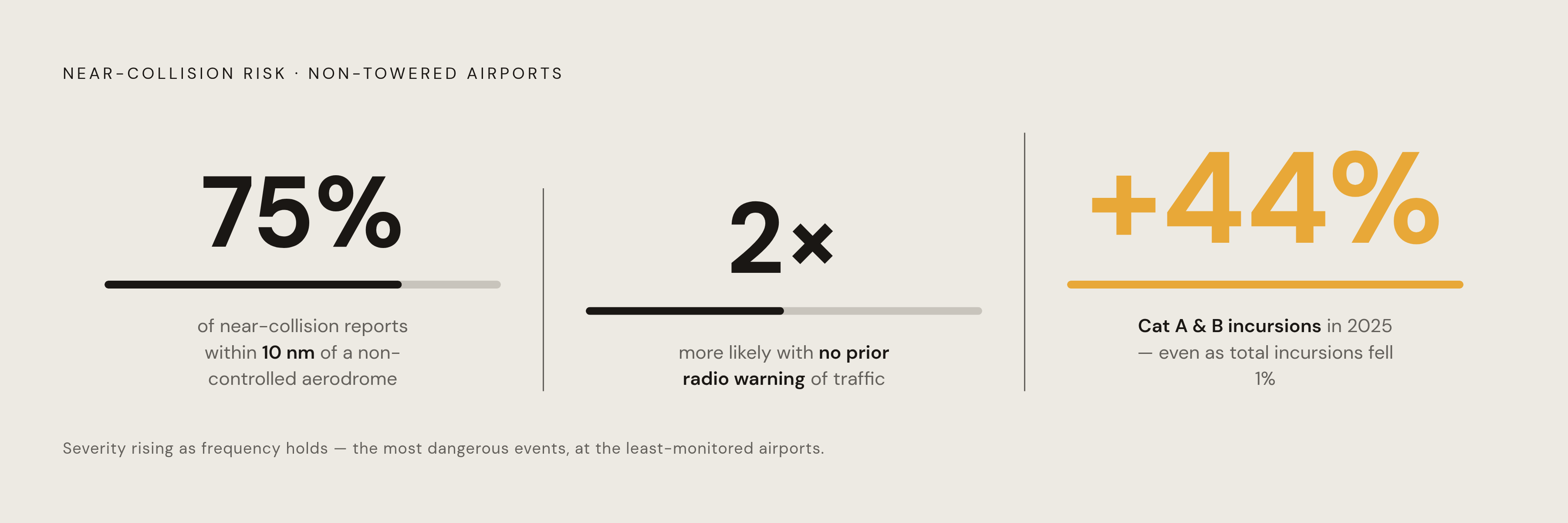
The FAA Safety Team stated that severe Category A and B runway incursions rose 44 percent in 2025, while total incursions fell about one percent. The two measures point in different directions. That national divergence provides context for examining where the most consequential risks concentrate, although it does not by itself attribute the increase to non-towered airports.
The FAA’s incursion classification system also complicates comparisons between controlled and uncontrolled facilities. An operational incident cannot occur at a non-towered airport because that category requires a controller. Pilot and vehicle deviations remain possible, but without an external authority watching and intervening. Pilot deviations account for close to two-thirds of all U.S. runway incursions.
Near-collision reports provide a more geographically specific signal. Three-quarters involve operations within ten nautical miles of a non-controlled aerodrome, and near-collisions occur twice as often when a pilot had no prior radio warning of other traffic. Incursion risk also clusters at a small number of non-towered facilities, many of them flight-training fields. These patterns are consistent with congestion and incomplete awareness being important features of the risk.
In a recent multi-year period ending before March 2026, every fatal runway-incursion accident occurred at a non-Part 139 airport without a control tower. A fatal runway incursion at LaGuardia Airport, a towered Part 139 airport, occurred in March 2026, so the earlier concentration cannot be treated as an absolute rule. Separately, the FAA reported that a Lancair and a Cessna 172 collided mid-air at uncontrolled Marana Regional Airport on February 19, 2025, with two people aboard each aircraft.
Why most small airports have no control tower
Johnston Regional Airport in North Carolina has roughly 300 operations a day without a tower. Its director describes the situation as removing all traffic lights from a city and expecting drivers to sort out traffic safely. Johnston Regional and neighboring Raleigh Executive Jetport have FAA approval to build towers that are expected to cost between $10 million and $20 million each, with taxpayers paying most of the cost. Approval does not eliminate the economic obstacle. The director estimates that a digital remote tower would cost roughly half that amount.
The FAA Contract Tower Competitive Grant Program helps with some of the cost, but its fiscal year 2026 funding can keep airports in the program going and pay for only a small amount of growth. It cannot extend coverage to thousands of unserved fields. At the same time, the FAA faces a significant controller shortfall against its full-staffing target. Staffing therefore constrains expansion as well as construction funding. When there are too few controllers to go around, airports that can barely support a tower remain hard to serve.
This is a mismatch between the conventional tower model and the airports needing coverage. A physical tower places a substantial construction burden on each location, while staffing adds another constraint on service. Small airports can experience crowded periods without having an economic base suited to that model. Traffic still needs to be coordinated at those busy times. A viable alternative must therefore change how coverage is delivered and how its costs are shared.
How digital tower technology addresses what a crowded, uncontrolled pattern actually needs
A digital tower replaces the view from a physical cab with a continuous sensor picture. A typical installation has cameras that give 360-degree coverage, infrared sensors for low-visibility conditions, surface radar or multilateration, and ADS-B receivers. An aircraft absent from CTAF can still be represented in the airport’s surveillance picture, directly addressing the gap between traffic that exists and traffic that pilots have heard.
Camera resolution can support identification of aircraft types, reading tail numbers, and detection of runway debris. Some systems add augmented reality overlays with aircraft identifiers and projected flight paths. Those capabilities help distinguish traffic when the pattern fills. Their operational purpose is not simply to produce more images, but to make conflicts easier and faster to detect in a crowded scene.
The decisive change is an authoritative traffic picture coupled with sequencing. A controller with digital tools and, where it is included, AI assistance can manage the sequence in place of five pilots each trying to piece together a traffic picture from overlapping calls. Sensors alone do not supply that authority. The digital tower model delivers the control function without requiring a physical cab at every airport. A controller or remote tower center can oversee multiple airports, distributing the cost of coverage across facilities rather than requiring each small airport to support the conventional model independently.
Where digital towers are already controlling traffic at airports like these
Digital towers are in operational use at dozens of small airports globally, including airports managed from centralized remote tower centers. Norway provides an operating example of that model. Kongsberg Defence & Aerospace announced an agreement with Avinor in July 2024 to add seven digital towers, plus an eighth at new Bodø Airport. Avinor’s Remote Tower Center in Bodø already controls multiple airports. Completion of the seven additions by 2027 would bring its coverage to 21 airports.
Italy’s air navigation service provider ENAV announced in April 2025 that its control centers at Brindisi and Padua would become remote tower centers serving low-traffic airports. Its plans extend to a larger network by 2033. In Canada, Nav Canada’s digital aerodrome tower in Kingston has 360-degree cameras, infrared imaging, and AI-driven tracking. Under the plan, controllers in Kingston would oversee Hamilton Airport, hundreds of kilometres away, once regulators approve it.
The U.S. example illustrates a different deployment path. The FAA is partially funding a new Federal Contract Tower at Leesburg Executive Airport in Virginia in FY2026. That project demonstrates demand for tower coverage at a small airport, but also continued reliance on traditional infrastructure where a remote alternative has existed. The distinction is important for assessing readiness.
What the U.S. policy and funding environment now makes possible
The Brand New Air Traffic Control System, or BNATCS, initiative explicitly funds remote digital towers within a comprehensive national modernization program. The DOT and FAA initiative moves the technology beyond the status of isolated experiments in domestic funding policy. The FAA’s April 2026 Request for Proposals for remote tower systems reinforces that change, with potential procurement of up to 50 units over five years. This creates a concrete route toward deployment. It is not, however, a commitment to cover all airports that could benefit.
Remote centers also offer a different response to the controller shortage. Concentrating oversight of multiple small airports allows the available workforce to cover more airports per controller, rather than tying every expansion in coverage to a separate conventional facility. That flexibility is relevant when the staffing gap is measured in the thousands. That flexibility changes how controllers’ capacity can be applied across airports whose individual traffic levels may not support the traditional model.
The same investment can serve another modernization need. Digital towers have surveillance and communication systems that can help UAS safely share the airspace around small airports. The same infrastructure can thus help with both pattern sequencing and new airspace users. Together, explicit funding, a procurement pathway, and multiple operational uses make domestic deployment more practical than an isolated demonstration. Whether those conditions will translate into sustained coverage where the risk is greatest remains uncertain.
What still has to go right for digital towers to actually close the gap
The principal objection is execution risk and cost uncertainty at scale. The GAO found in September 2026 that the FAA had not developed a comprehensive, well-documented lifecycle cost estimate for BNATCS. Officials could not provide the analysis supporting their high-level figures and acknowledged exclusions covering government-related costs, most Phase 1 operations and maintenance costs, and all Phase 2 costs. Those omissions weaken the basis for long-term commitments. A procurement opportunity is not yet a defensible account of what coverage will cost to sustain.
Deployment priorities require a stronger analytical foundation as well. The DOT OIG’s March 2025 audit found that the FAA had no joined-up way to analyze runway incursion data. That is the same analytical capability needed to identify the uncontrolled airports most urgently requiring coverage and to judge whether deployment reduces risk. Institutional follow-through is another constraint. The U.S. discontinued a remote tower pilot program in 2023, and Leesburg’s return to traditional tower funding shows that technical availability does not guarantee adoption.
Initial coverage should prioritize the highest-risk uncontrolled airports, including training fields and high-traffic VFR corridors, rather than treating every unserved field as an equal candidate. Congress and the FAA need a defensible lifecycle cost model before committing to a multi-airport rollout. Procurement must support affordable, domestically developed digital tower systems suited to small-airport economics. Success means funded, staffed, sustained traffic management at the airports where crowded conditions most urgently require it.