What the Fatal Accident Numbers Actually Mean for the Pilot Who Flies Into Uncontrolled Fields Every Week
Aggregate safety rates hide the conflicts that uncontrolled fields leave unseen.

The fatal accident numbers at uncontrolled fields describe a system-wide outcome. The safety gap is the absence of a deconfliction layer that can observe traffic, detect conflicts and intervene when pilots do not communicate. Better situational awareness lowers the risk, but it cannot provide the missing surveillance and authority.
Why aggregate GA fatal accident rates mislead the pilot who actually flies non-towered fields
“GA is safer than ever” is a comfort trap when it ends the inquiry. The long-run improvement in accident and fatal accident rates is genuine. But an aggregate rate combines towered and non-towered operations, busy and quiet airports, and instrument and visual flying. That average cannot isolate the conditions that repeatedly expose a particular pilot to conflict.
A pilot flying the same uncontrolled field three times a week does not encounter a representative sample of the whole system. She deals with how much traffic that field has, how pilots fly the pattern and how they communicate. Repetition makes the local conditions central to her risk picture, even when the national trend improves. A falling overall rate does not establish that every operating environment is improving with it.
The strongest objection is reasonable. If the overall trend is good, why focus on rare collisions? Because the fatal runway incursion record and the shift toward more severe incursions raise questions that the aggregate cannot answer. The distinction is between “safer on average” and “safer for you, here, this week.”
How the FAA's runway incursion severity categories were built around a world where someone is watching
The FAA’s runway incursion framework separates severity from event type. Its severity scale extends from Category D, with no immediate safety consequence, to Category A, where a collision is barely avoided, and then to Accident. That scale can describe how close an encounter came to catastrophe. It does not establish how reliably encounters were observed.
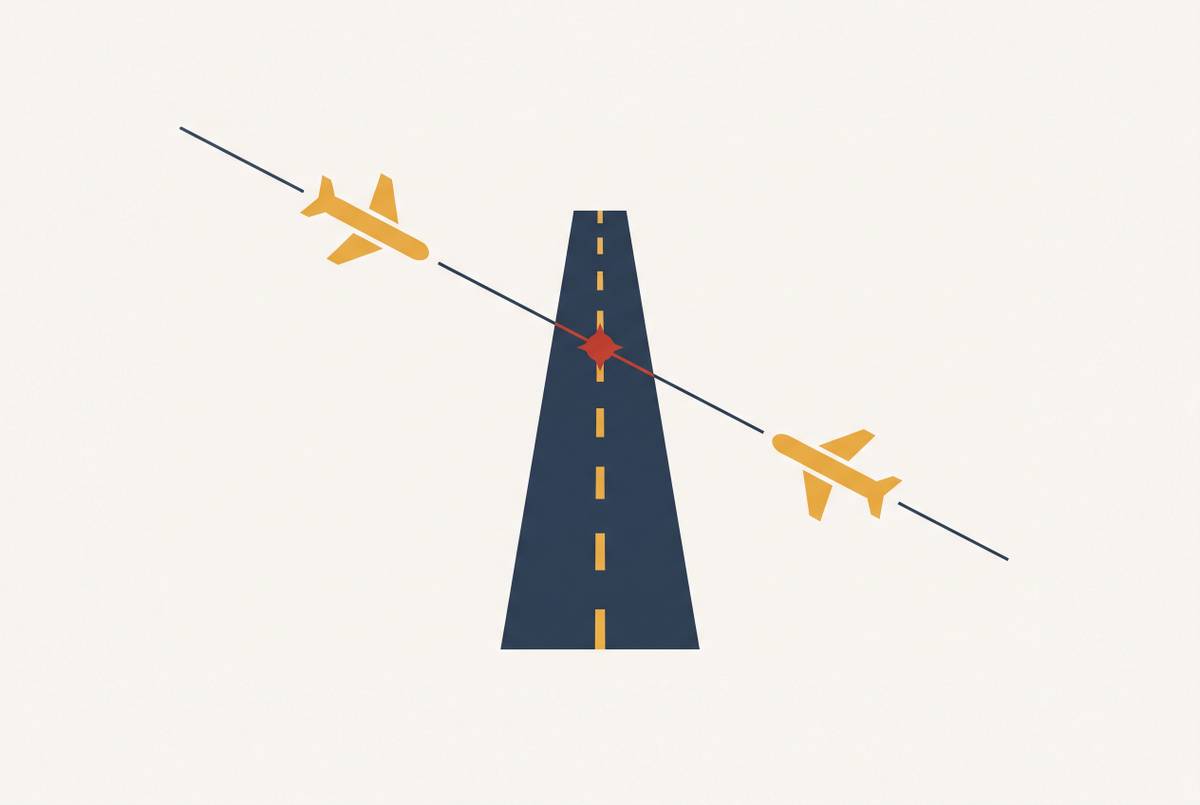
The event types expose the structural mismatch. An operational incident requires a controller to be present, so that category disappears at a non-towered airport. Pilot deviations and vehicle/pedestrian deviations remain, but without an external authority to catch, correct or record them as they unfold. The DOT Inspector General puts pilot deviations at nearly 62 percent of U.S. runway incursions, so what pilots do plays a large part even when that authority is in place.
At a towered airport, an observed conflict can prompt intervention and a corrective record. At a non-towered field, the record may depend on a pilot voluntarily submitting an ASRS report. Severity categories can still describe the events accurately, but anyone comparing airport types must allow for the lack of someone watching.
What the severity shift in runway incursions actually signals about where risk is heading
There were roughly as many runway incursions in fiscal year 2024 as in fiscal year 2019. Read alone, that comparison suggests stability. But the FAA Safety Team reported that Category A and B incursions rose by nearly half in fiscal year 2025 while the total number of events fell slightly. These are encounters involving a barely avoided collision or a time-critical evasive response.
The divergence is more informative than the total. Fewer events overall can coexist with more events at the dangerous end of the distribution. Whatever is restraining the total count cannot be assumed to be restraining the most severe encounters. Nor does this shift across the system, on its own, show the rate at non-towered airports.
The DOT Inspector General’s March 2025 audit found that the FAA has no joined-up way to study runway incursion data and find risks. That finding limits confidence in explanations of what is driving the shift. For the non-towered pilot, the structural concern is more immediate. The airport has no controller who can recognize and interrupt the next developing conflict.
The fatal record adds a different signal. In recent years, there were only three fatal runway incursion accidents, all at non-Part 139 airports without control towers. The number is small, so it cannot establish a precise comparative risk. Still, the fact that all occurred at these airports points to a rare but deadly problem that a steady total count of incursions would hide.
Why the per-facility midair collision comparison makes non-towered airports look safer than they are
Over a recent decade-long study period, towered airports recorded roughly 41 times more midair collisions per facility than non-towered airports. Pilots and operators who have encountered that number have reason to ask whether it contradicts concerns about uncontrolled fields. It does not answer the same question.
The denominator is airports. Towered airports handle vastly more operations per facility, so dividing collisions by the number of airports does not measure the risk of an individual operation. Without normalization for movements, the comparison cannot establish which environment is safer to fly in. A busy uncontrolled training field may have as much traffic as a contract tower field without having its deconfliction infrastructure.
Without a controller to observe and classify events, fewer records need not mean fewer conflicts. This is a reason to treat the observed incursion record as incomplete.
The Transportation Safety Board’s 2025 Watchlist found that the highest incursion rates cluster at a small number of airports, many of them flight-training facilities. For the regular pilot, local activity is a more relevant exposure measure than the number of airports in a national category.
The three failure modes that dominate ASRS near-collision reports at non-towered fields
NASA’s ASRS Non-Tower Airport Incidents report set, Update 41, dated June 17, 2026, supplies the cockpit-level detail that aggregate rates omit. Its voluntary reports lack independent corroboration and leave the prevalence or statistical ranking of a problem across the system undetermined. Their value is explanatory, showing how a conflict becomes invisible to the people involved.
The first recurring failure is a wrong or missed CTAF frequency. In one report, a student crew kept flying an approach toward a runway that was occupied while using the wrong frequency. They never received the warning about the aircraft at the opposite end. Visual contact finally exposed the conflict. The failure was not simply an omitted position call, but two aircraft operating without a shared communication channel.
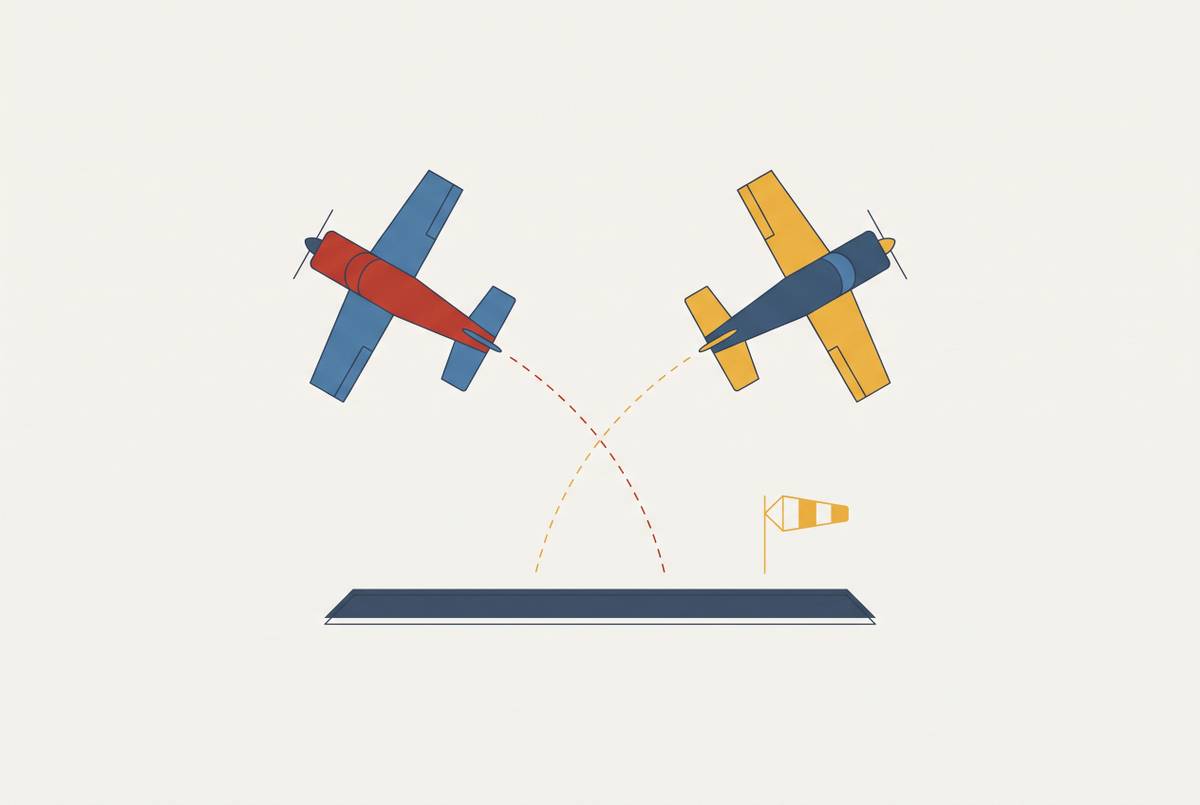
The second failure is non-communicating, opposite-direction traffic. A CRJ-200 crew reported a near-collision during landing rollout with an aircraft departing in the opposite direction. The other pilot was not communicating on CTAF and had improper lighting. The submission called for enforceable CTAF use, reflecting the reporting crew’s inability to make the other aircraft participate.
The third failure is pattern conflict in training-heavy traffic. Reports describe aircraft flying touch-and-go or formation activity without radio calls, so other pilots cannot get a full picture of the traffic. A flight instructor in a PA28 reported a near-midair on short final with another aircraft 100 feet below.
The February 19, 2025, collision between a Lancair and a Cessna 172 at Marana Regional Airport underscores the stakes. The NTSB investigation is ongoing, and details are preliminary. It cannot yet establish which of these mechanisms, if any, explains that accident.
What CTAF's structural limitations mean for the pilot who cannot opt out of the non-towered environment
CTAF provides a shared frequency for broadcasting position and intent. Pilots who monitor and transmit can use those calls to build a picture of traffic. That is a useful function, but a bounded one. A communication channel is not a surveillance system.
CTAF cannot verify that every aircraft is listening, enforce participation, observe aircraft that do not communicate or intervene when a pilot remains silent. When two aircraft approach the runway at the same time, pilots must detect and resolve the conflict without a tower controller directing them. If one aircraft is on the wrong frequency, the other pilot’s accurate broadcasts do not repair the separation between their traffic pictures.
FAA AC 90-66C makes the missing function explicit. At a non-towered airport, surveillance of other traffic by an air traffic controller is removed from the safety picture, leaving the pilot to assume that role. Yet taking on that role does not give the pilot a controller’s tools or authority. The pilot can watch and respond, but cannot check that everyone else is taking part.
Unfamiliarity compounds that limitation. Transient pilots may not know local patterns and terrain, and there is no controller to compensate for that missing knowledge. This explains why correct individual CTAF use is necessary but insufficient. The communicating pilot remains dependent on behavior she cannot compel or reliably verify.
What situational awareness actually looks like for the pilot who flies these fields routinely
For the regular non-towered pilot, the practical lesson is to model what the radio picture may be missing. The ASRS cases identify specific geometries, including opposite-direction runway use and overlapping aircraft on short final. Mentally briefing those conflicts before entering the pattern differs from simply planning position calls. It gives attention a defined target.
The wrong-frequency case supports verifying CTAF before entering the terminal area. A correct call on the wrong frequency is functionally silence to the intended listeners. Verification addresses the pilot’s own participation failure, but not another aircraft’s. A quiet frequency therefore remains information to interpret.
An aircraft below another aircraft on short final may escape a standard left-seat scan. Briefing that geometry makes the limitation explicit rather than treating “look for traffic” as a complete response. At a training-heavy field, silence cannot rule out aircraft conducting touch-and-goes or other pattern activity.
At airports with known opposite-direction departures or non-standard patterns, the notes’ practical implication is to review current NOTAM and ATIS/ASOS information before entry. Local familiarity does not guarantee that transient traffic shares the same expectations. NASA ASRS CALLBACK’s September 2025 issue warns that oversights or cutting corners can degrade safety more at non-towered facilities than under a controller’s watch. That asymmetry calls for particular care in communication and operations.
These practices strengthen detection. The pilot is acting both as pilot-in-command and as an observer of deviations a controller might otherwise catch. Keeping those roles distinct helps a well-prepared pilot avoid assuming that the system around her is just as ready.
Why the structural gap cannot be closed by better pilot behavior alone — and what a deconfliction layer actually requires
Non-communicating traffic, unfamiliar transient pilots and saturated training patterns share a critical feature. A fully compliant pilot cannot prevent the other aircraft’s participation failure. Closing that gap requires someone to watch, discipline in communication and authority to step in, beyond asking more of the pilot who is already making the correct calls. The missing function is organized deconfliction.
A conventional tower can cost tens of millions of dollars to build, while the FAA’s hundreds of towers serve only a fraction of a system with roughly 20,000 non-towered landing facilities. Conventional construction faces difficulty bridging that disparity and leaves responsibility for paying for ongoing operations unresolved.
The FAA announced on November 6, 2026, that digital tower systems had entered operational service at Bartow Executive Airport and Kenai Municipal Airport, the first of seven airports to receive them. But digital infrastructure is not, by itself, a complete operating model. A deconfliction layer still needs people, authority and funding that lasts.
At Leesburg Executive Airport, the path to funding has been complex. It received a FY2026 FAA Contract Tower Program award to help pay for a new Federal Contract Tower to replace a temporary mobile tower that was installed after a prior remote tower program ended in 2023. AOPA’s representative identifies a further constraint for airports using AIP funds to acquire a digital tower. An airport ineligible for the Contract Tower Program must maintain the system and pay controllers, with costs potentially passed to users.
For the weekly non-towered pilot, the decisive question is therefore access to an operating service.