Digital Tower Solutions for Runway Incursion Prevention at Small GA Airports
Severity is climbing at uncontrolled airports where voluntary separation fails most often.

The flat, headline runway incursion count masks the trend that matters: severity is climbing at exactly the facilities least equipped to prevent it. U.S. runway incursions in fiscal year 2024 were nearly identical to fiscal year 2019. Read against the severity trend, it suggests something closer to stagnation in the wrong places.
The divergence between a flat total and rising severity is the signal. Whatever is driving the most dangerous encounters is not being touched by whatever holds the overall count flat. The FAA itself lacks an integrated approach for analyzing runway incursion data and identifying risk, the DOT Office of Inspector General found in its March 2025 audit. The agency cannot yet say with confidence what is pushing severity upward, because its own analytical tools don't ask the question that way. That is the first gap. The second, and deeper one, is structural: the classification system beneath the data was never built to see non-towered airports clearly at all.
How the FAA's incursion taxonomy breaks down at non-towered airports
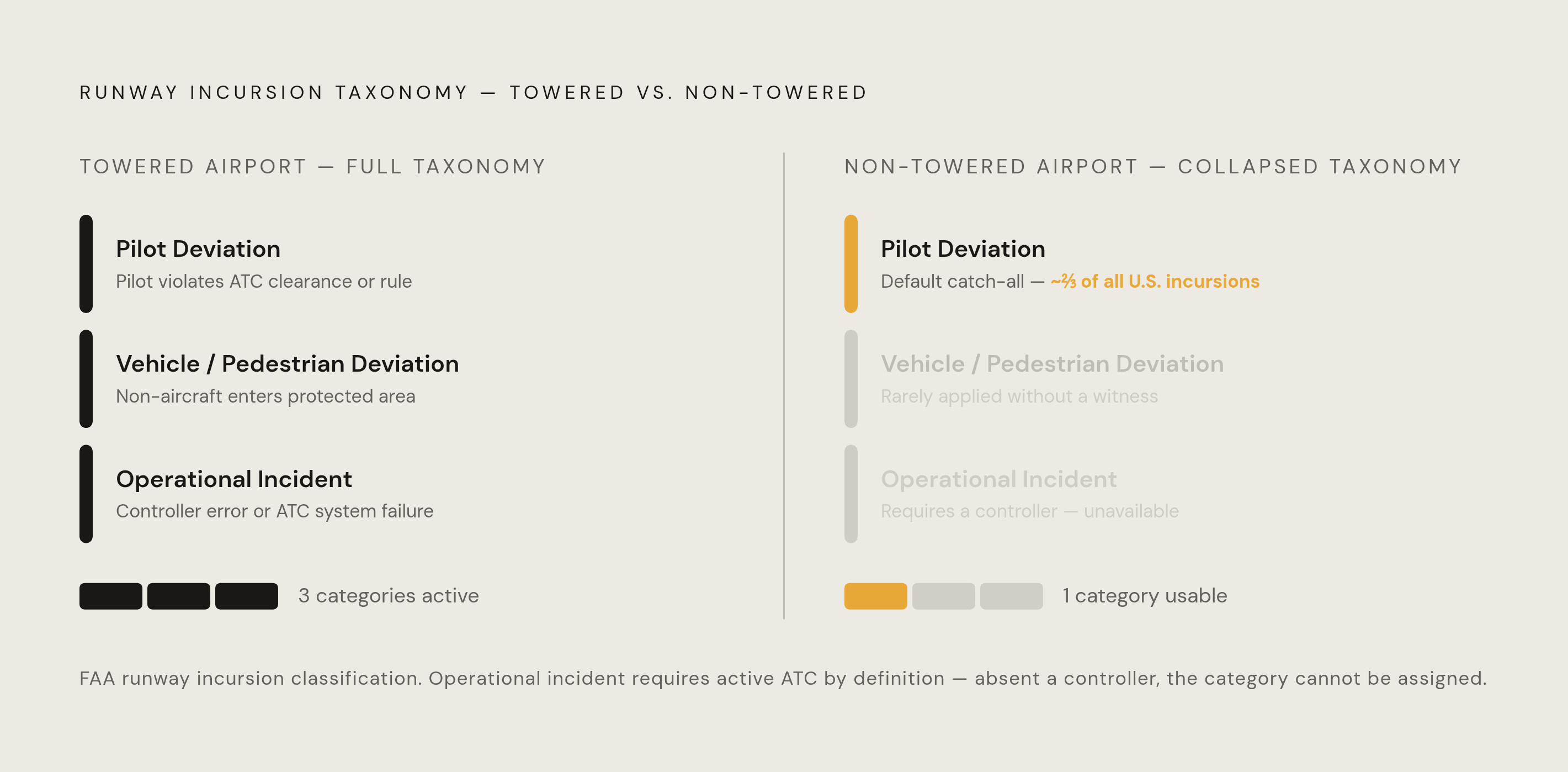
The FAA sorts runway incursions into three categories: pilot deviation, vehicle/pedestrian deviation, and operational incident. That third category requires a controller to be present and involved by definition. It disappears the moment a controller is absent, which means the taxonomy loses one of its three legs at every non-towered airport in the country. The system built to track runway risk simply cannot see a third of its own categories at the fields where that risk is increasingly concentrated.
Pilot deviations already make up close to two-thirds of all U.S. runway incursions. At a non-towered airport, pilot deviation is no longer one of three possible classifications. It becomes the default outcome of nearly everything that goes wrong, because the operational-incident category cannot exist where no controller works the field. The classification stops measuring a spectrum of failures and starts measuring a single bucket. That is not a reflection of what happens at these airports. It is a reflection of what the taxonomy can record.
The reporting gap is not subtle. FAA tracks runway incursions at 294 of its 383 primary commercial service airports. The remaining 89 do not report incursions because they have no operational FAA or federal contract tower to collect and report that data. Airport operators at non-towered facilities cannot measure the risk they are managing. The severity scale itself was built with a controller somewhere in the loop: watching, correcting, intervening before a deviation becomes a disaster. That assumption shapes the whole classification structure, and non-towered fields do not have it. General Aviation now builds digital ATC towers designed around precisely this structural blindness, so a non-towered field can feed its own incursion data into the same risk measurement system as a towered one.
What self-separation actually requires of pilots at non-towered fields, and where it fails
At a non-towered airport, every layer of separation a controller provides at a towered field is replaced by voluntary pilot action. Pilots rely on established traffic pattern procedures, radio calls on a shared Common Traffic Advisory Frequency, and visual scanning. None of these steps is required by a specific FAR. None is enforced. None is confirmed by an external authority. The entire separation model rests on pilots doing the right things for their own reasons, and no one outside the cockpit can verify that they did.
The system is not merely thin. It fails in predictable ways. Insufficient communication between pilots operating in the same area is the single most common cause of safety incidents near non-controlled aerodromes. Near-collisions occur twice as often when a pilot had no prior warning of other traffic by radio or a traffic alerting system such as TCAS. Three-quarters of near-collision reports involve operations within ten nautical miles of a non-controlled aerodrome. The pattern is consistent: when the voluntary call does not happen, or happens on the wrong frequency, or reaches a pilot unfamiliar with the local pattern, the separation layer simply does not exist.
One overlooked structural problem is how badly the standard taxonomy of incursion causes maps onto these fields. The three major contributing factors overall are failure to comply with ATC instructions, poor airport familiarity, and departure from standard operating procedures. The first cannot even occur where there are no ATC instructions. When it fails, no one is watching.
Where incursions and fatal accidents are actually concentrated
The severity-end risk is not spread evenly across the airport system. It clusters at a predictable and finite set of facilities, most of them uncontrolled. A small number of airports account for more than half of all incursions in Canada, according to the Transportation Safety Board of Canada's 2025 Watchlist, and the majority of those host flight training units. The concentration signature is the same across North American data: risk collects where traffic is dense, complex, and unmanaged.
U.S. fatal runway incursion accidents in recent years show the cleaner signal. Every one occurred at a non-Part 139 airport without a control tower. Raw collision counts by airport category are misleading without normalizing for movements: towered airports handle far more operations per facility, so their counts are naturally higher. The fatal-accident record strips that distortion away.
Flight training environments sit at the center of the concentration. High movement counts, many student pilots unfamiliar with local procedures, mixed traffic: these are exactly the conditions where voluntary self-separation fails most often. This is the natural intervention point, and it is where digital ATC tower technology can restore radar awareness, radio discipline, and real-time conflict alerting that self-separation alone cannot provide.
Why existing FAA safety programs were not built for this problem
An independent Safety Review Team issued 24 recommendations in November 2023. The key mitigation initiatives remain incomplete, and the bulk of funding and attention has gone to the commercial airports that already have towers. That is not an accident of execution. It is what happens when the problem is defined by the data a system can collect, and the data a system can collect comes only from airports where controllers are already present.
The tools at the center of the mitigation effort reinforce the pattern. Surface surveillance technologies, improved signage, hold-short markings: all of them require a controller to act on the information they produce. They do not help at a field where no controller is present. The airports least able to document their risk are the least likely to receive the resources to address it.
What a digital tower actually does at a small airport and what changes operationally
A digital tower replaces the out-the-window view and the physical tower building with a sensor-and-camera environment that gives a remote controller the same situational awareness a traditional tower provides, and adds capabilities a traditional tower cannot offer. High-resolution cameras aimed at arrival and departure paths, ramps, and runway intersections replace the direct visual scan. Infrared and night vision extend coverage into low-visibility conditions that reduce a traditional tower's effectiveness. Data from radar, weather systems, and aircraft transponders integrates into the digital interface. Augmented reality can overlay flight paths and aircraft identifiers directly onto the visual feed: each aircraft within visual range can be tagged with its tail number, as if the controller were looking at a radar screen.
At a non-towered GA airport, the operational change is concrete. The pilot's aircraft and avionics need not change at all. What changes is that someone is finally watching, measuring, and able to intervene.
The cost and staffing structure that makes digital towers viable where traditional towers are not
Most GA airports operate without any tower for one reason: a traditional tower costs tens of millions of dollars to build and staff, and the operations count cannot support it. Johnston Regional Airport and Raleigh Executive Jetport in North Carolina have both received FAA approval for an ATC tower. Airport director David Harris has publicly estimated that a digital remote tower costs roughly half that. The economic obstacle starts to dissolve.
Staffing amplifies the effect. Because cameras do much of the work, digital remote towers require fewer on-site air traffic controllers. One remote tower could theoretically serve multiple airports, spreading both capital and operating costs across facilities that could never individually sustain them. This is the model Avinor has proven at scale in Norway, where a single Remote Tower Centre in Bodø manages a growing portfolio of airports, with several additional airports scheduled to go live within the next two to three years. Avinor's stated motivation was reducing capital expenditure and operating costs through shared controller positions. The digital tower is not a cheaper version of the traditional one. It is a different staffing equation entirely, and that equation is what makes coverage of small GA fields financially possible for the first time. General Aviation's digital ATC tower approach is built around exactly this economics problem: purpose-built affordability for the vast majority of U.S. airports that have never been able to justify a traditional tower.
What the international operational record establishes about safety and reliability
The reliability question has already been answered through years of live operations across multiple countries and regulatory frameworks. Digital towers are not experimental technology. They are deployed infrastructure, and the international record establishes that the cameras, sensors, integration software, and remote controller workflows function in daily service.
How U.S. policy moved from the Leesburg closure to a statutory mandate and active procurement
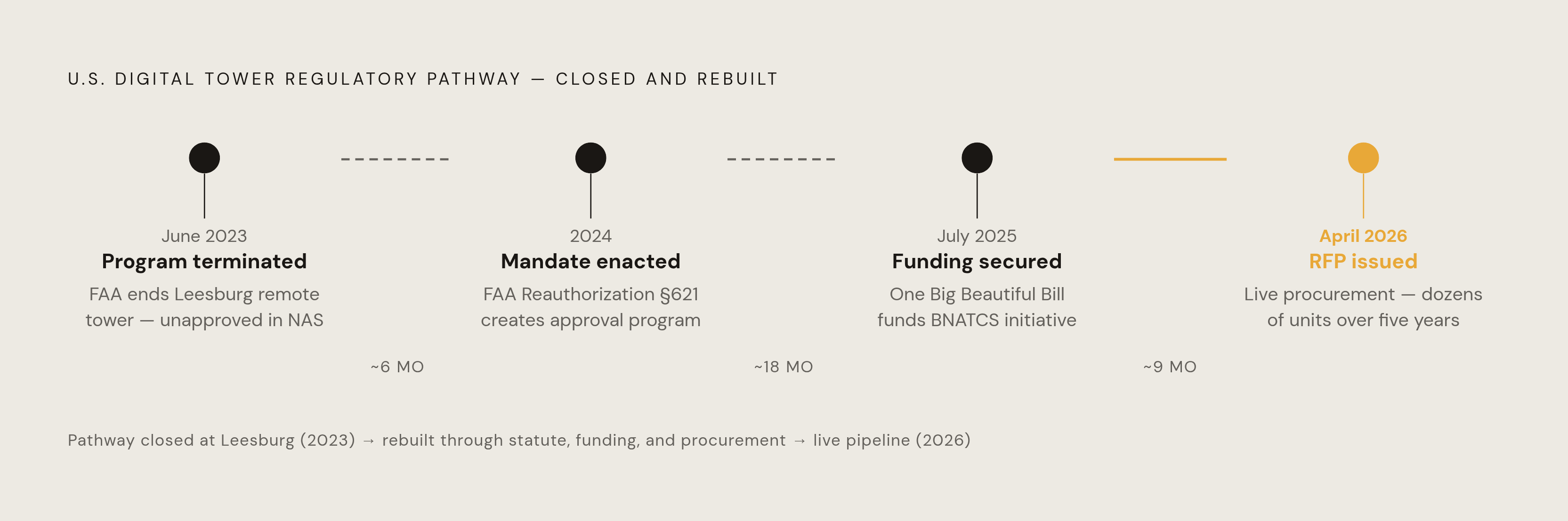
U.S. digital tower policy began this decade as a terminated experiment. The FAA terminated the remote tower program at Leesburg Executive Airport in June 2023, citing that the agency could not allow an unapproved system in the National Airspace System. The withdrawal came in the form of a letter from the System Design Approval process, not any operational safety failure of the program itself. The effect was the same: the regulatory pathway for a U.S. digital tower closed before it opened.
The statute changed the trajectory. Section 621 of the FAA Reauthorization Act of 2024 requires the FAA to create a program and publish milestones for the system design and operational approval of a remote tower system, prioritizing airports that do not have a permanent air traffic control tower, provide small or rural community air service, or have been newly accepted into the Contract Tower Program. Congress named the exact airports this article has described as the concentration of risk, and it made their coverage a statutory priority.
The funding and procurement environment followed. The "One Big Beautiful Bill," signed in July 2025, allocates substantial funding for National Airspace System overhaul as part of the FAA's Brand New Air Traffic Control System initiative, including a dedicated appropriation specifically for advancing remote digital towers. In April 2026, the FAA issued a request for proposals outlining plans to deploy remote tower systems at U.S. airports, with a potential procurement of dozens of units over five years. The regulatory pathway closed at Leesburg in 2023 has been reconstructed, through statute, funding, and active procurement, into a live deployment pipeline.
What airport operators and pilots can expect as digital tower deployment reaches small GA airports
For the GA airports that need it most, digital tower deployment is no longer a theoretical future. It is an active procurement environment, and the question for operators is not whether this technology is coming but how to engage with it. The FAA's April 2026 RFP and the BNATCS-dedicated funding establish that federal procurement is underway. Airports in the pipeline are already working through FAA certification processes.
For pilots, the operational change involves no change to their aircraft or avionics. A field that previously required full voluntary self-separation becomes one where a controller is in the loop, managing sequencing, directing radio communications, and providing conflict alerting. The load on the individual pilot drops substantially. The system's redundancy rises, because a second set of sensors and a second decision-maker now watches every movement.
For airport operators, the staffing model matters as much as the technology. Shared controller positions across multiple airports address the workforce challenge that has made traditional towers impractical at GA fields. The risk becomes visible for the first time, and the airport becomes eligible for the broader safety ecosystem that its invisibility previously excluded it from.
What has changed is not the risk. The risk was always there. The fatal incursion record at non-towered fields, the gap between what self-separation asks of pilots and what a controlling authority can enforce, and the data blindness that kept the problem out of risk measurement: each of these is addressed by the same operational change. The airport that has never had a tower can now have one, and the policy environment has moved to make that possible at scale.