AI-Assisted Traffic Detection in Digital ATC Tower Systems
Remote towers use AI to detect aircraft and predict conflicts at non-towered airports.
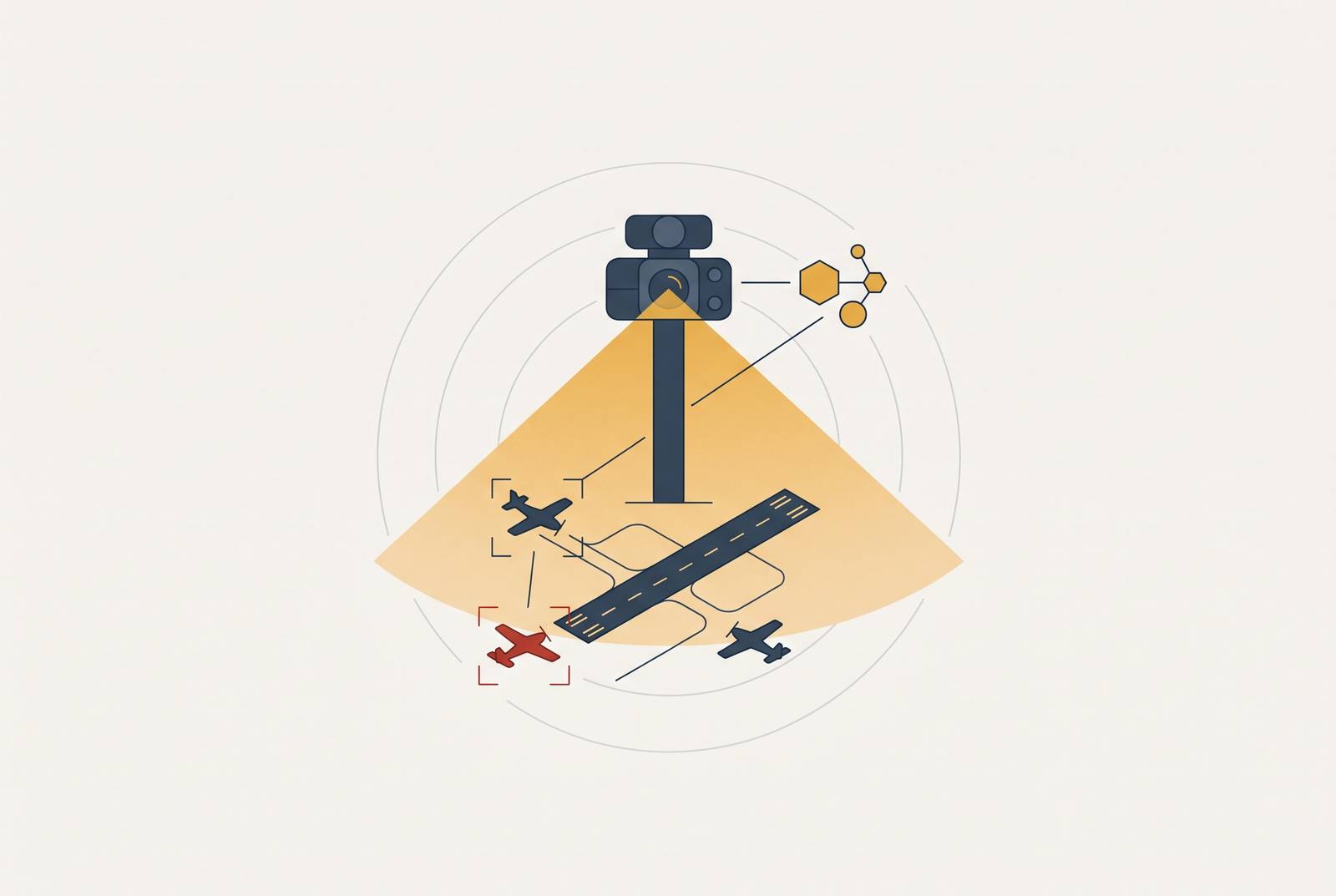
AI-assisted traffic detection makes digital ATC towers work by turning inputs from camera, radar, infrared, and ADS-B into a traffic picture that remote controllers can use [1]. Computer vision, sensor fusion, and predictive alerts provide the core capability for extending ATC to airports that cannot support a traditional tower. For non-towered airports weighing uncrewed aircraft and drone integration, this setup helps with situational awareness, but the ability to detect traffic alone does not secure operational approval.
Why most U.S. airports have no traffic control at all
Most airports in the U.S. National Airspace System operate without a tower providing local traffic control. Traditional towers need a building, a full roster of controllers, and money to keep paying staff. Small airports often cannot justify those costs. The expense does not disappear when traffic is light, because the airport still needs the infrastructure and people required to provide the service.
The FAA Contract Tower Program exists partly to address that affordability problem. Yet funding a tower and staffing it are separate constraints. NATCA estimated in September 2025 that the U.S. was short 3,800 fully certified controllers, while producing new controllers takes years.
The resulting coverage gap is structural: conventional ATC ties local service to a substantial investment at each airport, leaving smaller facilities outside the model. That distinction explains why the safety need has not produced widespread tower coverage. A different approach must change the relationship between the airport, the control facility, and the resources needed to connect them.
What safety looks like at an airport with no tower
At a non-towered airport, pilots bear the burden of traffic separation. They self-announce on a common traffic advisory frequency and depend on other pilots hearing, understanding, and making the appropriate transmissions. Pilots also rely on visual observation. Together, these practices depend on traffic being both communicated and visible, without a controller maintaining a shared picture and issuing instructions.
That dependence is most exposed in the traffic pattern. Aircraft approaching and landing converge within an environment where conflict geometry develops quickly and opportunities to intervene are short. NTSB mid-air collision reports place a majority of events in the airport environment, with the traffic pattern accounting for the largest share of accident locations. A missed radio warning thus comes where knowing about other traffic ahead of time matters most.
Runway risk also resists reassurance from aggregate counts. An FAA Safety Team notice published in August 2026 reported that Category A and B runway incursions rose 44% in 2025 even as the overall incursion count declined. Fatal runway incursion accidents have occurred at both towered and non-towered airports, so a tower is not a guarantee against failure. However, passive pilot self-separation lacks the active oversight needed to address the communication and awareness gaps that precede close encounters.
How does a digital tower give a non-towered airport situational awareness?
A digital tower replaces the controller’s physical window with a linked sensor and display system. High-definition cameras cover the airfield through overlapping fields of view, often supplemented by infrared and low-light capability. The controller works at a Digital Tower Center. Dedicated screens reconstruct a flattened 360-degree view, with radar returns, weather data, and other feeds supplying context beyond the panoramic image.
Nav Canada uses this setup in Kingston, Ontario. Controllers oversee Hamilton Airport from a distance, watching images from 360-degree cameras and infrared imaging on 12 large screens, with Kongsberg Geospatial as the technology partner. The airport and the controller’s workstation are physically separated. The continuous presentation of the airport environment connects them operationally.
London City Airport became the first major international airport fully controlled by remote ATC, with cameras in its tower structure and controllers working elsewhere. Norway has extended centralized remote operation across multiple airports. A Digital Tower Center can serve several facilities, spreading infrastructure and staffing costs rather than requiring each airport to support a complete local tower operation. The model relocates the controller’s working environment without removing the controller from the service.
What computer vision and sensor fusion add to camera feeds alone
A panoramic video feed is not the same as structured traffic awareness. Cameras and other sensors generate more data than a controller can continuously examine unaided. Computer vision processes high-definition images in real time to detect and classify aircraft, vehicles, and obstacles. Automated tracking follows each object it detects and flags those that need attention, so controllers have less need to keep searching the screens for movement.
Sensor fusion then brings together what the different sources detect. Camera arrays, radar, ADS-B position data, and infrared inputs contribute to a coherent traffic picture because no single sensor is reliable in every condition. Infrared and low-light imaging address limitations of ordinary visual observation after dark, while radar supplies coverage when weather restricts visibility.
The AIMEE platform at London Heathrow’s Digital Tower Laboratory demonstrates this approach. Its 38 ultra-HD cameras, including 18 on the tower and 20 along the airfield, work with fused radar and video data to track aircraft and alert controllers when they clear runways. For this system, the capacity objective is recovery of up to 20% of capacity lost to visibility issues during low-visibility conditions.
Belgium’s skeyes DiTo project documents a complementary arrangement. High-resolution daylight and infrared cameras give a panoramic view, ground radar keeps traffic in view in poor weather, and augmented reality overlays add context. These layers distinguish AI-assisted digital ATC from remote surveillance alone. They also clarify the relevant capability for airports evaluating nearby uncrewed aircraft operations, without implying that every system has demonstrated drone detection or integration.
How predictive conflict detection works and what it changes for a controller
Detection finds traffic, while predictive conflict detection looks at where it is going. Machine learning algorithms analyze historical traffic patterns together with real-time position data to identify trajectories converging toward a loss of separation. A warning before the geometry becomes critical gives the controller an opportunity to manage the developing conflict.
Decision support can extend beyond identifying the threat. The system can suggest sequencing changes, altitude adjustments, or holding instructions, leaving the controller to assess the situation and choose a response. In the airport traffic pattern, an alert generated minutes before a potential conflict can create time that visual recognition alone may not provide. This directly addresses the short intervention window that makes approach and landing encounters difficult.
Screens do not reproduce all the peripheral awareness available through direct observation from a tower cab. Predictive alerting compensates for that limitation by actively presenting threats instead of depending entirely on the controller to notice them. It does not eliminate the need for human judgment.
That distinction defines the role of AI assistance. Tracking establishes the current traffic picture, prediction identifies a possible conflict, and decision support presents response options. The controller remains responsible for interpreting those outputs in the operational context. The safety contribution comes from directing attention earlier.
The cybersecurity and reliability objections that cannot be dismissed
The connections that make remote control possible also give the system more ways to fail and attackers more ways in. Networked cameras, AI processing, remote data links, and centralized control create dependencies beyond those of a conventional tower’s physical window. Centralization also links multiple airports to shared infrastructure. Its economic benefit therefore comes with a need to address reliability across the whole system.
AI has a dual role in this problem. Machine learning can monitor network traffic for anomalies and flag potential intrusions, but an AI layer can itself become a single point of failure if compromised or degraded. System design, redundancy, and regulatory oversight must address the conditions under which the technology is expected to operate.
Remote controllers lack some ambient cues, including sound, peripheral vision, and physical presence, that support awareness in a traditional cab. Alerts and overlays help address that loss, but their existence does not demonstrate that the entire working environment is adequate. The resulting safety case must cover both technical performance and the controller’s ability to use it.
The Alan Turing Institute’s assurance framework addresses the evidence needed for an AI-enabled Digital Twin of en route UK airspace. It sets out structured arguments for demonstrating sufficient accuracy and fidelity for intended uses. Its scope is not digital tower certification. Nevertheless, it illustrates the distinction between showing that a system functions and demonstrating that its representation of physical reality is dependable enough for a defined operational task.
How U.S. policy has moved to fund and certify digital towers
FAA PGL 26-06, issued September 28, 2026, defines the funding and approval framework for eligible airports. Digital tower systems have been eligible under the Airport Improvement Program since the FAA Reauthorization Act of 2018. The 2024 Reauthorization Act added rules, including a formal process for System Design Approval. Eligibility is limited to airport sponsors participating in the FAA Contract Tower Program, rather than extending automatically to every non-towered airport.
System Design Approval is the technical and operational gate. Through that process, the FAA evaluates a digital tower system against technical, safety, and operational requirements before operational use. Only systems completing the process will enter the FAA Approved Systems for Non-Federal Use List. Funding eligibility and system approval are therefore distinct requirements, and neither substitutes for the other.
The guidance allows more than one installation pathway. Contract Tower Program candidates that have just been approved may get funds to install a stand-alone digital tower. Existing towers may also be replaced when approved by ATO/AMO and ARP and consistent with Engineering Brief 112.
The FAA Contract Tower Competitive Grant Program has made up to $100 million available for tower modernization, including digital tower certification. FY27 applications closed October 19, 2026. Separately, the digital tower pilot program established in 2018 has been extended through fiscal year 2028, allowing development of the certification track as early deployments accumulate operational data. For airport operators pursuing this option, the practical sequence is to establish program eligibility, identify the applicable installation pathway, and account for system approval and grant timing.
Why digital towers are the only viable path to ATC coverage at most U.S. airports
Building a tower, putting local infrastructure in place, and staffing it with controllers still cost a great deal, and the shortage of controllers holds back growth even where there is money. Digital towers change that equation through shared facilities. They offer a practical route to coverage where a separate staffed tower cannot be justified, although the U.S. funding pathway reaches only eligible airports.
AI-assisted detection is what makes that shared model operationally credible. Computer vision finds and tracks traffic, sensor fusion fills gaps in what each type of sensor can detect, and predictive alerts help controllers see conflicts coming even when screens limit what they can see. The shared model provides an ATC working environment designed to support active control of a remotely viewed airfield, including under conditions where unaided visual scanning is constrained.
Norway had enabled 23 airports for remote operation as of January 2025, while another deployment and London City demonstrate other applications of the architecture. Those examples establish remote ATC as an operational model. Local approval, reliability, and human-factors evidence remain necessary.
For airports considering uncrewed aircraft and drone integration, digital ATC infrastructure provides a layered approach to situational awareness and controller decision support, but its capabilities must fit the intended operation. The case for deployment rests on replacing unsupported pilot self-separation with an approved control service.