NTSB Accident Patterns at Non-Towered GA Airports
Counting midair collisions masks the operational chaos that actually threatens non-towered airports.
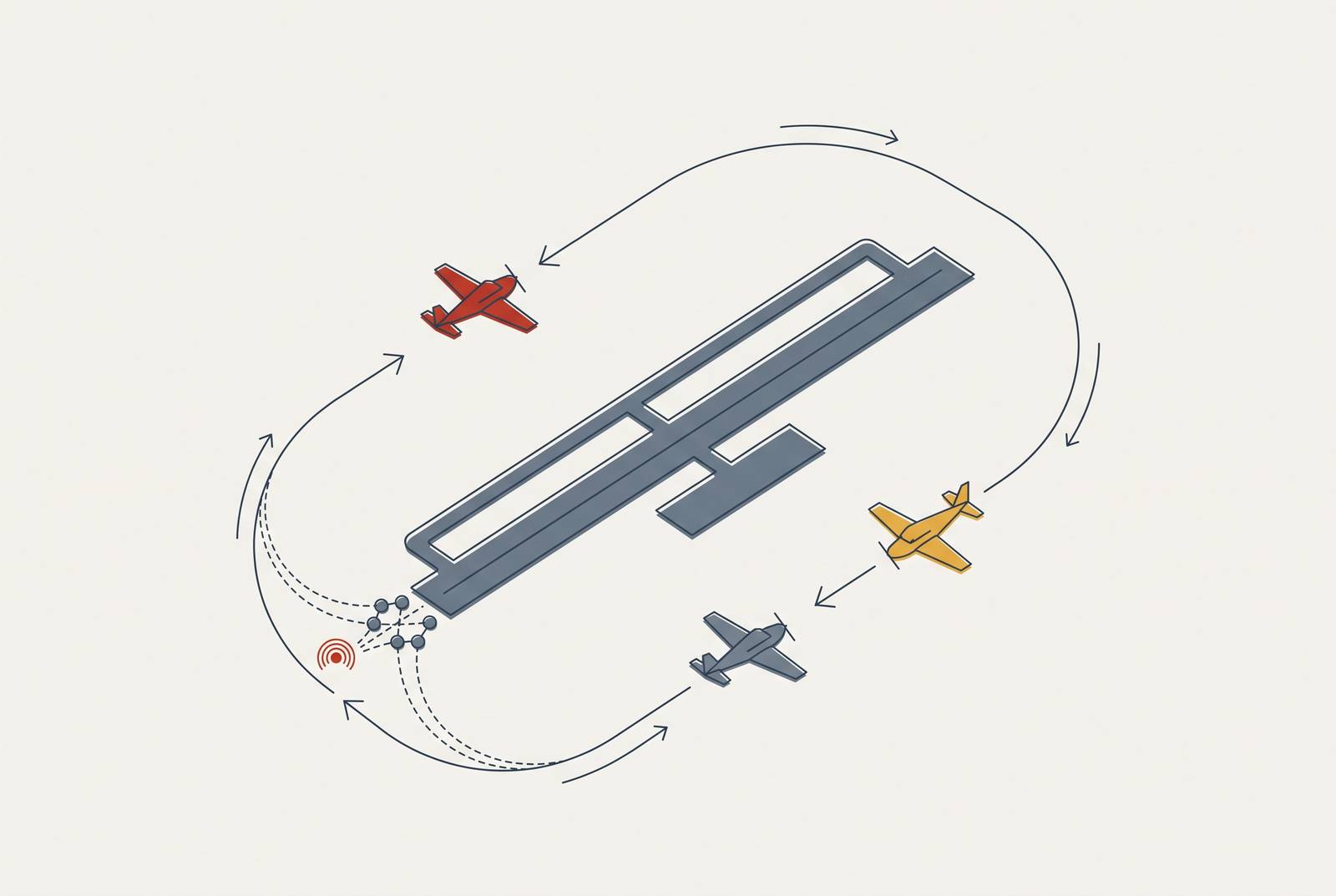
Non-towered airport safety hinges on whether the standard method of counting accidents there tells the truth about risk or buries it. Of 27 midair collisions where the airport type could be confirmed, 14 occurred at towered airports and 13 at non-towered airports, a nearly even split that, normalized per airport facility, appeared to favor non-towered fields by a wide margin. Normalized per airport facility rather than per collision, that near-even split tilts sharply in favor of non-towered airports, since there are vastly more of them absorbing roughly the same number of incidents. That analysis, credited to researcher Aguilar, goes further and argues that non-towered airports show "an excellent safety record" and that pilots, not towers, are the ones actually keeping the system safe.
Taken at face value, that's a reassuring finding, and not a baseless one. But the entire conclusion rests on a single metric: the midair collision count. That choice of metric is contested, and for good reason. Collisions are the rarest, most catastrophic tail-end event in a much larger distribution of near-misses, procedural breakdowns, and close calls that never make it into the NTSB's database at all. Reading only the collision count is like judging a highway's safety by counting fatal head-on crashes while ignoring every near-miss merge and every unreported fender-bender. The rest of this piece is an attempt to read the fuller record.
What Midair Collision Counts Leave Out of the Non-Towered Risk Picture
Near-midair collisions, or NMACs, occurring around non-towered fields go unreported through NASA's Aviation Safety Reporting System far more often than they're captured. The system is voluntary and confidential, and pilots use it inconsistently, so what regulators see later can differ sharply from what actually happened in the pattern. Most of the behaviors that actually generate close calls, non-standard pattern entries, missed radio calls, runway incursions caught just in time, never produce a formal report unless someone actually gets hurt. A near-miss that resolves itself through a last-second go-around leaves no paper trail. A midair collision leaves a permanent one. The NTSB's dataset, by design, only sees the second category.
There's a second distortion layered on top of the first. The NTSB collision count normalizes by number of airport facilities, not by number of operations, and towered airports handle dramatically more traffic volume per field than non-towered ones do. So when a per-airport tally makes non-towered fields look safer, it's comparing a small number of incidents spread across thousands of low-traffic runways to a similar number of incidents concentrated at a few hundred high-traffic ones. The per-operation risk at non-towered airports, the number that would actually tell you how dangerous any single approach or departure is, simply isn't captured by a per-airport figure.
ASRS reports fill in some of what the collision count misses, and the examples are specific enough to be instructive. An instructor pilot reported an NMAC while departing a non-towered field. A general aviation pilot caused an NMAC while turning to avoid other traffic already in the pattern. A Cessna 182 pilot on final approach had to abort and go around when another aircraft rolled onto the runway for departure. None of these incidents appears in an NTSB collision count, which tracks crashes, not near misses. Each one, though, describes the kind of conflict a midair collision represents when it isn't resolved in time.
None of this means non-towered airports are inherently dangerous places to fly. It means the metric used to declare them safe wasn't built to see the incidents that happen there most often.
The specific operational conditions that generate recurring accident patterns at non-towered airports
The accidents that do make it into NTSB records at non-towered fields aren't scattered randomly across flight phases. They cluster around a small number of identifiable, structural failure modes, and traffic pattern management is at the center of nearly all of them. Incorrect pattern entries and exits, flying a straight-in approach to downwind instead of the standard 45-degree entry, are among the most common conflict generators, because they put an aircraft where pilots already established in the pattern don't expect to see one. FAA Advisory Circular AC 90-66C specifically warns pilots against straight-in approaches when other traffic is working the pattern, citing midair collision risk directly, and identifies these non-standard entries as a leading cause of close calls precisely because they generate traffic nobody was watching for.
Radio discipline compounds the problem rather than solving it. Not every aircraft flying into a non-towered field carries a radio, which makes visual scanning just as important as calling positions on CTAF. The trouble is structural: at a towered field, a controller catches the gap when a radio call and a visual scan both fail at once. At a non-towered field, there's no one in that role, so a simultaneous breakdown in both systems goes uncaught until two aircraft are close enough to see each other out the windscreen.
Runway surface conflicts form a distinct pattern of their own. A separate pattern of runway surface conflicts appears in NTSB records at non-towered airports: the May 15, 2008 collision at Aero Valley Airport (then Northwest Regional, FAA LID: 52F) involved a Piper PA-28-161 landing on Runway 35 while a Stinson 108-3 initiated a takeoff roll on the same runway, and both pilots had announced intentions on CTAF. Both pilots had announced their intentions on CTAF beforehand. The radio calls were made, and the collision still happened, a reminder that CTAF is a coordination tool, not a guarantee, and that announcing an intention isn't the same as confirming the runway is clear.
That same airport later produced a cluster on its own terms. Between September 22 and November 3, 2012, four separate accidents were linked to Aero Valley, three of them occurring on the airport grounds, with six fatalities total. A concentration like that at a single field over a few weeks points toward systemic pattern issues rather than four unrelated incidents of bad luck. Both the Aguilar analysis and its critics agree on one underlying mechanism: safe non-towered operation depends on every single pilot in the pattern independently following the same standardized procedures, with no external authority checking that they do. That dependency makes the system brittle. One pilot who skips the 45-degree entry, or misjudges a radio call, or assumes the runway is clear because they announced it, is enough to break the whole arrangement.
A|The GA Safety Trend and Non-Towered Airport Risk
None of the pattern analysis above contradicts the fact that general aviation has gotten measurably safer over time. The long-run improvement in GA fatal accident rates is genuine, and it doesn't erase the recurring non-towered pattern risks so much as recast them as a persistent residual risk sitting inside a system that is, overall, getting better. General aviation accounts for more than 90% of all U.S.-registered aircraft, so the safety improvements embedded in this trend are overwhelmingly driven by non-towered operations. The baseline, in other words, is already better than most casual observers assume.
The BTS dataset behind this trend, NTSB Aviation Accident Statistics, sourced through July 2026, provides a long-run series covering fatalities, accidents, and flight hours back to 1975. But it's an aggregate series. It doesn't break results down by airport type or by phase of flight, which is precisely where the recurring patterns described above live.
The gap between the aggregate accident-rate trend and the recurring pattern-level failures deserves closer attention. An overall decline in GA accident rates doesn't mean the straight-in-approach conflicts, CTAF radio gaps, or runway conflicts at non-towered airports have been solved. It means those specific failure modes have been partially offset by improvements elsewhere, better avionics, better weather avoidance tools, better training standards. The patterns identified in NTSB records at non-towered fields keep recurring beneath a trend line that, read on its own, would suggest the opposite.
Why Non-Towered Airports Cannot Self-Fund a Solution to the Pattern Problem
Small non-towered airports mostly survive on ground leases, hangar rents, and fuel flowage fees, a narrow revenue base that covers routine maintenance and rarely leaves room for anything larger. That's the financial reality behind why so many of these fields still rely on CTAF decades after the failure modes tied to it became well documented.
Federal money exists, but it's neither unlimited nor growing at the pace the need requires: the Bipartisan Infrastructure Law added supplemental airport grants through FY2026, and with that funding expiring, and ACI-NA estimating in a 2025 study a five-year infrastructure need far exceeding NPIAS estimates, the funding gap facing small airports is widening rather than closing.
Even where capital were available, a traditional staffed control tower isn't a one-time purchase. Traditional manned control towers require not just capital construction but ongoing staffing costs and FAA operational commitments that put them structurally out of reach for airports with low operation counts. The airports carrying the recurring pattern risk described earlier are, almost by definition, the same ones without the revenue or the grant access to build their way out of it through conventional means.
A|Digital Remote Tower Technology at the Pattern Level
Digital remote tower systems are built to address exactly the failure modes driving non-towered accident patterns: pattern entry conflicts, radio gaps, runway conflicts that CTAF alone can't resolve. In the United States, though, the obstacle to deploying them hasn't been the technology. It's been the certification pathway.
The technology itself is mature. A digital remote tower combines live video, high-definition cameras, radar, and other sensors to give a human controller a continuous 360-degree view of an airfield and its surrounding airspace from a workstation that can sit anywhere, and infrared imaging extends that coverage into low-visibility conditions that a human eye at ground level simply can't handle. Because the cameras and sensors carry most of the observational load, a single controller can, in principle, manage traffic at more than one airport at once. The Johnston Regional Airport case in North Carolina illustrates the model directly: a single digital remote tower there could theoretically manage air traffic control for both the Smithfield and Sanford airports. A sequencing authority, even a remote one, breaks the CTAF-dependent coordination model at the exact point where it fails, when a single pilot deviates from expected procedure.
Deployment abroad confirms the technology works at scale. London City Airport became the first major international airport fully run by a remote digital tower in 2021, controlled from Swanwick using Saab's r-TWR system. In April 2025, Italy's ANSP ENAV announced it would convert control centers at Brindisi and Padua to manage 16 low-traffic airports remotely, with plans to grow that to 26 airports by 2033. Belgium's Skeyes is building a new control center in Namur intended to guide both Charleroi and Liège remotely by the end of 2026.
The U.S. story runs differently, and Leesburg Executive Airport in Virginia is the case that shows why. Leesburg was the first municipal airport in the country to implement a remote tower program through a public-private partnership with the FAA beginning in 2015, while the formal FAA Remote Tower Pilot Program was established by Congress in 2018. The Saab-designed system operated for a limited number of hours daily and logged tens of thousands of takeoffs and landings a year. In September 2021, the FAA ran a formal operational evaluation and concluded the system was "operationally viable".
That finding didn't save the program. New FAA certification requirements led Saab to withdraw, and the agency concluded that continued use of the unapproved system posed an unacceptable level of risk to all users, given how uncertain the timeline for any future approved Saab system had become. A temporary ATC trailer went in as a stopgap. As of July 2026, a permanent tower remains in the design phase, with plans under review and supported by design grants plus additional announced construction funding, for a facility expected to handle a high volume of annual operations in calendar year 2025. An operationally viable system was shut down anyway, because viability was never the actual test.
Certification progress elsewhere in the country has been slow by the same measure. As of May 2025, the FAA was testing a system developed by RTX and Frequentis at Atlantic City International but had not published System Design Approval for any project. The 2024 FAA Reauthorization Act now requires the agency to define formal standards for remote and digital towers and mandates that the SDA process run at no fewer than three airports. The FAA's own effort on this technology dates back to 2007, with initial testing at the William J.. Nearly two decades later, no remote tower system has been certified for deployment.
Industry pressure is building around that gap. The Digital Tower Technology Coalition (DTTC), formed in 2025–2026 and a member of the Modern Skies Coalition created in 2025, is advocating for federal funding, FAA approval, defined standards, multi-airport management strategies, and enhanced visual detection tools aligned to international best practices. Some U.S. jurisdictions are preparing SDA applications now, positioning themselves to move the moment the FAA publishes approval, in order to make use of the 2024 Reauthorization Act's three-airport mandate. The global market for digital airport tower services reached a substantial scale in 2025 and is projected to keep growing sharply through 2034, demand that international operators are already capturing while U.S. regulatory delay keeps domestic operators on the sideline. The tools exist. The barrier keeping them out of most U.S. Non-towered airspace lacks the technology for regulatory reasons.
What Understanding Non-Towered Accident Patterns Requires
Naming these patterns only matters if it changes what each party treats as fixable. For pilots, the record is concentrated in specific, nameable behaviors: straight-in approaches conflicting with an established pattern, non-standard entries, gaps in radio coordination, each with a documented procedural remedy already written into FAA AC 90-66C. Knowing where accidents cluster by phase of flight tells a pilot more about actual risk on a given approach than any aggregate GA safety statistic ever could.
For airport operators, Johnston Regional and Leesburg together demonstrate that digital remote tower systems can serve airports at the operational scale most non-towered GA fields actually have, and that the economics of managing several airports remotely from one control point look nothing like the economics of a traditional staffed tower. Operators running airports near the eligibility threshold for this technology have a concrete reason to track the FAA's System Design Approval process closely rather than wait for a finished product to be announced.
The 2024 FAA Reauthorization Act's mandate for defined standards at no fewer than three airports is the most actionable lever currently available for opening the System Design Approval pathway. The patterns in the NTSB data are already known. What happens next depends on whether the certification pathway moves fast enough to let the fix reach the airports that have been carrying this risk the longest.
Sources
- Are Non-Towered Airports Safe? The Data Says Yes
- Northwest Regional Airport (Texas)
- U.S. General Aviation Safety Data | Bureau of Transportation Statistics
- General Aviation Accident Statistics: A Pilot's Guide
- Statistical Reviews - Aviation
- ADVANCING REMOTE TOWER DEPLOYMENT IN THE UNITED STATES
- Johnston Regional Airport hopes to pioneer FAA's next-gen digital air traffic control :: WRAL.com
- FAA seeks remote air traffic control tower tech for U.S. airports | Military Aerospace