Latency and Audio Latency Standards for Digital ATC Systems
Remote towers require sub-second latency to keep controllers' views current with airfield reality.
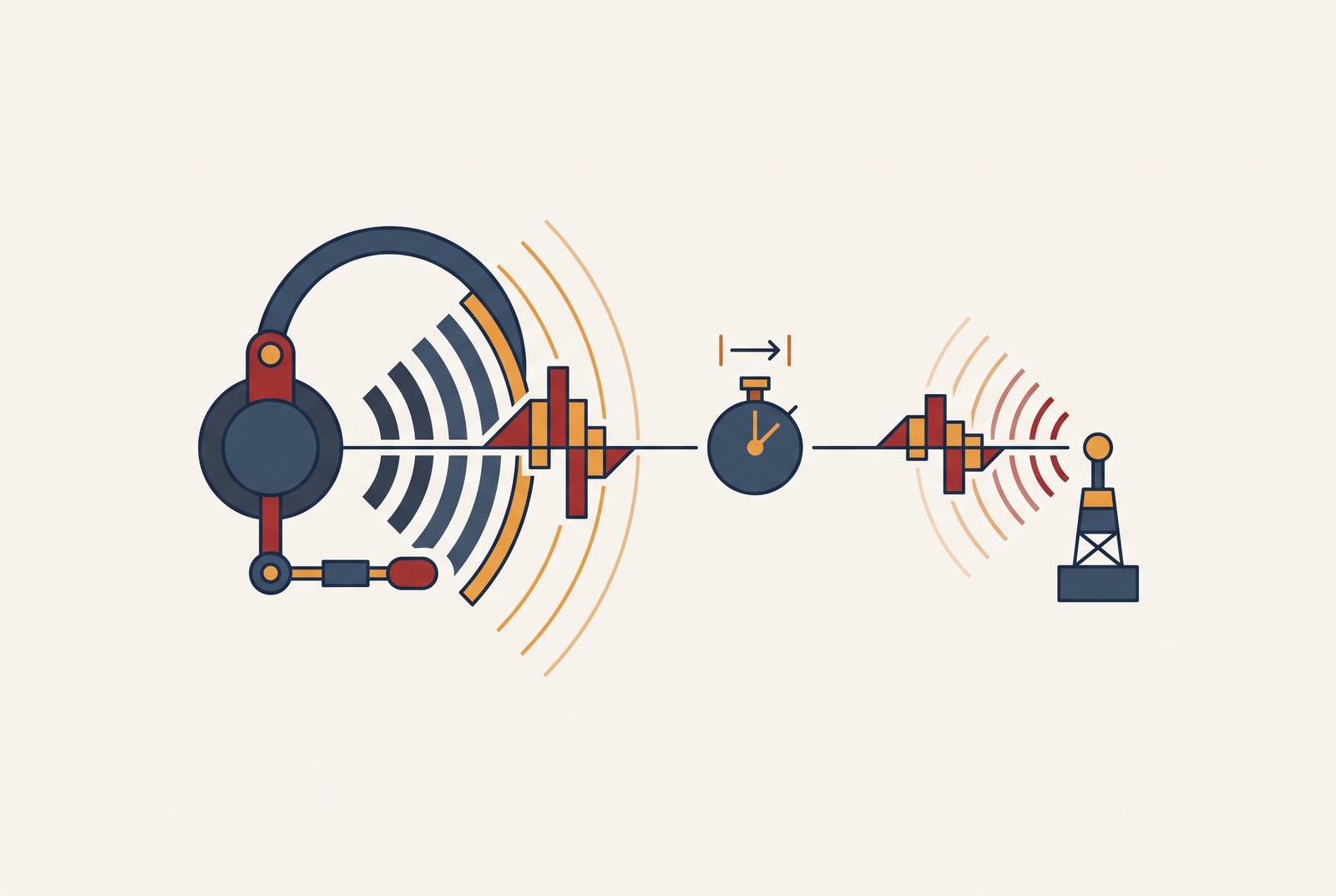
Digital ATC infrastructure can give non-towered airports a remote controller’s view through cameras, sensors, and communications, but using it to manage traffic depends on data arriving in time and on operational approval. For airports considering this infrastructure for drone integration, latency compliance is a safety prerequisite. The core limits are one second for video, one second for ambient airfield audio, and 250 milliseconds for control response.
What digital ATC systems actually do and why latency is their central engineering constraint
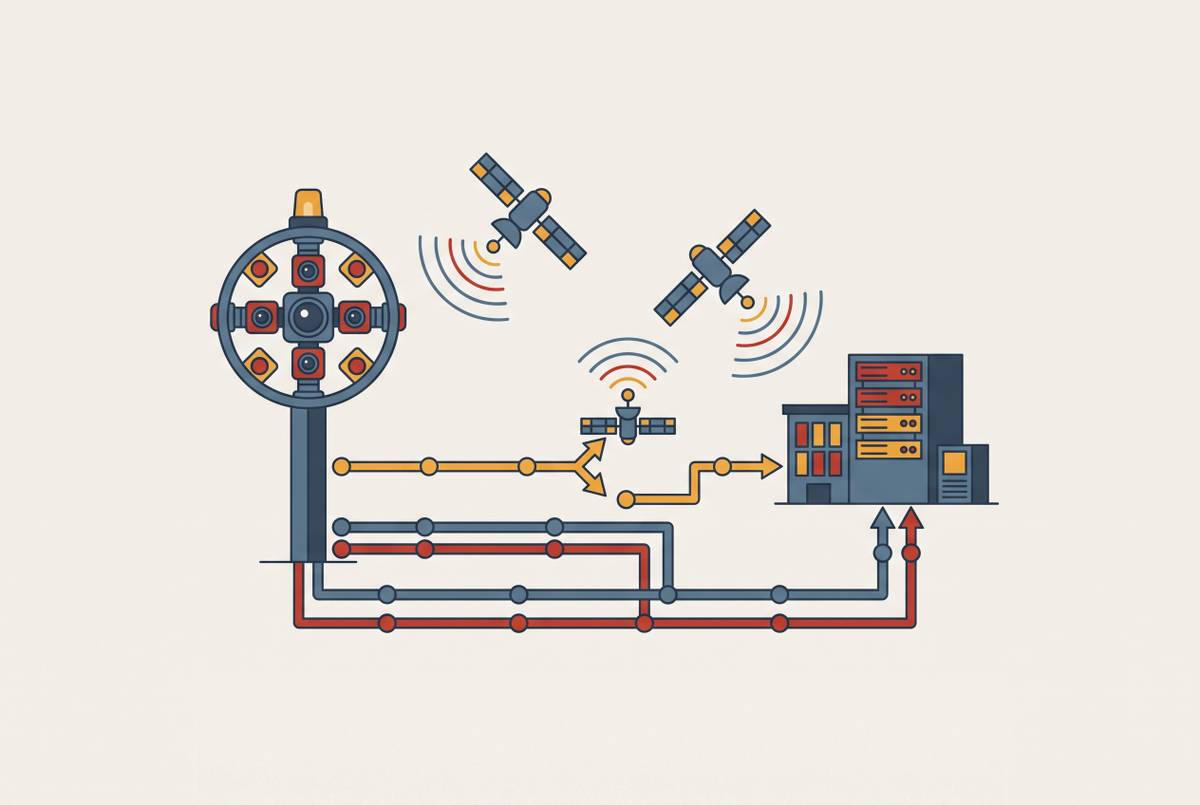
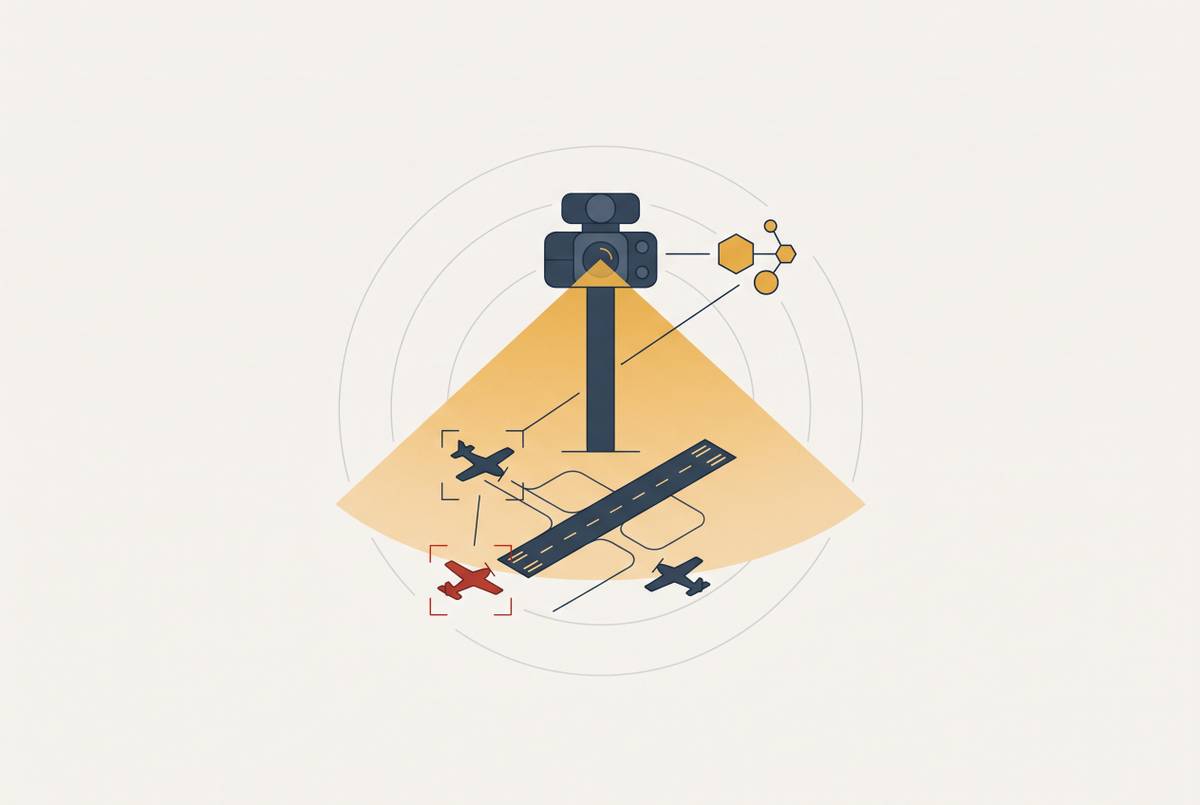
Digital ATC, also called Digital Aerodrome Traffic Service, or DATS, replaces a controller’s direct out-the-window view with information delivered to a remote location. Camera feeds show the airfield, while sensors and communication systems add other information that the controller needs to manage traffic. The fidelity of that representation determines what the controller can discern, and that information still represents the current situation only if it arrives in time.
Latency creates a gap between an event at the airfield and the controller’s perception of it. During that gap, the displayed state and the actual state diverge, even if the image itself remains clear. General Aviation builds affordable digital control towers for non-towered general aviation airfields, where this dependence on remote sensor data makes timing a basic engineering commitment. The timing requirements differ for three channels: video, ambient airfield audio, and the system’s response to controller inputs.
The specific latency thresholds that certifiable digital tower systems must meet
EUROCAE ED-240A Change 1, VC REQ 01, sets a maximum video latency of one second between an event at the airfield and its appearance on the controller’s display. Tests by SESAR Joint Undertaking support the same maximum. The FAA draft Remote Tower Systems requirements, Version 5.0, June 2024, also specify a one-second capture-to-display ceiling, explicitly including the interval between consecutive frames. That scope matters because the limit covers the information’s complete journey to the controller. An assessment that leaves out the interval between frames does not address the complete requirement.
EUROCAE ED-240A ties the one-second video ceiling to the standards already in place for ground surveillance sensors. The threshold therefore has an operational baseline rather than an arbitrary preference for fast video. Its purpose is to constrain how far the controller’s displayed picture can fall behind events on the airfield. Even a clear, accurate image of an earlier position is too old to serve as the basis for an instruction. The video requirement addresses freshness as well as the availability of a remote view.
The FAA draft specification sets a separate maximum of one second for reproducing ambient airfield sounds at the Remote Tower Module. This requirement concerns sounds from the field and should not be treated as a blanket specification for every form of voice communication. The same draft sets a tighter control-response threshold of 250 milliseconds for the execution of an operator input, such as muting airfield audio. That shorter allowance reflects the need for a deliberate action to have its expected result right away, allowing less delay than receiving information. Together, the three limits define a latency performance floor, with each channel required to meet its own limit independently.
Where the international standard for these thresholds comes from and how it has evolved
EUROCAE approved ED-240B, an updated edition of “Minimum Aviation System Performance Standard for Remote Tower Optical Systems”, on 31 July 2023. It supersedes the prior revision and adds provisions for non-optical surveillance sensor integration and a recording and playback function. Those additions broaden the standard beyond the optical view alone. They also make edition identification important when discussing compliance, since a requirement cited from ED-240A Change 1 and the scope of ED-240B are not interchangeable references. A precise account names both the requirement and the edition from which it comes.
EUROCAE WG-100 is developing a further revision, ED-240C, which is currently in draft. SESAR Joint Undertaking validation work gives the recommended one-second maximum video latency empirical grounding beyond committee agreement. Standard-setting and validation serve related but distinct purposes, with one defining the requirement and the other testing its operational basis. These standards and tests give the threshold more weight than a supplier’s claim that a feed looks fast enough.
ICAO AAO/SG8 WP/3.2M, July 2025, records that the first remote tower providing aerodrome ATS was introduced in Sweden in April 2015. ICAO has recognized the remote tower concept globally, but it has not yet produced harmonized Standards and Recommended Practices governing how ATS shall be provided using remote sensing. Recognition of a concept is therefore not the same as a complete governing framework for its use. The technical standards can be established and internationally recognized while the rules above them remain incomplete. That distinction matters when a system moves from engineering checks toward approval for use.
Why meeting the latency standard is necessary but not sufficient — the U.S. regulatory approval gap
FAA PGL 26-06, September 28, 2026, identifies System Design Approval, or SDA, as the formal evaluation of technical, safety, and operational requirements before operational use. A system can meet the published latency limits before it has gone through that process. FAA PGL 26-06 states that only systems that successfully complete SDA will be added to the FAA Approved Systems for Non-Federal Use List.
The FAA Reauthorization Act of 2024, Section 621, directed the FAA to publish milestones for achieving system design and operational approval. It also extended the remote tower pilot program through FY2028. These provisions addressed the need for a more defined route after an ad hoc approval approach had deterred airport sponsors and vendors. Published performance criteria still leave a gap when there is no clear process for checking systems against them. That gap helps explain why a system can be technically ready before it can be put to use.
The FAA draft minimum performance requirements, Version 5.0, June 2024, are scoped specifically for Class D airspace in non-federal applications. They do not, by themselves, settle the approval conditions for every other operational context. For developers serving non-towered airports, including General Aviation, this creates a distinction between engineering a compliant system and securing authorization for its intended use. The distinction also limits what can be inferred about unmanned aircraft operations from a latency specification alone. Compliance is necessary, but it is not a general authorization to manage drone traffic or to operate outside the specification’s defined scope.
What happens when latency or audio integrity fails — the failure modes latency standards are designed to prevent
A delayed video feed can present an aircraft position that no longer reflects where the aircraft is when the controller acts. If the display lags by more than one second, an instruction may be based on a stale picture, undermining timely conflict resolution. The failure is therefore not merely that the screen feels slow. It is that the controller and the aircraft are effectively working from different moments in the same developing situation. The video ceiling constrains that divergence before it compromises the controller’s ability to intervene.
Audio creates a related but distinct problem because the useful information may depend on hearing a critical instruction in full and at the right time. The towered-airport example illustrates the danger of a gap or partial transmission in a critical instruction. It does not show that towered airports are dangerous by nature, and an incomplete transmission does not prove that a digital tower’s ambient-audio latency limit was measured and exceeded. A sub-second gap or missing part of an instruction can be fatal, even though integrity and latency are separate properties.
Consumer-grade audio streaming, which can run tens of seconds behind real time, provides a useful contrast with operational airfield audio. A stream may reproduce sound intelligibly and still deliver it far too late for control purposes. A delayed system response can also cause trouble when a controller’s deliberate input fails to take effect at the expected time. Under high workload, that delay degrades the ability to manage the system dynamically, particularly when rapid sequential inputs are needed. These mechanisms explain why acceptable media playback and acceptable digital ATC performance are different standards.
At non-towered airports, the starting condition is different because there is no ATC service to provide that shared control picture. Pilots must self-separate through radio calls and visual lookout. The NASA Aviation Safety Reporting System has documented cases in which non-communicating aircraft took off from opposite-end runways without warning, leaving pilots no recourse. The reports show why more airports need traffic services, while the latency requirements set out how a remote system must work to avoid creating another information gap.
Why latency standards matter most where there is no ATC — how can small airports gain situational awareness?
The United States has about 527 towered airports and tens of thousands of non-towered landing facilities. For much of that coverage gap, the relevant comparison is a compliant digital service against no ATC coverage at all. Cameras, sensors, communications, and a remote controller can give an airport a picture of its traffic through technology where it had none before. For a small airport asking how to manage nearby drone activity without a control tower, that architecture explains the potential source of situational awareness, while its latency limits define only part of the conditions for safe use.
Digital towers are recognized as the most cost-effective solution where cost or location makes a traditional brick-and-mortar tower prohibitive. FAA PGL 26-06 describes Airport Improvement Program eligibility established in the 2018 Reauthorization Act and reinforced by the 2024 Act, with eligibility limited to sponsors participating in the FAA Contract Tower Program. Financing therefore has its own conditions rather than following automatically from the choice of digital technology. IFATCA WP-93, 2025, covers multiple-aerodrome control from a single Remote Tower Centre, which can cut the cost for each airport further. That economic model still requires every connected airport’s system to meet the latency standards independently, because a non-compliant link can degrade service across the network.
The market served by General Aviation is this group of small airports for which affordable ATC capability could close a longstanding coverage gap. Its engineering commitments must therefore meet the same safety floor as those of a certifiable system, even at a small airport. Airport operators weighing whether to adopt a system should understand its latency requirements and check that it meets them. A system that cannot demonstrate compliance will not reach the FAA Approved Systems list or qualify for AIP funding through this approval route. The standards are not a bureaucratic hurdle separate from deployment, but a definition of the performance a safe, certifiable system must deliver before underserved airports can gain meaningful ATC coverage.