Runway Incursion Rates at Non-Towered Airports
Severe incursions rise at uncontrolled airports lacking oversight.
Total U.S. runway incursions tell a story of stability.
The severity shift in runway incursions
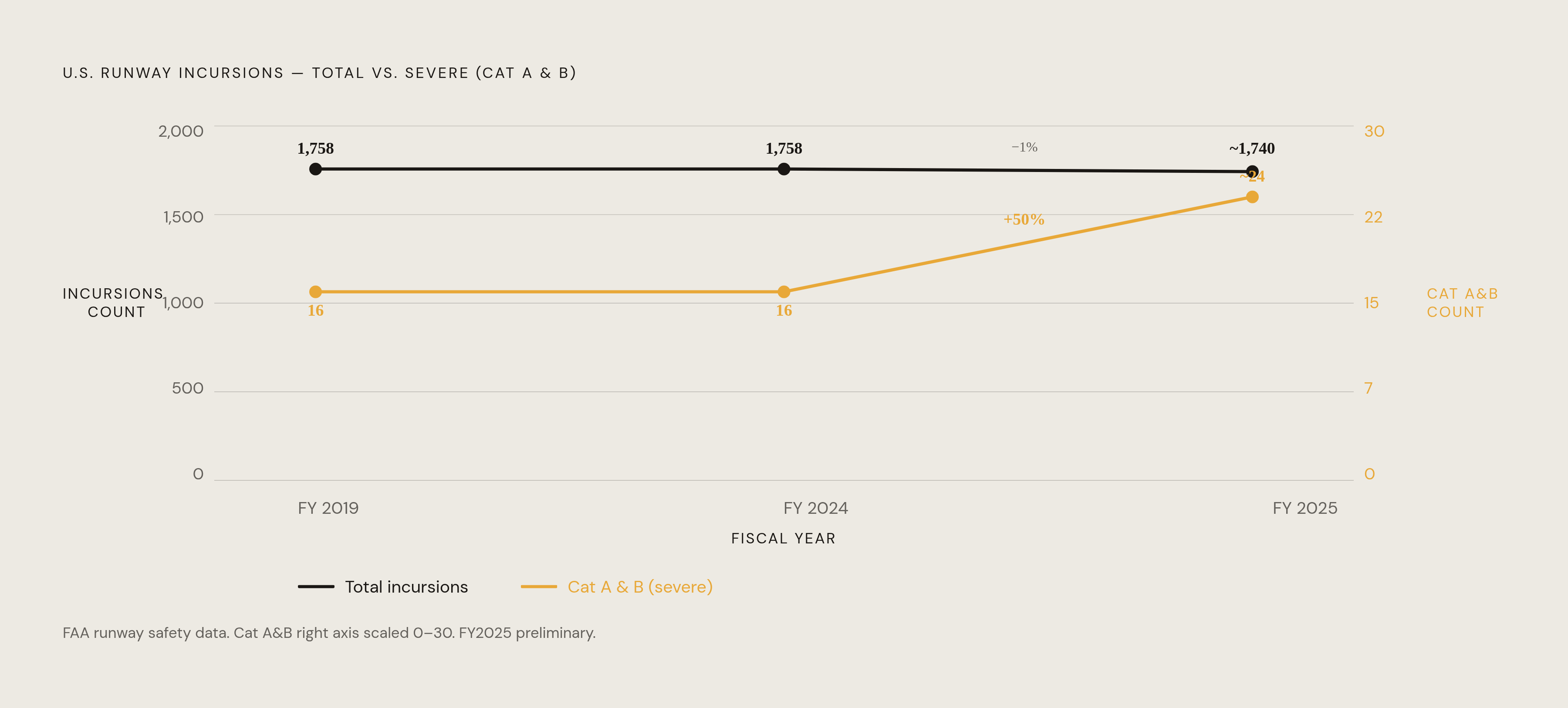
Fiscal year 2024 closed with 1,758 runway incursions nationwide, a number nearly identical to fiscal year 2019. Read alone, that figure suggests a system holding steady after the pandemic disruption, not one sliding toward crisis. But the FAA Safety Team reported that severe incursions, the kind classified as Category A and B, rose by nearly half in fiscal year 2025, even as total events actually fell about one percent. Category A events mean a collision was narrowly avoided. Category B events mean separation had broken down badly enough that a pilot or controller needed a time-critical, evasive response to prevent one. Those are near-misses of the kind that end careers and sometimes lives, not clerical entries in a safety log, and their rate is climbing while the overall count flattens. That divergence is the real finding here: whatever is pushing the most dangerous encounters higher is not being touched by whatever is keeping the total count flat. The DOT Inspector General's March 2025 audit found that the FAA lacks an integrated approach for analyzing runway incursion data and identifying risk. That suggests the agency itself may not yet have a clear picture of what is driving the trend.
What runway incursion categories measure
The FAA's severity scale exists to let analysts compare wildly different situations, a taxiway misjudgment at a quiet regional field against a near-collision on an active commercial runway, on a common scale. That scale runs from Category D, where there is no immediate safety consequence, through Category A, where a collision is barely avoided, up to the terminal classification of Accident, where a collision occurs. The system was built with an assumption baked in: that a controller sits somewhere in the loop, watching, correcting, and intervening before a deviation becomes a disaster. That assumption shapes the whole classification structure. The FAA also sorts incursions into three types: pilot deviation, vehicle or pedestrian deviation, and operational incident. These are not spread evenly across the airport system, because an operational incident, by definition, requires an air traffic controller to be present and involved. Pilot deviations already make up close to two-thirds of all U.S. runway incursions, a figure the DOT OIG puts at nearly 62 percent in its analysis of FAA data. At a non-towered airport, that category is no longer one of three options; it becomes the default outcome of nearly everything that goes wrong, because the operational-incident category cannot exist where no controller is working the field. One of the taxonomy's three legs disappears entirely at these airports, and the two that remain, pilot and vehicle deviations, happen with no external authority present to catch them, correct them, or even record them as they unfold. The categories still measure severity accurately. They were simply built around a world where someone is watching, and that is precisely the world non-towered airports do not have.
Where self-separation at non-towered airports breaks down
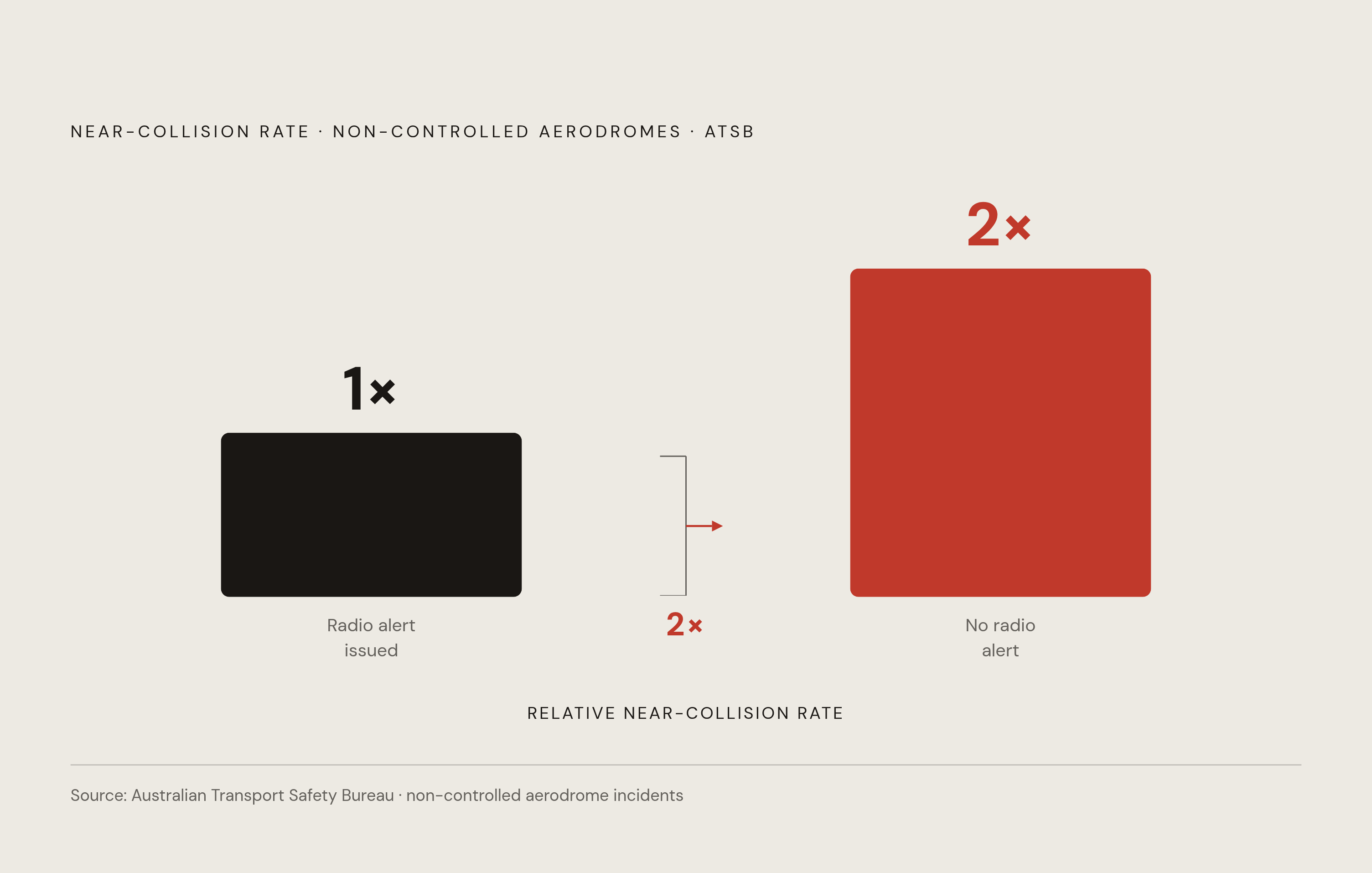
At a non-towered airport, runway separation depends entirely on voluntary action: pilots follow established procedures, make radio calls on a shared common traffic advisory frequency, and scan visually for other traffic, and none of these steps is mandatory, none is enforced, and none is verified by anyone outside the cockpit. Safety researchers have found that insufficient communication between pilots operating in the same area is the single most common cause of safety incidents near non-controlled aerodromes. Across all U.S. airports, three factors drive most runway incursions: failure to comply with ATC instructions, poor airport familiarity, and departure from standard operating procedures. The first of those three simply cannot occur at a non-towered field, since there are no ATC instructions to fail to comply with. Data from a national transport safety body makes the communication dependency concrete: three-quarters of near-collision reports filed by pilots involve operations within ten nautical miles of a non-controlled aerodrome, and near-collisions occur twice as often when a pilot had no prior radio warning of other traffic in the area. Non-towered fields also draw a disproportionate share of transient pilots unfamiliar with local patterns and terrain, and the airport-familiarity risk factor hits hardest in exactly the environment where no controller exists to compensate for it. None of this is a story about careless flying. It is a story about a system that asks pilots to do, unaided and unverified, what a controller does with radar, radio discipline, and legal authority at a towered field.
Raw Collision Counts and the Actual Risk at Non-Towered Airports
A decade of midair collision data appears, at first glance, to tell a reassuring story about non-towered airports: towered facilities recorded far more collisions per hundred airports than non-towered ones did. On raw per-facility numbers, the uncontrolled fields look like the safer bet. That comparison breaks down as soon as traffic volume enters the picture. Towered airports handle a far greater number of operations per facility than non-towered fields do, so a simple collision count by airport category reflects how many airports sit in each bucket, not how many aircraft movements actually occurred there. Without normalizing for movements, the comparison cannot support any real conclusion about relative risk. The fatal-accident record gives a far cleaner signal than the raw collision tally. Recent years produced only three fatal runway incursion accidents, resulting in three fatalities, and every one of them occurred at a non-Part 139 airport without a control tower. A small number of events, concentrated entirely at uncontrolled facilities, is exactly the signature of a low-frequency, high-consequence risk, the kind that aggregate statistics are built to hide rather than reveal. Canada's data points the same direction. The Transportation Safety Board's 2025 Watchlist found the incursion rate per movement has climbed steadily even as air traffic recovered to pre-pandemic levels, and that incursions cluster at a small number of airports, many of them flight-training facilities, which points toward environment-specific risk rather than a risk spread evenly across the system.
FAA's existing runway safety programs and their limits
The FAA's primary tools for reducing runway incursions were built to solve a specific, different problem: complex airfield geometry at busy, towered airports, and they have largely passed over the non-towered fields where severity is now concentrated. The FAA Runway Incursion Mitigation (RIM) Program had mitigated 100 complex airfield locations by the end of fiscal year 2024, with an average recurrence reduction rate of roughly four-fifths. That is a genuine achievement, but it was built for towered airports with nonstandard taxiway layouts, not for the uncontrolled fields carrying the severity risk described above. Miami Executive Airport shows the program working as intended: a major project shortened a runway and relocated taxiways, and no incursions have been reported there since the work finished in May 2024. Miami Executive is a towered airport that does not handle scheduled commercial passenger service. Even this success story sits outside the category of field most exposed to the severity trend. More than $200 million in FAA grants went to airports for incursion mitigation following the 2023 incidents, and that money went predominantly to commercial airports. The DOT OIG's March 2025 audit found that runway incursion data gets used mainly for airport-specific analysis, and that gaps in available causal data make it hard to do broader, system-wide analysis. Risk accumulating at the non-towered tier is not being systematically tracked. The FAA Contract Tower program extends staffed tower service to airports across many states, delivering a large share of tower operations at a fraction of the cost of a fully federal tower, yet it still covers only a small slice of the many thousands of non-towered landing facilities across the country. None of this reflects a failure of execution. It reflects a set of programs designed around a different airport, scaled to a problem they were never built to reach.
What the Canadian and international data add
Trends from Canada and Australia confirm independently that dangerous encounters are becoming more frequent, and that communication breakdowns near non-controlled aerodromes sit at the center of the problem. Canada's TSB 2025 Watchlist recorded 639 runway incursions in 2024, the highest annual total in the fifteen years for which data exists, with the rate per movement climbing steadily over that span despite new procedures and new technology meant to curb it. The TSB has completed seventeen detailed or limited-scope investigations since placing runway incursions on its Watchlist back in 2010, and of the four recommendations issued after its 2019 investigation into Toronto Pearson, only one has since been assessed as fully satisfactory. Australian ATSB data adds a direct empirical link to the causal story: near-collisions near non-controlled aerodromes occur twice as often when pilots received no prior radio alert about nearby traffic, compared with situations where an alert went out. Canada's concentration finding, that a small number of airports, many of them flight-training environments, account for a majority of all incursions, mirrors the U.S. pattern. The Australian alert finding does more than confirm the diagnosis. It also points directly at what a fix would need to supply.
What remote and digital tower technology can provide
Digital Aerodrome Traffic Service closes the gap identified above by restoring something non-towered airports currently lack entirely: an external authority watching the field and relaying traffic information, rather than leaving the job to pilot behavior alone. The technology, also called Remote Tower Operation, replaces a controller looking out a tower window with panoramic cameras placed at strategic points around the aerodrome, feeding video to screens in a remote control room equipped with pan-tilt-zoom and infrared capability for low-visibility conditions. One control room, certified and staffed, can oversee more than one airport at once, which turns a staffing cost that no single small airport could justify into a shared infrastructure expense split across a network of fields. Camera and sensor coverage can also eliminate blind spots that persist even in a conventional tower, which makes the case for the technology about more than saving money. The Australian radio-alert finding maps onto this directly: a digital tower gives pilots continuous traffic information over the radio, replacing the silence that the ATSB data shows doubles near-collision rates at non-controlled aerodromes. The core shift, as these systems have matured, is one of legal authority. Controllers working from a certified, networked control room retain real authority over the airspace, and they can maintain coverage through weather, night hours, or equipment outages, conditions under which a non-towered airport today would otherwise sit entirely unmonitored.
How remote tower operations scaled into standard infrastructure abroad
The Swedish air navigation service provider LFV opened the first remote tower center in Sundsvall in 2015, establishing the original proof that the concept could work in live operations. Leesburg Executive Airport in Virginia became the first municipal airport to run a remote tower, operating successfully from 2018 to 2023; Airport Director Scott Coffman confirmed the timeline. Norway's experience shows what the technology looks like once it moves past the pilot stage. Avinor's Remote Tower Centre in Bodø, the largest facility of its kind, managed eleven regional airports and was growing to fifteen by March 2025 in its first expansion phase, with a total of twenty-one towers planned to run from the Bodø center by 2027. Budapest Ferenc Liszt International Airport became the first airport in a European capital city fully managed by controllers stationed outside the airport grounds, proving the approach scales beyond small regional fields into major international hubs. Bodø's growth from a single experimental site to a planned twenty-one-airport network shows that multi-airport remote tower operation is no longer a pilot project. It has become standard infrastructure in some of the world's most advanced aviation systems.
The status of the U.S. regulatory process
Despite an established proof-of-concept and a clear international precedent, the FAA has not yet certified remote tower technology for deployment in the National Airspace System, leaving interested airports in a holding pattern. The caution has a defensible origin: certifying a system that holds legal authority over an airport's airspace, without a human physically present at the field, raises questions the FAA has to resolve carefully before granting approval nationwide. But the gap between what has been proven operationally and what has been certified domestically is now the main obstacle standing between non-towered airports and a tool built specifically to address the rising severity of incursions documented throughout this piece. The data on severity, concentration, and communication failure all point in the same direction.
Sources
- Risk of collision from runway incursions - Transportation Safety Board of Canada
- RISK OF COLLISION FROM RUNWAY INCURSIONS
- Severe Runway Incursions Jump 44% in 2025
- FAA Runway Incursions Final Report_3.12.25.pdf - DOT OIG
- Runway Incursion Mitigation Fiscal Year 2024 Annual Summary Report
- Remote ATC towers and the changing airport landscape