Multi-Airport Remote Tower Hub Architecture and Scalability
Centralized control hubs let small airports manage drones without building expensive towers.

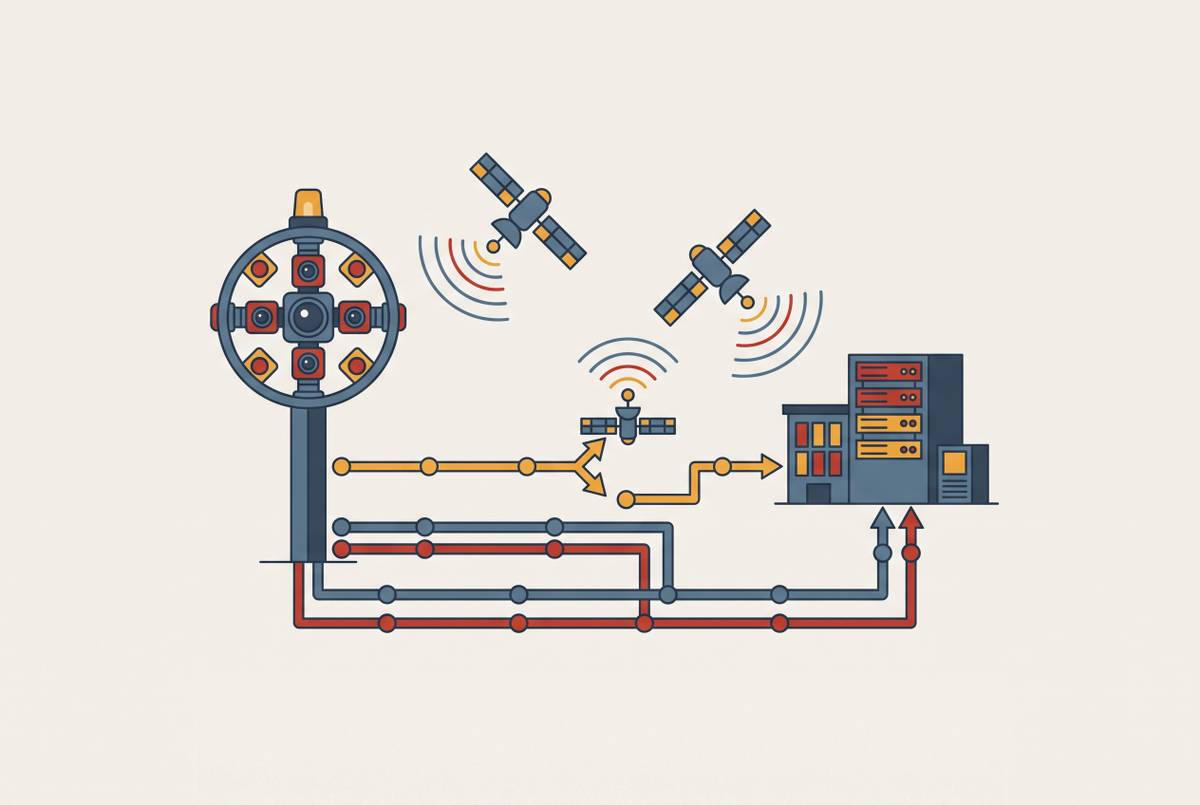
Multi-airport remote tower hubs provide digital ATC infrastructure that can support UAS and drone integration at non-towered airports without building a conventional tower at each location. Airport sensors feed centralized controller positions, while shared facilities and staffing make coverage more affordable across many airports. The architectural breakthrough is the hub because it spreads the cost of control infrastructure across an airport portfolio.
Why most U.S. airports still operate without any air traffic control
Roughly nine in ten airports in the National Airspace System have no control tower. The vast majority have never had one. That gap reflects the economics of conventional infrastructure, which requires a permanent concrete structure, full-time local staff, and continuing maintenance. Those commitments make financial sense where traffic volume supports them, but they are difficult to justify at a quiet airport.
The FAA's Federal Contract Tower program serves only a fraction of airports, and participating airports are not insulated from staffing shortages. Some have too few staff to keep controllers on duty during scheduled hours. The operating model also has to sustain the people who provide the service, including at locations where local traffic offers relatively little productive work for a dedicated staff.
This leaves a structural gap between the airports that could use controlled operations and those that can support conventional tower costs. For smaller airports facing nearby unmanned aircraft system operations, that gap also frames the question of how to provide better situational awareness. The requirement is broader than a better view. A different model must get airport information to controllers and keep the costs of the facility, staffing, and maintenance low enough for airports with little traffic.
How does a remote tower give a non-towered airport situational awareness?
A remote tower replaces the physical cab and its out-the-window view with airport sensors and a digital display system. Cameras, microphones, and other sensors mounted on a mast or structure capture the airfield, including a 360-degree real-time visual view. Infrared adds visibility at night and in low-visibility conditions. The feeds reach a controller working position that can be located away from the airport.
The system has separate layers for sensing, transmission, and presentation. Each has a different job to perform. The airport equipment captures the scene and soundscape, the connection transports that information, and the displays present it to the controller. ALG Aviation specifies that worst-case video display latency must remain under one second to preserve near-real-time presentation. Transmission performance is therefore a control-system constraint.
Controllers issue the same instructions and use the same phraseology as they would from a conventional cab, but their view can include digital zoom, AI-assisted object tracking, infrared imagery, geo-fencing, and augmented overlays. Reason Foundation's 2025 report identifies increased situational awareness as a way to reduce controller workload and stress, with implications for retention. For an airport evaluating nearby UAS activity, these are the relevant digital awareness capabilities, rather than evidence of an automatic drone-management service. The sensor and display system supports human control. It does not replace the procedures or approvals needed for operations.
The architectural step from a single remote tower to a multi-airport hub
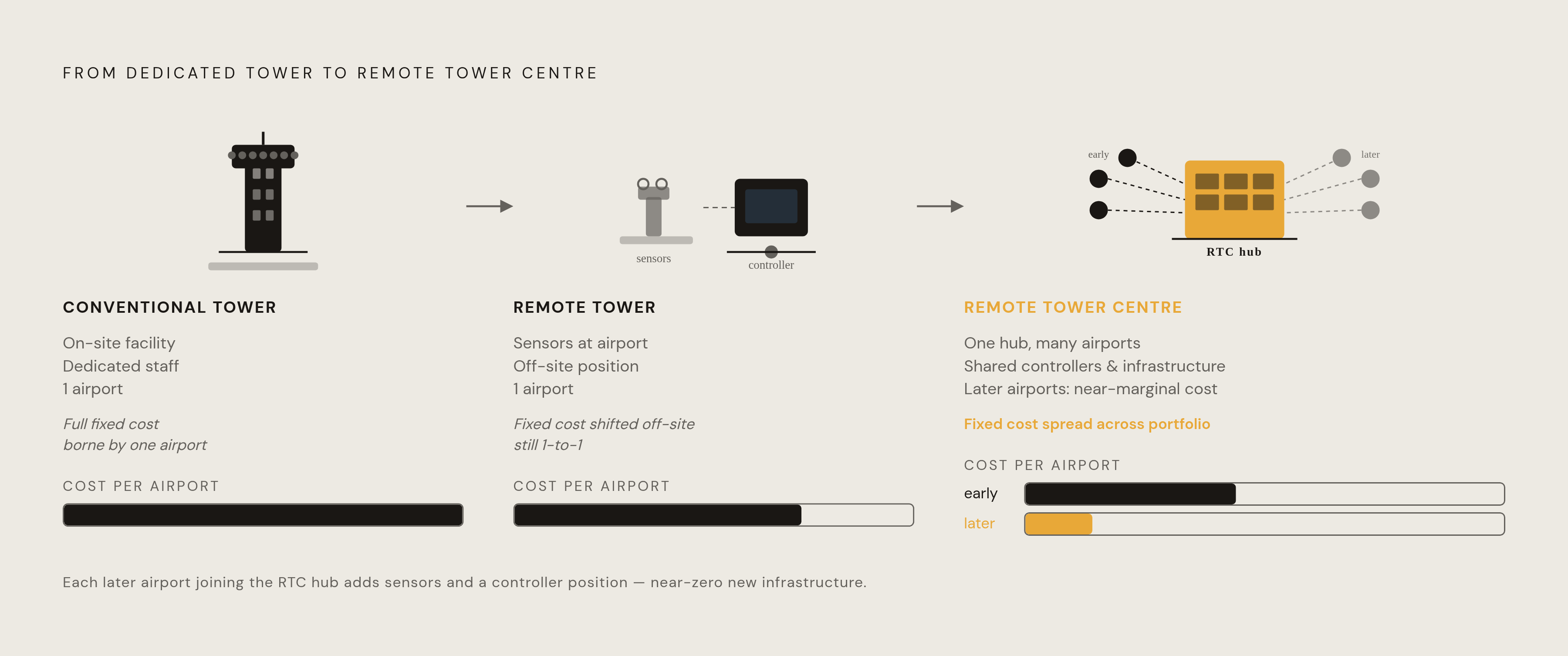
A single remote tower changes how a controller sees an airport, but a remote tower center changes how control resources are organized. An RTC has multiple controller working positions that serve a group of airports. A position can be certified to handle traffic at multiple airports, with its controller working one airport at a time under that operating model. Positions can be handed off, reassigned, or shared across the portfolio. The facility can serve several airports at once while each controller works one airport at a time.
That distinction is central to the economic argument. The early airports bear the fixed infrastructure cost of establishing the center, while later airports can join at near-marginal cost. Instead of replicating a complete tower facility for every additional airport, the architecture shares the central investment while adding the airport-specific equipment and connections needed for service.
Staff can be shared too, as several low-activity airports can use one center without each having to support a local team of its own. Controllers can be reassigned from a quiet airfield to where traffic needs them. Geography becomes less restrictive as a result. The center can be placed where controllers live and recruitment is feasible, avoiding the need for postings to isolated airports. The same report says younger prospective recruits are drawn to digital working environments that serve multiple airports, so the setup that helps the center run efficiently can also help it attract staff.
How Norway's Bodø RTC demonstrates what hub scale looks like in practice
Norway's Remote Tower Centre in Bodø is the largest operational demonstration of one facility managing a national airport portfolio. The Avinor and Kongsberg program began with the NINOX agreement in 2015, and the system has been in continuous operational use since 2019. Its development spans a decade of collaboration and iteration. That timeline distinguishes a hub shaped through operational feedback from an architecture designed on paper and deployed without that experience. Variable traffic and weather conditions form part of its operating record.
The center combines high-resolution day and infrared cameras with real-time airport audio that recreates the local soundscape. Smart overlays display aircraft positions, runway data, and weather, while the system connects with airport lighting, radar, weather sensors, and electronic flight strips. Open architecture also allows integration with future air traffic management frameworks, including Europe's SWIM, or System Wide Information Management, so that the existing platform can continue to evolve.
Avinor's stated reasons for adopting the model were economic and operational, including avoiding expensive tower renovation or construction, reducing operating costs through multiple-airport operations, standardizing service, easing recruitment, and supporting digitization. The next efficiency step concerns simultaneous control. Software enabling a single controller to manage up to three airports simultaneously is operational at Bodø, but activation of that capability awaits final regulatory approval. A standalone digital tower using the same technology is also planned in Bodø by 2029, demonstrating that a common platform can support both hub and standalone deployments.
The design decisions that determine how well a hub actually scales
Kongsberg describes its architecture as modular so that it can be updated, expanded, or adapted as requirements change. Expansion must not become repeated system reconstruction. At hub scale, the value of modularity is the ability to accommodate another airport without reworking the basis on which the existing portfolio operates.
Connectivity places a separate limit on that expansion. Rural and small airports cannot be assumed to have dense telecommunications infrastructure, so a low technical footprint and minimal bandwidth requirements widen the range of viable sites. Kongsberg identifies low bandwidth requirements as a deliberate design constraint. That does not relax the latency requirement. As more airports join, the transmission architecture must keep worst-case video display latency under one second even when it uses bandwidth efficiently.
The staffing economics can survive growth if controller working positions remain flexible. Positions must support easy handoff and reassignment as traffic ebbs and flows across the portfolio. Otherwise, centralization risks reproducing locally dedicated staffing inside one building. Integration also keeps costs down because each added airport can connect its existing lighting, radar, weather sensors, and electronic flight strips without having to replace them all. The architecture supports these as fully integrated components or in conjunction with existing systems.
Resilience becomes more consequential as one facility serves more airports. Backup power, duplicate control stations, and failover routing are structural requirements because the hub concentrates operational dependence. Certification must scale with the architecture as well. Approval of one airport installation does not automatically authorize a hub of fifteen, so the approval framework has to cover the intended multi-airport operating model. Technical modularity alone cannot make an airport addition deployable if its operational approval remains unresolved.
Where U.S. policy and certification currently stand as a barrier to hub deployment
The principal U.S. constraint is a certification and policy framework that has not yet adapted fully to multi-airport hub operations. The FAA's System Design Approval process is the formal gate before a digital or remote ATC system can operate in the National Airspace System. The FAA's August 2023 letter to airport operators describes it as a long and rigorous process that can take upwards of five years. That timetable creates a substantial deployment burden. For a hub, the additional concern is whether the approval pathway addresses both individual installations and the shared operating architecture.
Critics argue that the existing framework was designed for single-airport deployments and does not map cleanly onto multi-airport hubs. The most scalable configuration consequently remains insufficiently addressed. The Reason Foundation report says the FAA has done little to comply with the remote tower law despite being directed by Congress to move deployment forward. This is a policy design problem.
The Federal Contract Tower program already allows funding for FAA-certified remote or digital tower configurations, so the law leaves a path open for these projects. Eligibility alone does not resolve hub certification or extend access to every small airport below the existing benefit-cost threshold. A September 2024 finding that a large majority of FAA ATC systems were unsustainable or potentially unsustainable adds urgency to the choice of replacement architecture. Modernization policy must make room for shared digital infrastructure if it is to move beyond the conventional tower model.
What recent U.S. policy and procurement moves signal about the path forward
The first U.S. System Design Approval for a remote or digital tower system establishes a regulatory precedent and allows airport sponsors to begin procurement. It opens the way to procurement but does not authorize all hubs. In April 2026, the FAA issued RFP 693KA8-26-T-00016 for remote tower capabilities at rural, small community, and non-towered airports, with Federal Contract Tower sponsors also eligible.
Congress appropriated billions for the Brand New Air Traffic Control System in July 2025 through the One Big Beautiful Bill Act. Within that investment, $50 million was specifically allocated to establishing a clear remote tower approval process and deploying remote towers at nontowered airports. The FAA Contract Tower Competitive Grant Program also allows funding for FAA-certified digital towers, and applications close on 19 October 2026.
FAA guidance permits funding for a digital tower with system design approval at Contract Tower candidates, but the sponsor must own, operate, and maintain the system. The guidance also requires the system to be on airport-owned or leased property to receive AIP funding. Ownership remains a concrete implementation condition. A shared operating model must meet the funding conditions for its facilities and equipment, since eligibility for digital tower funding does not cover every hub configuration.
For airport operators and policymakers, the practical response is to evaluate certification requirements, funding mechanisms, and hub design standards together. UAS integration adds urgency because smaller airports need scalable airspace-management infrastructure where unmanned operations are likely to occur. Preparing an airport for that model means establishing not only whether the technology can serve it, but whether the proposed portfolio, approval pathway, and sponsor responsibilities fit together.