Midair Collision Risk Factors Specific to Non-Towered Airspace
Structural flaws in non-towered airspace create predictable collision zones.
Midair collision risk at non-towered airports comes from a specific, compounding set of structural conditions, not from scattered pilot mistakes. These conditions concentrate danger at predictable places and phases of flight, so you see the same patterns of risk at small airstrips across the country year after year. Non-towered airports, as defined in FAA Advisory Circular 90-66C, include airports that have never had a control tower and airports whose towers are not currently operating, a category far wider than most people assume when they picture a small grass strip with no services. The United States has roughly 527 towered airports and nearly 20,000 non-towered landing facilities, a group that includes public airports, private airstrips, grass and turf runways, gravel strips, and seaplane bases. The vast majority of the National Airspace System runs without any sequencing authority at all, and understanding why requires looking past individual pilot behavior to the system each pilot operates inside: no mandatory communications, no sequencing authority, inconsistent traffic pattern procedures, and a visual-only burden for spotting conflicts. Each of these factors adds to the others, and together they explain both where collisions concentrate and why the problem has proven so difficult to resolve through pilot training alone.
Where collisions concentrate: the traffic pattern and final approach
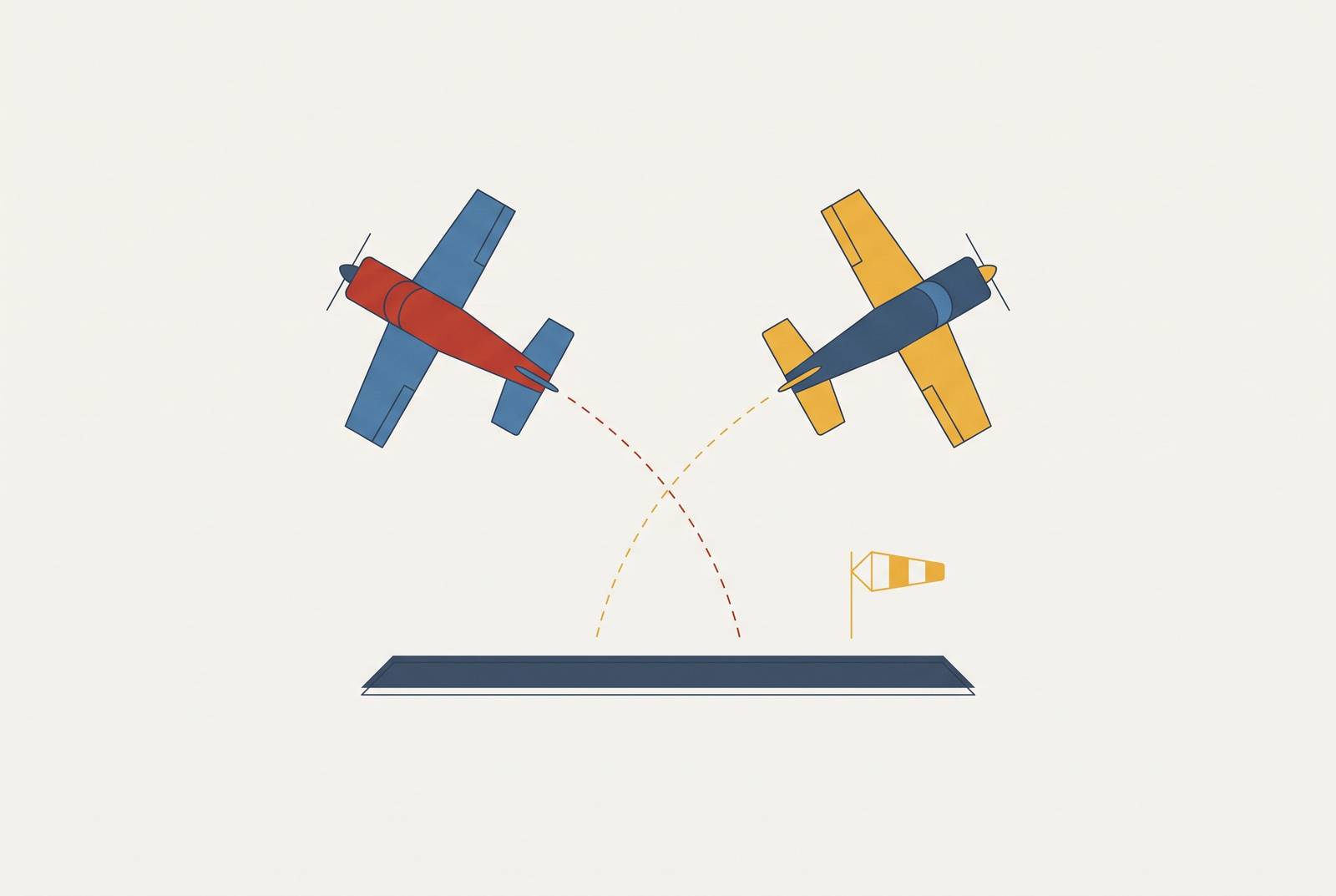
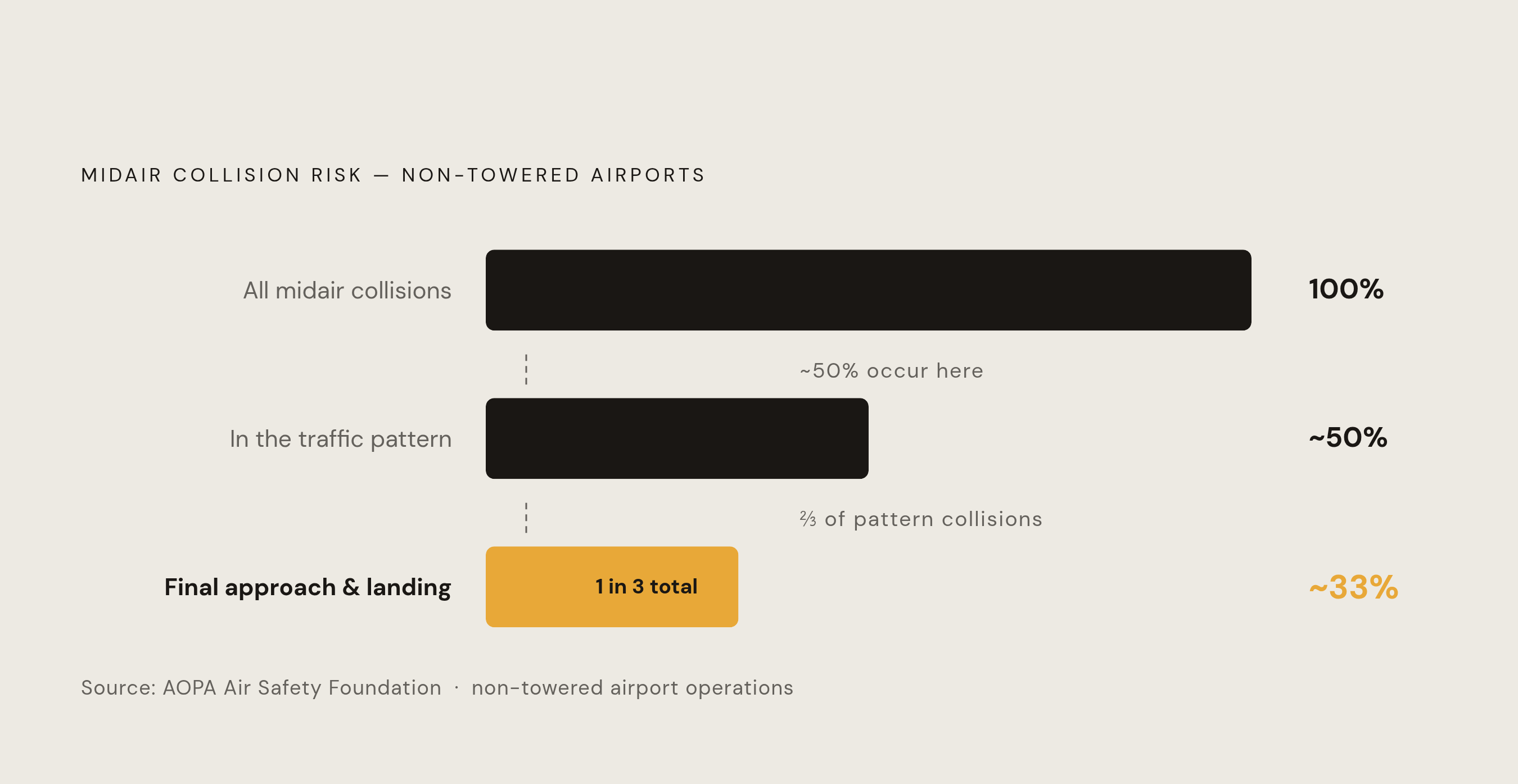
The traffic pattern, and within it the approach and landing phase, is where collision risk concentrates most sharply at non-towered airports. AOPA Air Safety Foundation data show that nearly half of all midair collisions happen in the traffic pattern, and two-thirds of those occur during approach and landing, when aircraft sit on final or are crossing over the runway itself. Confusion about where other aircraft are and who should land first usually starts earlier, on downwind or base, well before it turns into a collision risk on final. The pattern squeezes aircraft together in space and time: planes of different types and speeds converge on the same small block of airspace within minutes of each other, and nothing in the system sorts them into order. That concentration is the lens for everything that follows. Why that danger collects so consistently in this one stretch of airspace, at this one phase of flight, is the real question.
No mandatory communications: how the CTAF system creates a voluntary safety net
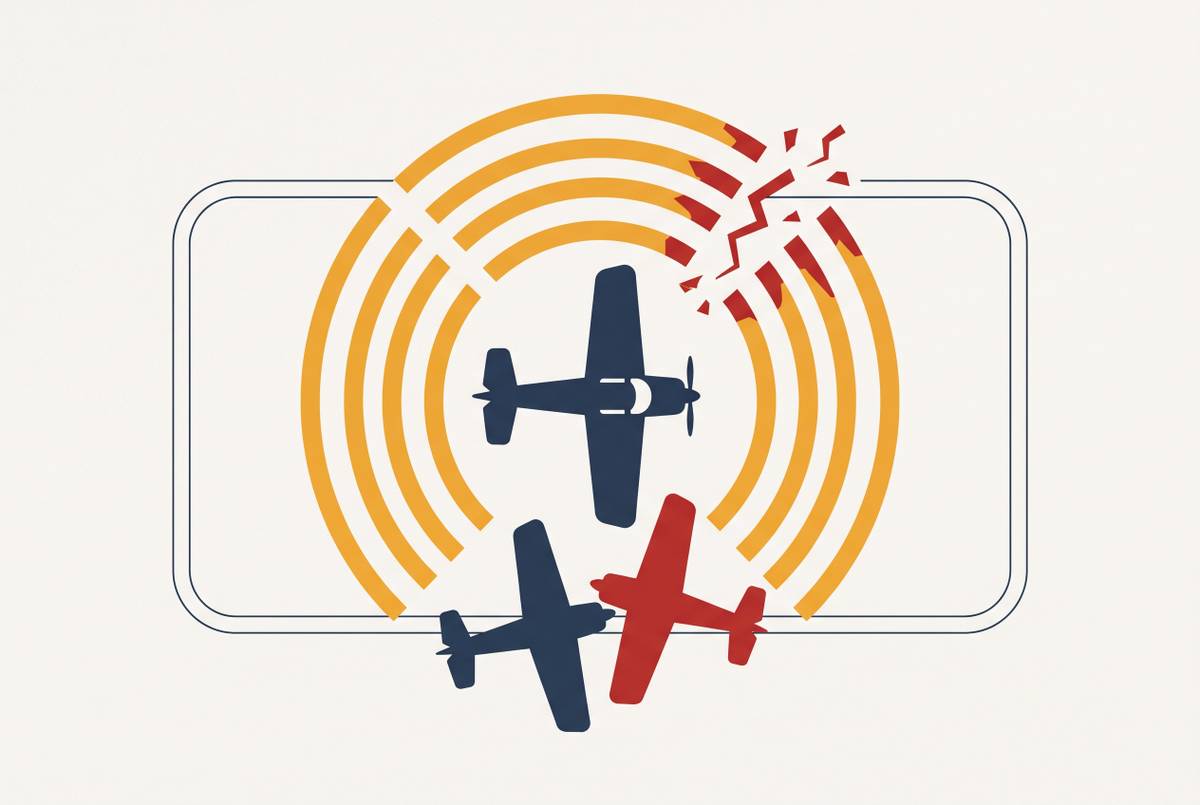
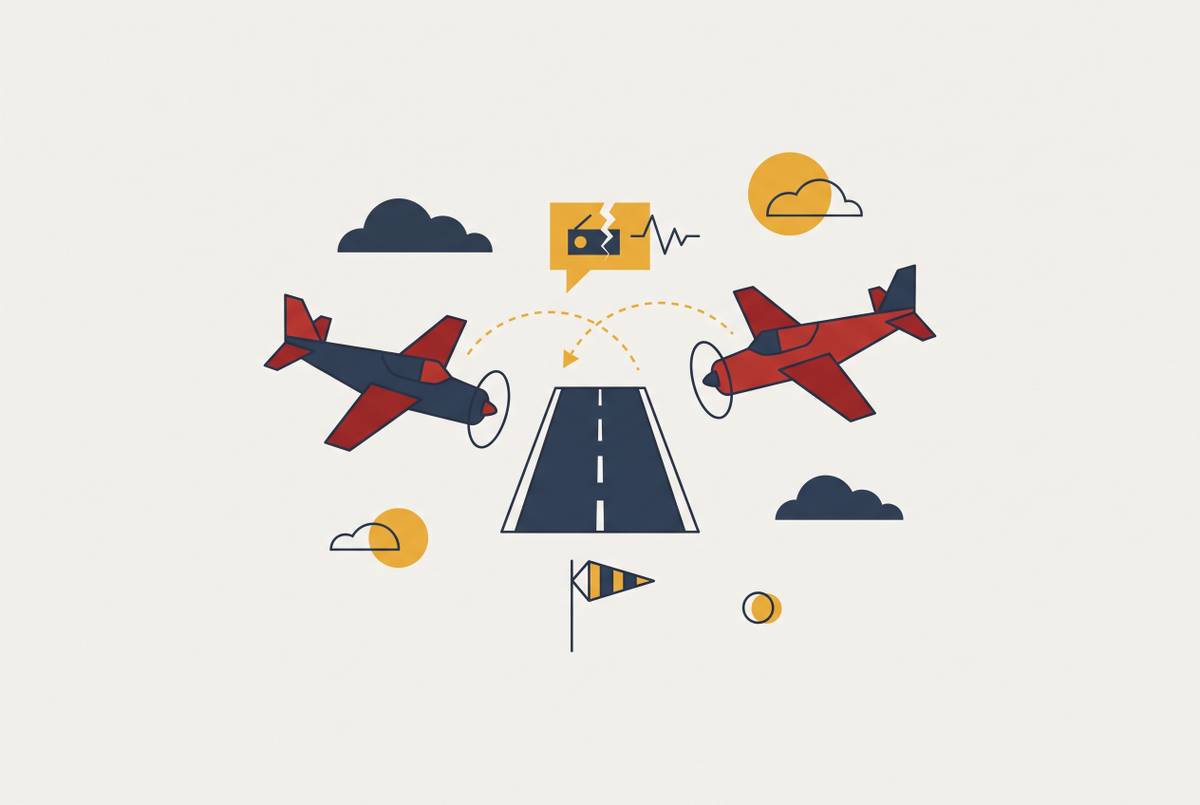
The Common Traffic Advisory Frequency is the main tool pilots use to coordinate at non-towered airports, and its use is recommended. So the safety net it offers has holes you often cannot see until it is too late. FAA AC 90-66C describes the CTAF as a frequency for carrying out airport advisory practices: advisory, not controlling, and no authority enforces whether anyone uses it. Aircraft without radios are legal at non-towered airports, so if you broadcast a clear position report on the CTAF, you cannot assume silence on the frequency means empty skies. A pilot can make every call correctly and still get no acknowledgment and no sequencing instruction in return. That pilot learns about other traffic only if those other aircraft also broadcast, and only if the broadcasts happen to arrive in a useful order. AOPA guidance states that aircraft without radios may be working the pattern at the same time, a known operating condition the whole system is built to tolerate. The CTAF builds shared awareness when every participant uses it correctly, but that awareness collapses toward zero warning the moment one aircraft opts out or lacks the equipment, and nothing in the system flags when that has happened. Underreporting makes the gap worse: when a near-miss happens without radio contact, neither pilot may realize how close the call actually was, and neither has reason to file a report, so the hazard never reaches a safety database.
No sequencing authority: what happens when pilots must sort themselves
At a non-towered airport, no one holds the authority to sequence traffic, so pilots sort themselves out in real time through informal negotiation, and that negotiation breaks down under the exact conditions that also raise collision risk. At a towered field, a controller clears aircraft, sets their order, and resolves conflicts before they turn dangerous. No equivalent authority exists at a non-towered field. Pilots are expected to self-sequence by announcing their intentions and yielding when appropriate, but that only works if every pilot in the pattern shares the same picture of where everyone else is, and the voluntary CTAF system cannot guarantee that picture exists. Speed differences between aircraft types create their own kind of pressure: a fast turbine aircraft entering behind a slow trainer compresses the spacing in a way that self-sequencing alone cannot fix, because no one has the authority to extend the spacing or redirect one aircraft to a different runway. FAA AC 90-66C itself acknowledges that straight-in approaches at non-towered airports, flown in other-than-instrument conditions when other aircraft are already in the pattern, may conflict with aircraft on base to final and raise the risk of a midair collision. That is the FAA's own guidance naming a collision scenario that exists specifically because no one can prohibit or sequence the straight-in approach. The straight-in is common, it is not against the rules, and it inserts an aircraft into the flow at the most vulnerable phase of flight without any guarantee that the pilot flying it knows another aircraft is already established on base. The resulting conflicts are the predictable output of a system that assumes every pilot shares perfect situational awareness while offering no mechanism to make that true.
Inconsistent traffic pattern procedures at non-towered airports
Federal rules specify which direction to turn in the traffic pattern, but they leave the entry point, the altitude, and much of the procedure to advisory guidance and local habit, and that gap multiplies the chances of conflict when pilots from different training backgrounds share the same pattern. Teresa Sloan's review of 14 CFR 91.126 shows that the regulation requires left turns when approaching to land at a non-towered airport, but it does not say where in the pattern a pilot must enter or how to exit. FAA AC 90-66C recommends procedures, but an advisory circular does not carry the force of law, so compliance with any of it is voluntary. Several valid entry methods exist, including the 45-degree entry to downwind, the straight-in, and the overhead break, and different flight schools and training environments emphasize different ones. Two pilots can each fly their pattern exactly the way they were trained and still create a conflict that neither one saw coming. Traffic pattern altitude is not fixed across the board either: some non-towered airports with mixed traffic run different pattern altitudes for different categories of aircraft, and helicopters may work a pattern at a lower altitude on either side of the runway, adding a three-dimensional layer of conflict that is hard to resolve by eye. By this point the picture compounds on itself: no mandatory communications, no sequencing authority, and now no guarantee that two pilots in the same pattern share the same idea of where aircraft belong. Two pilots can each believe they are flying the pattern correctly and still converge on the same spot, because nothing in the system confirms they are flying the same pattern.
Visual conflict detection as the last line of defense, and its structural limits
When communication, sequencing, and pattern standardization all fail to head off a conflict, the system falls back on the pilot's own eyes, and that last safeguard carries limits built into aircraft design, visual geometry, and the false comfort of a clear day. AOPA guidance notes that most collisions strike from the rear, even though pilots overwhelmingly scan straight ahead, so the habit most pilots rely on guards against only a small share of how a collision actually develops. Aircraft shape itself creates blind spots: a high-wing airplane loses visibility above, a low-wing airplane loses visibility below, and a low-wing aircraft flying above a high-wing aircraft creates a worst case where neither pilot has a clear line of sight to the other. The AIM's own criterion for a collision course, an aircraft that shows no relative lateral or vertical motion and simply grows larger on the windscreen, leaves a pilot very little time to react once the threat becomes visible, especially at pattern speeds. AOPA data and Sloan's review both point out that many collisions happen in good weather, because clear skies cut down on instrument workload but build a false confidence that you would already see any nearby traffic. That visual burden lands hardest at exactly the phase of flight where every other structural weakness also peaks: final approach, where cockpit workload runs highest, scan time is most compressed, and aircraft arriving from different pattern entries can appear from angles a pilot isn't watching. ADS-B Out gives pilots electronic traffic awareness, but the mandate does not reach Class G airspace or low-altitude Class E airspace below 10,000 feet MSL outside the Mode C veil, and many non-towered airports sit there. That leaves many of the aircraft most active at these fields electronically invisible to each other, even with modern avionics on board.
Why the Safety Record at Non-Towered Airports Is Hard to Read
The strongest challenge to this argument comes from collision data that, on its face, appears to show non-towered airports performing well on a per-airport basis. That reading depends on a reporting system that structurally undercounts the incidents most likely to happen at non-towered fields. Any analysis built on counting incidents per airport facility, rather than per operation, compares apples to oranges: towered airports handle far more traffic, more complex aircraft, and a wider range of operations than most non-towered fields ever see. A deeper problem sits underneath that one. The NTSB database captures reported collisions, and reporting rates at non-towered airports run structurally lower, because no controller stands by to observe a near-miss, document it, or flag a deviation the way controllers routinely do at towered fields. The per-airport comparison is not wrong on its own terms. It reads the reported data correctly. But reported data at non-towered airports reflects how much detection capacity exists there, and that capacity is close to nonexistent. None of this means non-towered airports are categorically more dangerous than towered ones. So the available data cannot settle the question either way, and the structural conditions described above create risk that the current reporting system was never built to measure.
How the structural factors compound at the pattern
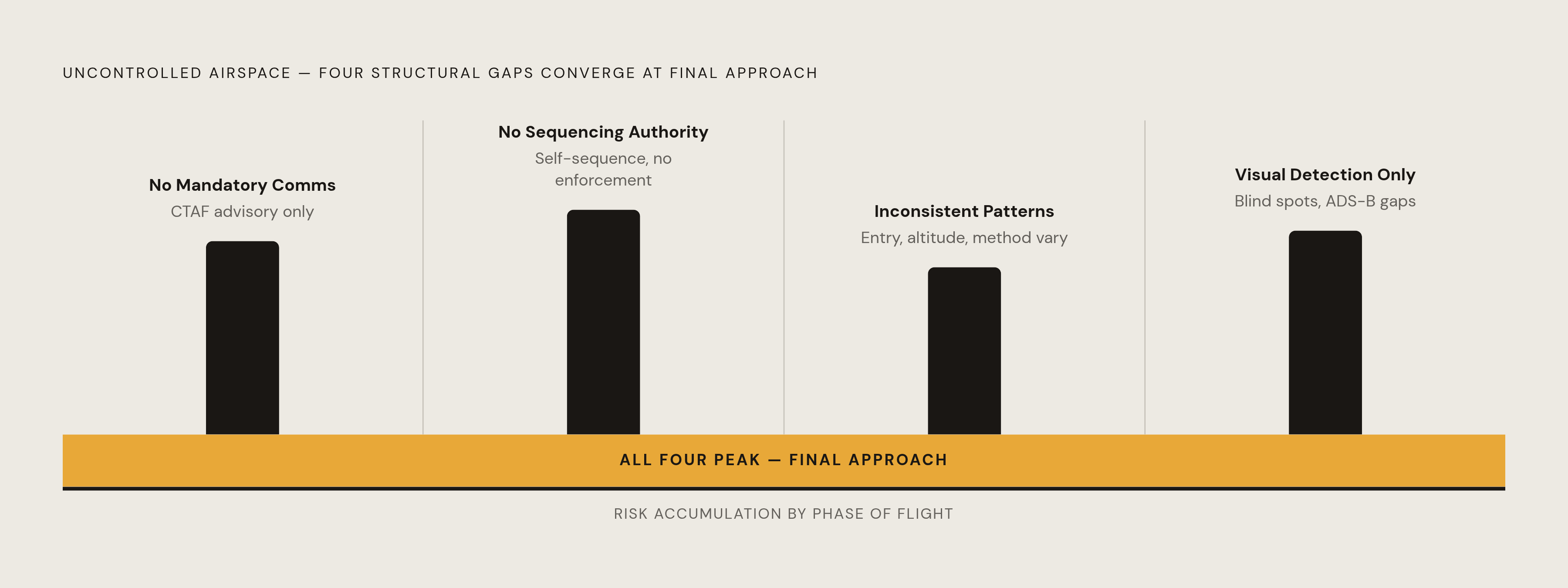
Each structural factor carries its own danger on its own, but the traffic pattern brings all of them together at once, and that convergence makes approach and landing at non-towered airports a system-design outcome. On final approach, pilot workload runs highest and radio calls grow less frequent exactly when they matter most, so communication is most likely to break down there. Sequencing stays impossible without an authority to enforce it. Pattern entry assumptions diverge most sharply between a pilot flying a standard pattern and one flying a straight-in. Visual separation faces its hardest test at the one moment cockpit workload peaks. Aircraft design adds another layer on top: a low-wing airplane flying above a high-wing airplane on final produces the collision geometry most likely to leave both pilots blind to each other, even when both are flying exactly as trained. Timing compresses the danger further, since aircraft well-separated on downwind can close to within seconds of each other by the time they reach final, leaving no room for see-and-avoid to work even if every other condition had gone right. This is why the earlier finding, that nearly half of all collisions happen in the traffic pattern and two-thirds of those on final, reflects no statistical coincidence. It is the predictable result of a system where every structural weakness peaks in the same place at the same moment. Seeing the compounding clearly also shows what a real fix requires: closing the communication gap, the sequencing gap, the standardization gap, and the detection gap all together, not one at a time.
What would need to change to reduce collision risk at non-towered airports
Because the risk runs structural, you need structural change to reduce it, not another round of pilot education campaigns layered onto the same voluntary system. Pilot education and procedure guidance have been the standard response for decades, and AOPA's materials together with FAA AC 90-66C represent that approach well. They help at the margins, but they cannot close gaps created by voluntary compliance, aircraft flying without radios, or the hole in ADS-B coverage. Understanding these structural factors matters because it explains why digital air traffic control technology, already in use at some non-towered airports, changes the underlying equation: it introduces sequencing authority and mandatory communications in a system that has relied on voluntary coordination since its inception. The FAA has described Digital Tower Systems as a way to deliver airport traffic control tower services through a network of cameras, sensors, displays, and related equipment, and it has set out that these systems may be installed at airports in Class E and G airspace that want to move to Class D. That reclassification is the regulatory path that turns an uncontrolled airport into a controlled one without constructing a physical tower. Class D status is the structural fix this analysis points toward, since it brings mandatory communications, sequencing authority, and a controller responsible for watching and managing conflicts, addressing the three central gaps identified throughout this piece. The traffic pattern concentrates aircraft in space and time at precisely the point where a sequencing authority, human or digital, could step in: digital ATC tower systems built for non-towered airports aim to solve exactly this problem by giving controllers real-time conflict detection and resolution that visual-only separation cannot match. The cost of building and staffing a traditional tower has historically kept Class D designation out of reach for most of the roughly 20,000 non-towered facilities in the country, and that economic barrier, not any lack of technical understanding, is what affordable digital ATC technology is built to remove. General Aviation's digital ATC systems target this exact market: airports that cannot justify a traditional manned tower's cost or staffing needs but still face every structural risk condition described here. The CTAF's voluntary framework exposes a real gap in how uncontrolled airspace is built, and it is a gap that affordable digital tower technology can close by making communication and conflict detection automatic and mandatory rather than advisory and dependent on every pilot doing everything right. The risk at non-towered airports has always been structural. What has kept it unresolved for so long was never a missing explanation but a missing path to a structural fix that smaller airports could actually afford.